Roadblocks and Raised Fists: Economic Protests at the Cerrejon Coal Mine in Colombia
Nithyani Anandakugan
In May 2021, mine workers and members of the local indigenous community gathered around the Cerrejon mine—the largest open pit coal mine in Latin America—to obstruct the roadways. Standing together in this act of defiance, they raised their fists in solidarity. In the photo below, two protesters in the front hold a Colombian flag inscribed with the message "SOS," the universal signal of distress. They sought to bring an end to the human rights violations perpetrated by the coal mining companies that have colonized the region. The demonstrations at the Cerrejon mine reveal that forms of economic resistance—especially embargo and boycott—can offer impactful ways to hinder the corporate culprits of climate change.
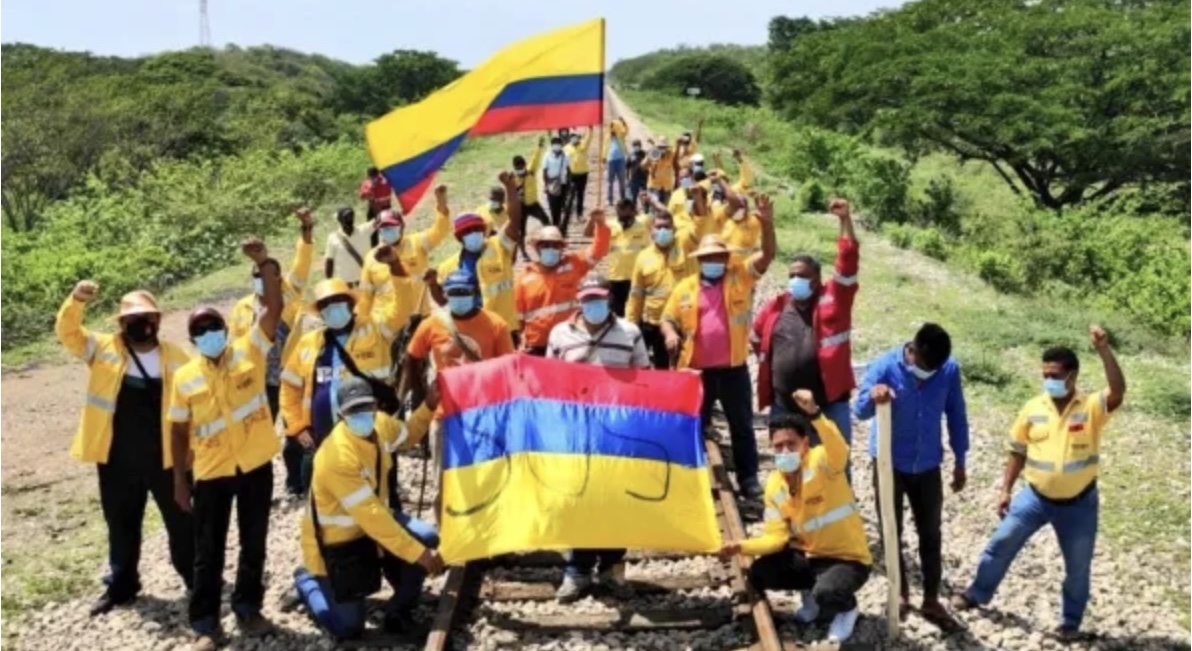
The Cerrejon mine holds sacred significance for the local Wayúu indigenous community. Cerrejon was once a mountain where, "[j]ust over a generation ago, Wayúu healers made ritual journeys" and "gathered traditional plants for remedying community members' ailments." For the Wayúu community, Cerrejon has always offered an environment of plentiful resources. But in recent decades, efforts to reap the land's resources have shifted from the hands of the indigenous owners of the land to profit-driven colonizers.
The Cerrejon mountain in Colombia's Guajira region has become the site of Latin America's largest coal mine. In recent years, unrest has erupted as protesters periodically block the roads and railways to and from the mine. Protests are quite frequent at the Cerrejon mine due to "repeated disagreements with nearby Wayúu indigenous communities and its largest union." The protesters "[demand] access to water services, larger social investment and jobs" from the companies in charge of the coal mines. In other words, community members in the Cerrejon area seek a fair bargain—that is, some level of reciprocity from the companies that have colonized their homes and exploited their land and natural resources. Given the clear profit motives of the Cerrejon mountain's contemporary owners, acts of economic resistance in the community have proven especially powerful.
Indeed, historical newspapers suggest that Colombian government officials and other corporate leaders have long been motivated by Cerrejon's potential for profit and business activity. In 1980, Colombian President Turbay Ayala announced his ambitious Cerrejon coal exploitation project.1 He aimed to export 50 million tons of coal from Colombia each year, a significant fraction of the country's annual coal production at the time.2 Later, in September 1983, Mines Minister Carlos Martinez Simahan shared that Colombia was in the process of negotiating with several countries from Europe and the Caribbean about future carbon sales.3 In both cases, the sense of corporate greed is clear. Colombian governmental officials viewed Cerrejon as a business opportunity and, especially in these early years, paid little attention to the environmental, economic, and health consequences for the local indigenous populations and other laborers involved.
By the early 2000s, the Cerrejon coal mine had fallen into the hands of "a consortium of multinational mining companies," the main one being Glencore—a Swiss mining company with widespread global reach. Indeed, the business prospects for these companies was impressive: "Cerrejón boasts a production capacity of 32m tonnes per year – most of which (about 60%) goes to fuel Europe's coal-fired power stations." Companies like Glencore no doubt stood to profit a great deal from acquiring the land at Cerrejon and ruthlessly harvesting its mineral resources. Despite this clear pivot in Cerrejon toward corporate exploitation, Glencore has presented itself as an agent of social progressivism. Its website, for instance, highlights a number of ostensibly positive accomplishments. In 1990, for example, Glencore established a "Land Reclamation Program of lands disturbed by mining before it was a legal requirement in Colombia." And between 2014 and 2021, it "delivered 200 million liters of drinking water" to neighboring communities. Glencore insists on presenting itself as a socially progressive and community-conscious company. In reality, it is quite the opposite.
Despite the image Glencore projected, the Cerrejon coal mine has been the site of several human rights violations. Due to the it water-intense mining operations, Glencore has expended much of Cerrejon's water supply necessary for both food production and basic hydration; as a result, "4,770 Wayuu children died in la Guajira due to malnutrition" in the 2010s, and the situation has not improved. The most marginalized local residents, including Wayúu indigenous residents, Afro-Colombians, and campesino groups, "clamor that La Guajira has been sacrificed in the name of development," and mining operations have "caused sickness, environmental degradation, and cultural loss." For all of Glencore's outward efforts to present itself as a community-oriented mining company, it has caused significant harm to its neighbors. The case of the Cerrejon mine and Glencore's operations reveals how profit-motivated corporate exploitation manifests in environmental histories, as well as Indigenous and labor histories. It also shows how economic resistance can create meaningful pressure on the corporate culprits of environmental injustice.
The most recent iteration of economic protests around Cerrejon in September 2022 shrank the mine's output by 70%. A statement from Glencore's leadership team noted that "Cerrejon's operation has been affected, for six days, because of various illegal blockades" that "impede access to operational areas of the company." The local community's protests have hampered Glencore's business operations and profits—an ostensible success.
Although economic blockades like this one have effectively threatened Glencore and challenged its inhumane practices, it remains important to note that these sorts of acts of resistance can also harm other workers and community members. Glencore reported that the blockade may put "at risk the jobs of more than 11,000 workers and contractors." These economic protests offered an impactful form of resistance against an exploitative company by putting significant pressure on its operations and profit potential, but these demonstrations bring to bear their own risks. Even as workers and indigenous community members boldly resist environmental injustice and inhumane exploitation in their community, their livelihoods continue to hang in a delicate balance.
Notes
1. "Start of Coal Project," Bogota Domestic Service, September 3, 1980, Foreign Broadcast Information Service.
2. Ibid.
3. "Sale of Carbon Negotiated," Bogota El Siglo, September 21, 1983, Foreign Broadcast Information Service.