Line 3 Pipeline
Mia DiLorenzo
Searching the phrase "Line 3" in my Google Drive reveals a number of naïve documents from campaigns of years past. Unpublished opinion pieces filled with half-baked ideas adorn several untitled folders, various fact sheets list recent aquifer leaks from the pipeline — it's a time capsule of sorts, a record of the pipeline's reconstruction.
This search produces a photo of the Gitchi-Gami Gathering in 2019 — a statewide event protesting the reconstruction of Line 3 and a celebration of communal advocacy. Our bus to the protest shuttled hundreds of people from the Twin Cities into Northern Minnesota, discussions about renewable energy sourcing filling the cabin. It was full of life, joy, and genuine connection — it was the clearest example of finding community through collective grief.
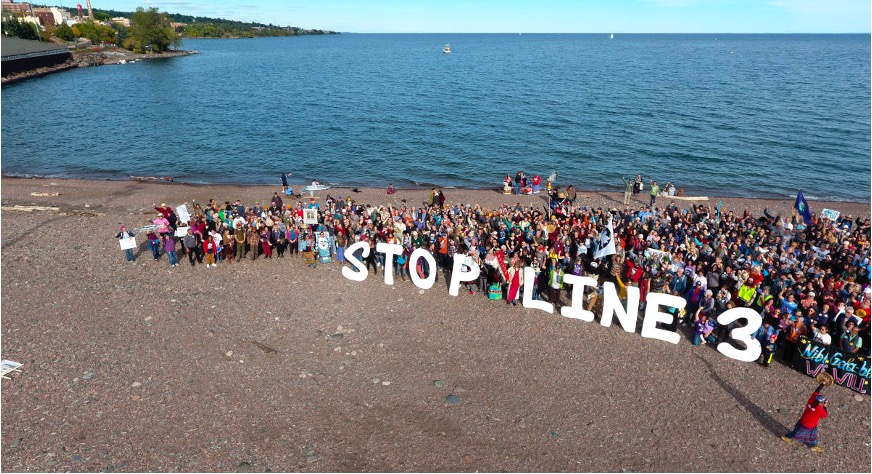
The pipeline has been in dispute for years, and gatherings such as this one are far from rare. Minnesota's Line 3 pipeline has been the epicenter of petroleum transport negotiation in the upper Midwest. Initially built in 1968, the line has been actively extracting tar sands for decades — however, recent construction and expansions have brought this fossil fuel infrastructure into the limelight.
The pipeline has been responsible for over 4 million gallons of oil spills along its multi-state path and its parent company, Enbridge, continues to wreak havoc upon northern Minnesotan communities. It's uniquely positioned as the intersection of environmental, social, and industrial conflicts; in some ways, it's a perfect microcosm of the climate justice movement.
As a mechanism that runs through previously protected Indigenous territory, the pipeline caused palpable tension between Enbridge and tribes affected by its construction. Line 3 runs through land protected by the Treaty of Washington, an 1855 treaty that protected the land of the Anishinaabe people.
Though critics may state that this treaty isn't legally viable and still leaves much of the land available for private use, the current Minnesota governor called any pipeline that interfered with these lands a "non-starter." Governor Tim Walz relied on this support during his first gubernatorial election as he received the endorsement of the Mille Lacs Band of Ojibwe, promising to uphold the aforementioned treaty — unlike his predecessors. In the most recent 2022 election, Walz failed to secure the same endorsement.
What changed?
The Mille Lacs Band government has been expressly clear about their opposition to Line 3 and notes that its existence is antithetical to the tribe's values. Though Governor Walz has painted himself as one of the most climate conscious governors in the state's history, his lack of action on Line 3 discounts any future policies he pushes forth - Line 3 and statewide environmental stewardship cannot coexist.
In more recent months, Enbridge has been responsible for countless aquifer leaks and groundwater contamination — Minnesota's attorney general even charged the company with an $11 million fine in response to the environmental impacts.
Despite the clear environmental burdens of this framework, many northern Minnesota residents are employed by the pipeline's parent company, Enbridge. The slight increase in employment in the region accompanied by expanded infrastructure makes the continuation of the line attractive to a number of blue-collar workers.
Minnesotans in support of Line 3 frequently cite expanded career opportunities as a sweeping benefit of the ongoing project. Even so, renewable energy sources would create hundreds of thousands of viable jobs in comparison to Enbridge's temporary employment. Pipeline repair jobs are frequently contract-based and can have severe impacts on the local community. Past employees have even been tied to local sex trafficking rings and largely contributed to the high rates of missing and murdered Indigenous women.
Such activities are clearly unsustainable and focused on placating corporate executives rather than community wellness. In order to recreate a renewable energy grid in Minnesota, Line 3 must become obsolete and opposed on all levels: the state must recognize the environmental ramifications of its existence and political leaders must take appropriate action to curb expanded fossil fuel infrastructure.