alberta methane
Mia DiLorenzo
Alberta, Canada is no stranger to high levels of fossil fuel energy extraction and distribution: in 2019, 89% of Alberta's energy was derived from either coal or natural gas. In the Grande Prairie region specifically, oil and natural gas processing accounts for a significant portion of the local economy — the city's website notes the wealth of natural resources pushed oil and natural gas to the forefront of its financial development. Pipeline infrastructure has similarly allowed this rural Canadian area to maintain some notoriety, as Grande Prairie's adjacent small town of Wembley is almost entirely reliant on the continuation of fossil fuel extraction.
In addition, Wembley benefits from nearby resources and greatly capitalizes on the wealth of natural gas in the surrounding area. Wembley's economy is largely rooted in the processing of oil and tar sands: the region is "associated with heavy oil production and isolated activity near Grande Prairie, the remainder of the province shows generally uniform, and about an order of magnitude lower venting levels." Such high levels of oil production are the consequence of long-term historical trends. Following the development of the transportation and rail system in western Alberta during the 1930s, the region thrived on its natural resource exports and mirrored the rise of North American industrialization.
This rapid creation of new technologies and commercial goods increased the need for quick and affordable fuel. Pipelines allowed both tar sands and natural gas to flow across long distances and thus reaffirmed the economic importance of energy source exports; much like the rest of the world, Wembley chose economic gain and regional development without noting the unforeseen consequences.
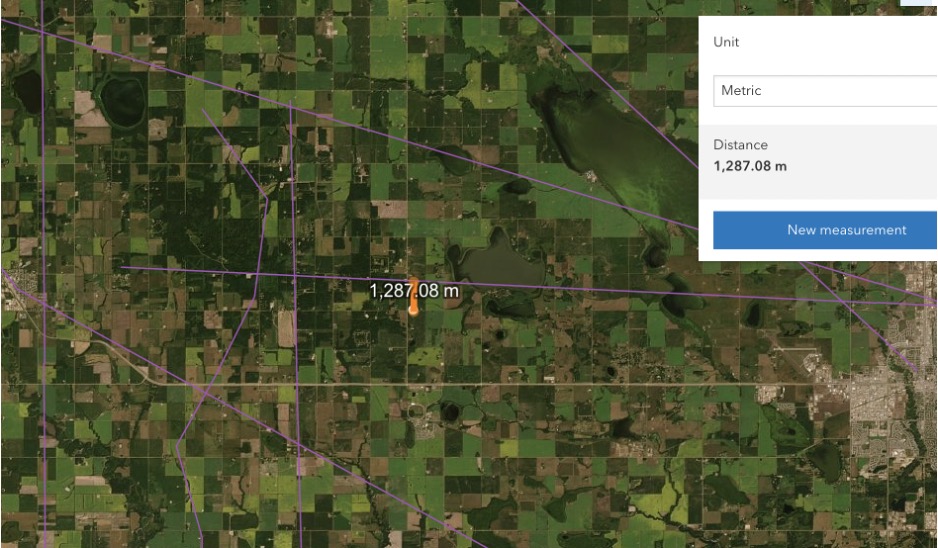
For a sense of scale, the image above notes the distance between emitter site 432 and the nearest source of energy distribution — the site is not even a kilometer away from Pembina Pipeline Corp.'s Peace Pipeline. Wembley is surrounded by two other pipelines beyond the aforementioned Peace Pipeline and an energy processing plant, all of which are less than 15 km away from the source noted in the given data. Though the direct source of this methane pollution is unclear due to the plethora of oil/gas mechanisms near the emission location, it can be inferred that a combination of such sources contribute to the regional pollution as a whole.
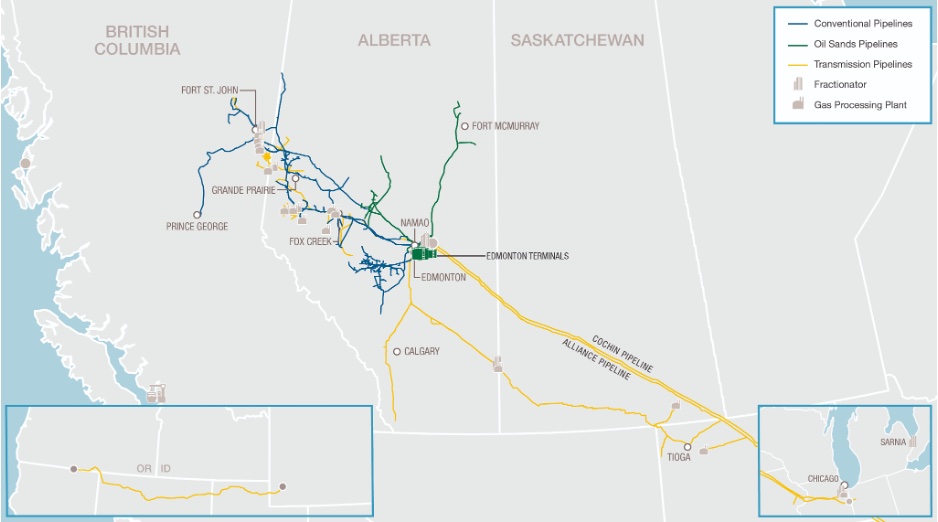
The Peace Pipeline, as pictured above, stretches throughout most of Alberta and parts of British Columbia. Its original parent company, Peace River Pipelines, sold ownership to the Pembina Pipeline Corporation in the late 1990s — Pembina quickly began to expand the project and worked to re-establish the longevity of this mechanism. New construction on the Peace Pipeline has neared the end and the system is again operational; according to Pembina, the first quarter of the pipeline's operation has yielded "strong results." The company cites the Peace Pipeline volume expansion as a key source of increased economic gain and a strong second quarter.
However, recent shifts from fossil fuel energy to renewable sources have forced the region to reconsider methods of energy production and storage. As of January 2022, the Canadian government is taking special measures to sequester and store carbon in the Grande Prairie region of Alberta. Though this doesn't concern the issue of methane emissions explicitly, it's worth noting that such attitudes inform public policy.
This site may appear insignificant globally, but it tells the tale of many towns in rural North America largely reliant on fossil fuel extraction for their economic growth. Such microhistories must be recorded and understood on a larger scale, as the town itself has not made any significant steps toward reducing its methane emissions. Alberta's sustainable urban redevelopment measures will remain obsolete if rural communities are left in the dust, attempting to regain some semblance of prosperity in the wake of an energy revolution.