From One Greenhouse to Another
Coal Mines and Fossilized Leaves in Svalbard
Caleb Fried
Walking up the slope of Svalbard's Mt. Breinosa, you might be forgiven for thinking that nothing could ever live there. The site of the world's northernmost active coal mine is on a stark, bare mountain slope. In the months when the mountain isn't covered with snow, you might be lucky enough to see a few tufts of coarse yellow grass poking out among the loose grey rubble, rooted in the dusty sepia-toned soils, but other than that, plant life is nearly nonexistent.
Walking up the same slope 55 million years ago, you would have experienced a very different sight. To your left, you might spot a stand of mid-sized hardwood trees covered with long green toothy leaves. To your right, squat redwood-like trees with low-lying branches radiating every which way, covered with large flat needles that turn yellow-brown and fall off in the winter just like an oak or a maple. Masses of flat leafy ferns – some with stems of long, elegant pinnae, and others with clusters of short, lobed offshoots – cover the underbrush. The soils are dark brown and wet, waterlogged even, making the boundary of the nearby riverbank muddy and ill-defined.
The deciduous forest biome that you would have seen on your walk through Paleogene period Svalbard does not exist on Earth anymore. Almost all of what we know about the archipelago's ancient flora comes from fossilized coal, extracted and mined by Norway's state-owned Store Norsk Coal Company. The remains of the ancient forest above are dug up by the ton to power Norwegian life in the far north and to bolster the European steel industry. Among the compressed bituminous rock buried in the ancient sand and mud, some beautifully preserved fossil specimens of ancient wood, leaves and pollen have provided humans a window into the prehistoric plant life of Svalbard since their discovery in the late 1800s.
While 55 million year old plants may seem ancient, the coal mines of Svalbard are actually tapping into a much younger resource than most coal fields around the world. Most of the world's largest coal deposits were formed in the Carboniferous period around 350 million years ago. Walking among continental forests in this period would provide you with some truly alien sights – 100 foot tall trees with leathery leaves and branches; ferns and scrambling vines covering entire swaths of the understory; massive unbranching woody spires whose crowns blossom into dense fernlike growths. Most tree species in the Paleogene had at least some relation to modern taxonomical groups: you might recognize the cousin of a redwood, gingko, or plane tree. In contrast, the closest modern relatives of many Carboniferous trees are horsetails and club mosses, plant families which are no longer even classified as trees.
For more of an idea of the difference between the two periods, this is what the globe looked like during the carboniferous:
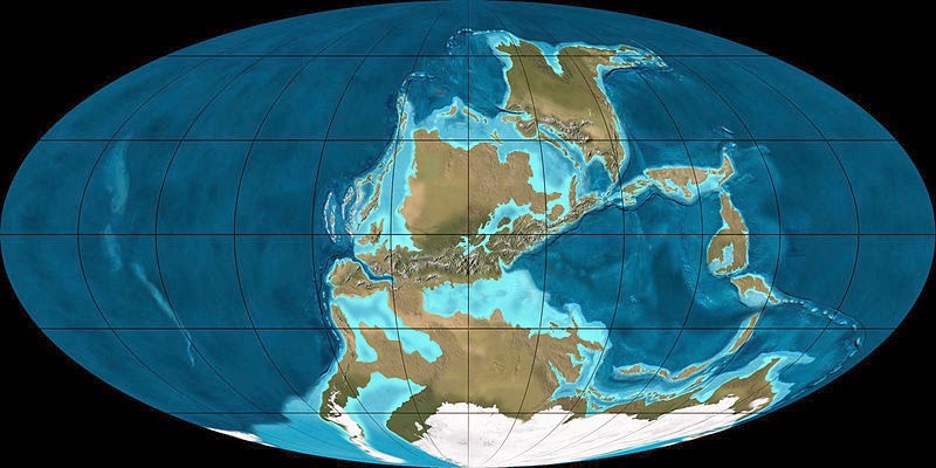
And this is what the globe looked like during the Paleogene:

One of the first thoughts you might have looking at the above maps is that the continents are much closer to their modern configurations in the Paleogene, compared to the Carboniferous map. Svalbard is still up north in the Arctic Circle, and you can see most of the continents we know of now taking shape clearly. This makes sense, considering how relatively recent the Paleogene period was. But if Svalbard was still in the far north, how did it grow such lush forests? A clue to the answer lies in a more subtle difference in the two maps: the map of the Paleogene lacks the polar ice caps seen on Carboniferous (or modern day) maps of Earth.
This is not an oversight on the part of some poor paleogeographer. Global temperatures in the Paleogene period were 4-8 °C warmer on average compared to the modern day. Within the period, there were notable periods of even warmer conditions, up to 12 °C warmer than modern average temperatures. These events brought the earth to into a true greenhouse period, with no ice at all at the poles. Unlike other northerly coal deposits in Russia and Canada, which were formed when the northern parts of continents were closer to the equator and thus enjoyed more temperate climate, Svalbard's coal was formed in the north and has stayed in the north. As the Paleogene gave way to the cooling of the Neogene, and Svalbard's forests stopped being able to withstand the freezing winter temperatures, the islands did not migrate: instead, the fossil remains of the plants, buried in alluvial mud and sand, were folded over on themselves and compressed by tectonic activity along the nearby De Geer Fault Zone, consolidating the energy reserves that would eventually go on to draw people to Svalbard's shores.
While the islands had been visited by whalers throughout the 1600s, overwinter settlement on Svalbard did not start in significant numbers until Russian hunters arrived in the late 17th century. Even back then, though, energy was what drove humans to Svalbard. The first major settlement, Smeerenberg, literally means "blubber town" in Dutch, named for the precious source of whale oil they were hunting for. When coal reserves were discovered in the late 1800s, the islands quickly became a more popular destination for production, exploration, and arctic tourism. One 1919 article in the Dundee Courier heralded the archipelago as "A European Eldorado" for its "vast deposits of ungotten mineral wealth, incomparable for their abundance and diversity." Throughout the 19th and 20th centuries, control of the islands' natural resources was a source of tension between nations, but Norwegian coal mining has persisted nearly continuously from 1916 through present day.
In 2020, the last coal mine on Svalbard, the Gruve 7 Mine, was flooded by water from a melting glacier, prompting headlines of "climate change hitting back." The mine has since reopened, but increased flooding risks and the pivot to renewables has led officials to set 2025 as its permanent date of closure. Polar amplification of climate change is warming the arctic much faster than the rest of the globe – winter temperatures in Svalbard have already increased by 7°C since pre-industrial times. This rapid temperature increase has both direct and indirect implications for the archipelago and the world. Glacier ice on Svalbard covers a lot of area, and so is inevitably a design consideration for infrastructure – flooding from glacier melt has recently also caused major problems for the Global Seed Vault, and melting permafrost has condemned over 250 houses in Longyearbyen to be torn down due to sagging ground. The narrowing temperature gap between the equator and the poles is steadily making the global climate look like another greenhouse period, little by little. 55 million years ago, Svalbard's ancient forests lived through the Paleocene-Eocene thermal maximum, the most rapid warming event in the paleoclimate record. Svalbard's glaciers are currently living through a period of climatic change 40 times as rapid.
Svalbard is still far from having the lush, dense forests of 60 million years ago. A return to its past temperate climate in our lifetime is extremely unlikely. But the lifetime of CO2 in the atmosphere is long. Once the carbon extracted from the Gruve 7 coal mine is burned for its energy, much of it will float in the air for hundreds or even thousands of years, absorbing outgoing sunlight and warming the Earth. By the time that carbon is finally buried back in sediment, it's more than plausible we will have entered a new period of greenhouse climate on Earth – and we humans will have created a strange time machine, transporting carbon from one greenhouse to another.