Diamonds and Methane in the Rough
The Nyurbinsky Open-Pit Mine
Caleb Fried
In the dark, you crystallize. You're 90 miles deep, immersed in a two thousand degree slurry of pressurized liquid methane, growing larger atom by atom. Conditions this perfect for diamond formation are rare on Earth – if you're not below stable continental crust at least a few billion years old, or are outside the small sliver of upper mantle where the temperatures and pressures are exactly right, no dice. Even then, your continued existence is a thermodynamic luck of the draw. If, in your billion-year lifespan, your surroundings shift in the wrong way, you might fall deeper into the mantle and never see the surface – or worse, get oxidized and dissolve back into nothingness.
You, however, are lucky. Sometime in the Early Jurassic, an eruption of ultramafic magma carries you upwards, towards the surface. A magma intrusion would normally be bad news – most magmas' compositions oxidize diamonds rapidly. However, this particular plume is kimberlite – magma from the deep mantle with an exotic chemical makeup which causes it to erupt quicker and oxidize less. The journey still dissolves you slightly – your simple octahedral shape gives way to a more complicated dodecahedron – but you survive. With an explosion of carbon dioxide, methane, and molten rock, you make it to the surface, free from the immense pressure of the mantle for the first time.
Now, buried in the crust, you're surrounded by very different rocks than during the first billion years of your life. These rocks are sedimentary, formed by pressing sediments together until they stick. Some of these sediments are even organic, the decaying remains of plants and animals – lifeforms many times more complex than existed on earth when you first formed. Buried together, you sit inert as these bits of organic carbon are heated, broken down, and reformed into coal, releasing methane in the process. The same form of carbon that aided in your formation all those years ago precipitates out of the rock beside you – how nostalgic – this time as a gas, not a liquid. Together you wait, through the fall of the dinosaurs, two ice ages, and countless human migrations until, in the year 2022, you are finally pulled out of the ground. You sit patiently in your cart, waiting to be processed, cut, and shipped. Your gaseous companion, however, is done being tethered down. As excavation continues, methane escapes to the atmosphere by the ton, leaving you behind in the stark scenery of an Eastern Siberian mine.
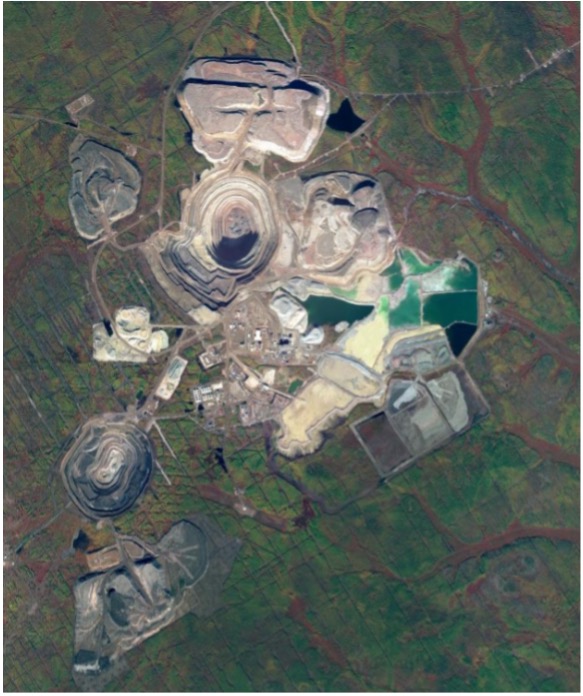

The Sakha Republic in Russia produces more than a quarter of the world's diamond supply, and holds an even larger percentage of the world's proved diamond reserves. The Nyurbinsky open-pit mine from which our diamond originates is one of the largest sources in the region – not only for the diamonds buried in its Nakynsky Kimberlite Field, but also for methane, which occurs alongside coal lenses in the aforementioned Jurassic sediments, and escapes to the atmosphere in massive plumes during the excavation process.
The development of diamond mining in the Sakha republic has historically been met with resistance from the indigenous Sakha (or Yakut) community, who make up half of the population of the region, and more than 80% of the population in the Nyurbinsky district where the mine is located. In addition to methane emissions, metal contaminants (manganese, copper, nickel, zinc, and lead, among others) from the intensive and costly excavation process are collected in dumping areas directly outside the mines, spreading to the soil of the area and causing significant damage to the local ecology. Additionally, because the Nyurbinsky mine lies less than 20 kilometers from the banks of the Markha River, a main tributary of the Vilyuy and Lena rivers, the environmental impacts from diamond extraction extend to population centers across the region.
Sakha activists have been raising these environmental health concerns for three decades, citing a contamination of drinking water, increasing instances of cancer and birth defects, and destruction of local native ecosystems. In response, Alrosa, the company in control of the vast majority of Russian diamond operations, took on the governments of Russia and the Sakha republic as shareholders, promising extensive economic and infrastructural development in the region to satiate protestors. However, many local Sakha say that the benefits of this development have largely passed over indigenous communities, which continue to lack new roads and water filtration systems as further expansion of the mining industry continues to degrade the environment of their ancestral home.
The Russian diamond industry, being the largest in the world, has significant economic sway around the world, and is careful about their PR. Alrosa maintains on their website that they are a sustainable company which invests significant funds into environmental protection. Long-term geochemical studies and the methane plumes detected by the Copernicus Sentinel-5 Precursor satellite in 2019 tell a different story, but with national and geopolitical interests caught up in the mix, truly holding Russian mining companies to account is a both a delicate operation and a difficult one to execute. The most recent attempt, a US ban on Russian diamonds designed as a sanction against the war in Ukraine, was almost entirely bypassed by a loophole surrounding secondary processing of Russian diamonds in India.
More sustainable mining practices are possible – sites in both South Africa and the US have instituted methane capture infrastructure projects, each of which are set to offset over a million tons of CO2 emissions over their lifetimes. In the same vein, the technological knowledge to curb soil pollution from mine waste dumps already exists. Environmental protection doesn't necessitate condemning the story of our diamond to end 1000 feet below the ground, but it does demand careful scrutiny of how mineral extraction is done – and what unintended passengers are coming along for the ride.