Pilgrimage
Mira-Rose Kingsbury Lee
On a sunny morning in July of 2018, in the small town of Barapukuria, Bangladesh, 142,000 tonnes of high-quality bituminous coal packed up its things to go away for a while. It planned on traveling to Dinajpur, to visit the Nayabad Mosque and the Kantajew Temple and perhaps the Dinajpur Rajbari if it had time. It would have liked to go to the Shopnopuri Artificial Amusement Park as well but feared it would not fit in the roller coaster seats, which would have been terribly embarrassing; it had therefore decided not to risk it.
For the journey, 142,000 tonnes of high-quality bituminous coal bought a few sleeves of Pran Potata biscuits and a small takeaway container of beguni, deep-fried eggplant slices. It purchased these at the Cooperative Grocery Store of Barapukuria, just off Phulbari Road. Down the road from the Cooperative Grocery Store was the Barapukuria Coal Power Temple, where 142,000 tonnes of high-quality bituminous coal went next, to pray for safe travels.
After a little while spent in prayer, it went down Coal Mine Main Gate Road, passing the small Barapukuria Coal Mine School on its left. On its right was the Barapukuria 230KV Grid Substation and the Barapukuria Coal Based Thermal Power Plant Residential Area, which had recently been painted in festive shades of red and blue. A few plant workers were visible through the open door, eating breakfast with their heads low to their plates. 142,000 tonnes of high-quality bituminous coal took a right at the Barapukuria 230/132/33kv Grid Substation Control Room and passed through about a thousand feet of sparse, dry woodland to its customary bathtub, the Acid Lake (Dangerous). Here it immersed itself for a while, as it did every morning.
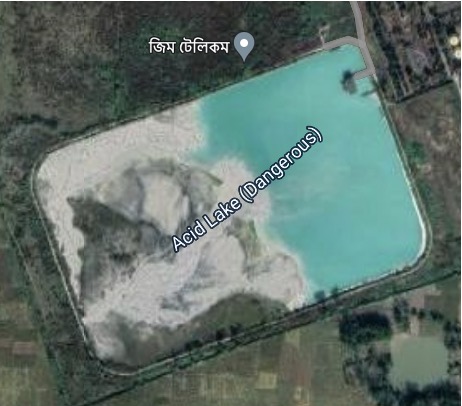 As it soaked, it wondered idly who to tell where it was going. Of course, the higher-ups at the BCMCL already knew; it had been the managing director, Habib Uddin Ahmed, who had recommended visiting the Kantajew Temple. And Abul Kashem Prodhania, the company secretary, had given it a parting gift: a large container of dahi, sweetened with khejur gura and fragrant with cardamom. But the others would be wondering where it had gone.
142,000 tonnes of high-quality bituminous coal determined to stop by the Barapukuria Coal Mine Office; if anyone asked where it had gone, it reasoned, the managers could tell them. In the office Abu Taher Md Nur-Uz Zaman Chowdhury and Khaledul Islam were sitting at their desks. 142,000 tonnes of high-quality bituminous coal said good-bye and told them it would be going to Dinajpur for a little while. They did not, it observed, seem all that terribly sad to see it go. Well, hmph, it thought, and left in a huff.
Thus, with all resolved, 142,000 tonnes of high-quality bituminous coal passed down Phulbari Road, past the Bagra government primary school, pausing once (and only briefly!) at Pabna Sweets for some spicy-sweet rasgulla. Exiting the sweet shop, it heard the rumbling of a government car coming up the street, and hastened to hide itself. As it looked out to check the coast was clear it saw the gelled hair of an official’s head through the back seat window. The car was headed toward Barapukuria. Hopefully the official would not be looking for it; after all, the last thing 142,000 tonnes of high-quality bituminous coal needed now was to be found.
In the end, 142,000 tonnes of high-quality bituminous coal made it safely to Dinajpur. On its way it passed through Ambari Bazar for lunch, and, later, stopped at the Mohonpur Rubber Dam to see the stunning blue waters. Watching the light play on the ripples of the water’s surface, 142,000 tonnes of high-quality bituminous coal felt abruptly very homesick; it wished all of a sudden it might go back to Barapukuria and its homely little Acid Lake (Dangerous). But what was done was done, and it was miles away now, and despite all its reassurances to the BCMCL, it knew that it would never go back home again.