Hope for Belonging: David Suzuki
Melinda Meng
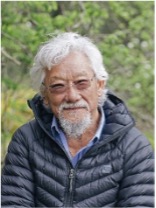 Growing up in Canada without a cable subscription and before the age of streaming services, most of the television I consumed was produced by the Canadian Broadcasting Corporation (CBC). The CBC is a publicly-funded agency, and thus has a mandate to support Canadian creatives and productions. One such production is the documentary series The Nature of Things, which has been hosted by environmentalist David Suzuki for the span of my entire lifetime (Suzuki first started hosting the show in 1979).
In Suzuki's own words, The Nature of Things adopts an "eco-centric rather than anthropocentric perspective" in order to impart "a critical understanding of how we got into the mess we are in and how to move out of it." It has been several years since I watched an episode of The Nature of Things, although it is still on the air, but I have many memories of sitting on the couch or floor at home and watching fantastical scenes from all around the world flit across the TV. The hallmark of my experience watching The Nature of Things is Suzuki's David Attenborough-esque narration, and even now his voice is instantly recognizable. Much of the appeal of The Nature of Things during Suzuki's tenure has been his casual approach to discussing scientific topics, a distinctive shift in style that is taken for granted now but had others in the scientific community ruffled at the prospect of "this hippie" talking to the public about science.
Even without his "headband and hair down to [his] shoulders and granny glasses," Suzuki is a rare kind of Canadian icon, even today, both for the extent of his activism and for his Asian heritage. Ranking sixth on a 2014 list of top Canadian heroes, Suzuki is the only non-white entry and known for being the champion of a cause of more variable popularity, the environment, then things like universal healthcare (Tommy Douglas) or excellence in sport (Wayne Gretzky) and science (Chris Hadfield). Suzuki has been criticized for his skepticism over the safety of GMOs and support for more militant environmentalism, yet he remains a fairly popular and well-liked figure in Canadian culture.
Suzuki's environmentalism importantly includes the amplification of Indigenous issues in Canada. A 1982 episode of The Nature of Things featured the Haida people's opposition to logging in British Columbia, told from Haida activists' point of view, giving a national platform to a cause that otherwise might not have been featured, and certainly not from this perspective. Suzuki's own lived experience with injusticeunderpins his commitment to advocacy and activism. Born in 1936 in Vancouver, British Columbia, Suzuki is a third-generation JapaneseCanadian. During World War II, his family was one of many that the Canadian government sent into internment camps, and his father was sent off to do forced labor.
Like many ambitious Canadians, Suzuki journeyed south to the United States for college, earning a bachelor's degree in biology from Amherst College and a PhD in zoology from the University of Chicago. He returned to Canada with plans to become a geneticist, but soon found that science funding in Canada was inadequate, especially compared to his American colleagues. This sparked his desire to increase the accessibility of science for the Canadian public and prove its importance, leading to his career in broadcasting.
David Suzuki is a figure that inspires hope for me on many fronts. I find hope in the fact that despite the rejection and degradation Suzuki experienced because of his ethnocultural background, he was able to find support for his passion and communities to collaborate with. I find hope in the fact that although there are far too few Canadian cultural icons who look like me and share similar lived experiences as me, there are not none, and that's always something to work with. I find hope knowing that Suzuki's work has inspired multiple generations of Canadians to pay more attention to the world around them and take action on the causes that matter to them. In David Suzuki I find hope that I can find acceptance and belonging in the place I call home, and that this is something worth fighting for.