Turcot Interchange
Melinda Meng
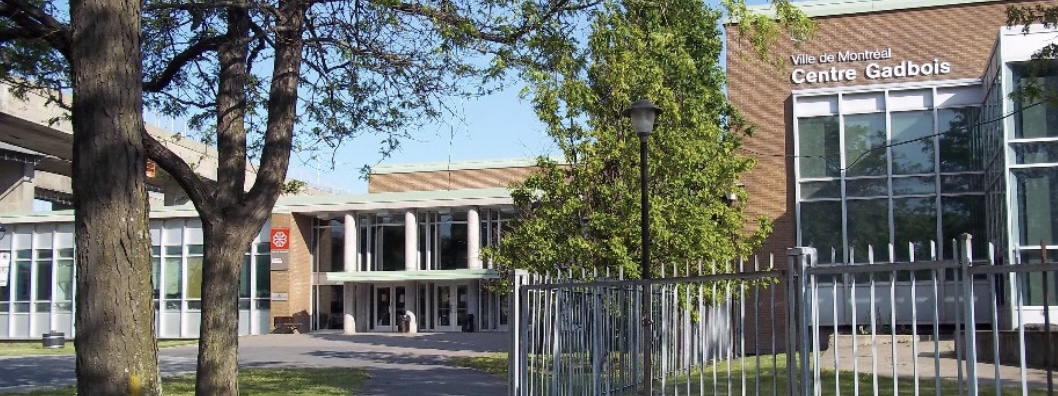
This is the Complexe Récréatif Gadbois, a sports complex that includes two ice skating rinks, a gym and Olympic weightlifting room, a pool, a basketball court, and two multi-purpose training rooms. It is located in the historically industrial working class neighborhood of Saint Henri, which runs along the Lachine Canal in the southwest region of Montreal. Gadbois is the main training location for the world's most prolific ice dancing school, as well as a vibrant community center that hosts a variety of classes and events for local residents. A local bus route stops right in front of the building slight out of frame to the left, and the front of the building looks out over a grassy lawn onto the rehabilitated Lachine Canal.
What escapes one's immediate attention looking at the photo above is that Gadbois is located directly adjacent to the Turcot Interchange, a colossal multi-level highway overpass system that was built as part of Montreal's major infrastructural push surrounding with 1967 World Expo and 1976 Olympic Games. Only slightly visible on the left side of the photo above, the photo below shows what the main approach by car looks like. The Turcot Interchange serves as the meeting point for Highways 20, 720, and 15, and is thus a vital node connecting the more suburban western half of the island to the downtown core.
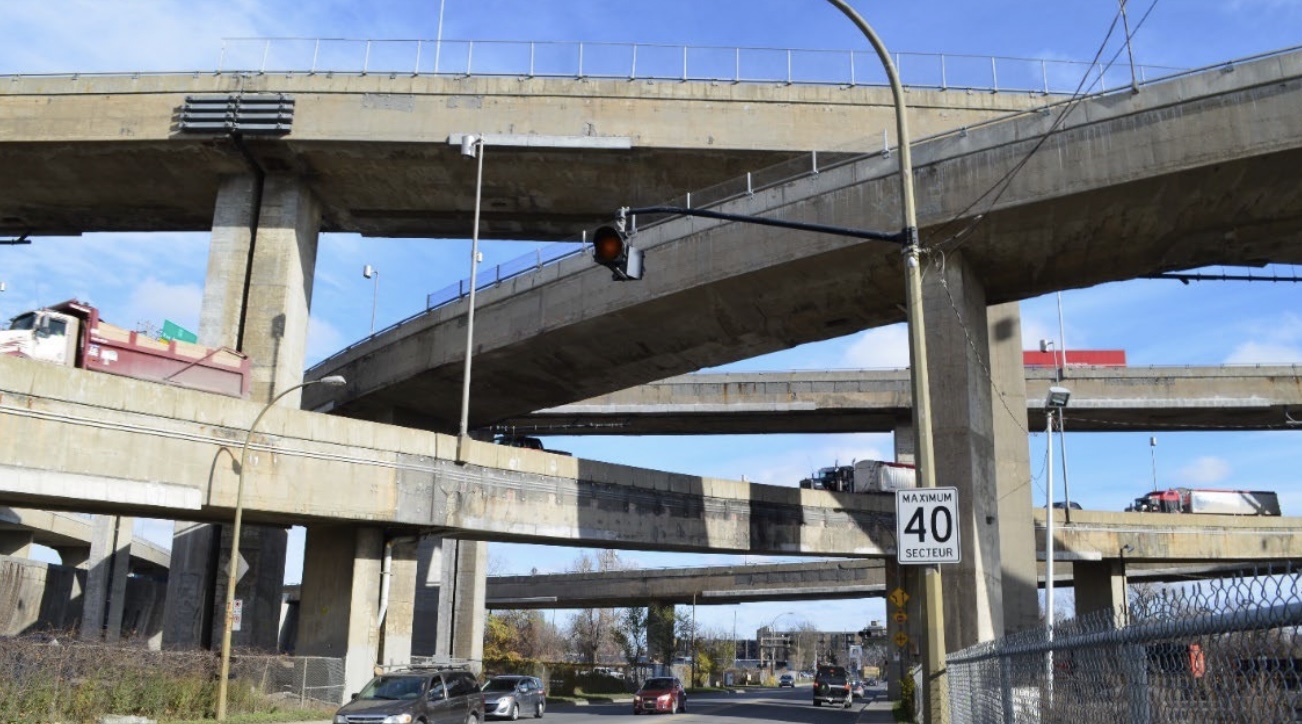
Despite its critical situation within Montreal's transportation network, the Turcot Interchange was allowed to fall into a severe state of decay, marred (as many of Montreal's other infrastructure projects) by poor design, craftmanship, and quality of materials. Currently the main object of a $3.7 billion rebuilding project, reports of concrete chunks falling from the overpass date back to at least 2003. Mesh was added in several places to keep the structure from shedding additional pieces, a not-so-reassuring visual reminder for the roughly 300,000 motorists who use the interchange on a daily basis.
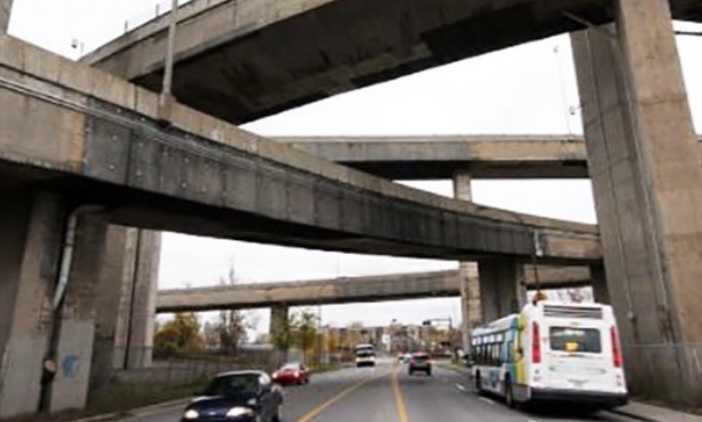
One of the main reasons given for the Turcot Interchange's dismal state is the poor quality of concrete used in its construction—in the rush to build up the city in the 1960s and 1970s, lowquality permeable concrete was used and drainage was not properly incorporated, resulting in the quick corrosion of the structure's supporting steel beams. The steel beams themselves were also found to have been improperly positioned (or missing altogether depending on the report referenced), resulting in the formation of cracks in the concrete. Communication with the public about the safety of the Turcot Interchange and similar structures, like the Mercier and Champlain bridges, was a contentious subject, as officials offered vague assurances of safety as incidents of accidents and collapses continued to accrue. Notably, the Quebec Transport Minister had initially refused to release engineering reports to the public, telling reporters all the public needed to know was that the infrastructure was safe.
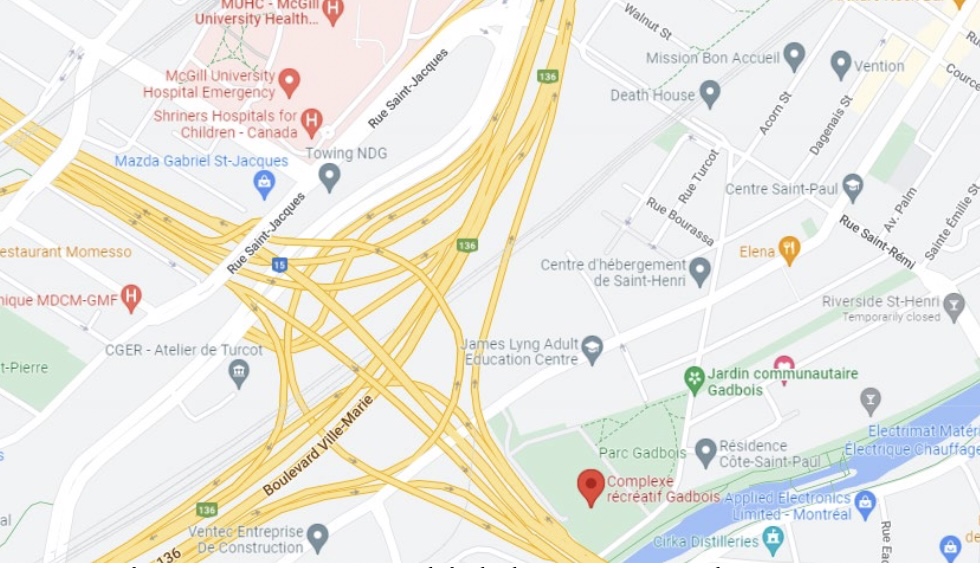
Even now that reconstruction is underway, Montreal's Turcot Interchange woes are far from over. The multi-year project has involved tearing down some old parts of the structure and building new connections, processes which have created an enormous and persistent amount of air pollution. Residents of Saint Henri have reported developing asthma and other respiratory-related illnesses, and air quality reports show sharp peaks in pollutants during demolition periods in the project. Even more disconcerting is the fact that Montreal's colloquially-named "mega-hospital," otherwise known as the McGill University Health Center's Glen Site, is also located right next to the sprawling Turcot Interchange (it's the shaded red area in the upper left of the Google maps photo above). The Glen Site is advertised as "one of the most innovative academic health centres in North America" and includes the Montreal Children's Hospital, the Royal Victoria Hospital, the Montreal Chest Institute, and the Cedars Cancer Center, sites which all cater to vulnerable populations that would be especially affected by air pollution. While the Turcot Interchange was intended to better connect Montrealers to jobs and services, it has instead been a public health and safety hazard with outsized effects on already vulnerable populations.