Buenos Aires, Indeed
Gabrielle Pesantez
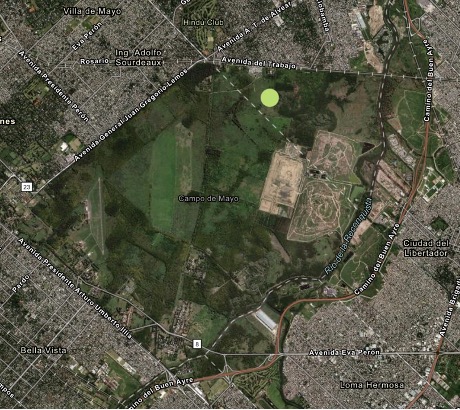
Even among some of the world's most highly polluting cities analyzed in a recent study, the aptly named Buenos Aires, Argentina has emerged as a leader in landfill-driven methane emissions. Buenos Aires is home to the Norte III landfill run by CEAMSE (the Ecological Coordination Society of the State Metropolitan Area), the organization responsible for receiving and managing 85 percent of the city's waste.
Farming and the burning of fossil fuels are primarily responsible for atmospheric methane emissions. Yet waste management still poses a very real threat to our climate. Waste management causes 18 percent of our current global methane emissions arising from human activities. In Argentina, a waste management facility near the capital city has managed to raise significant concerns as an ultra-emitter.
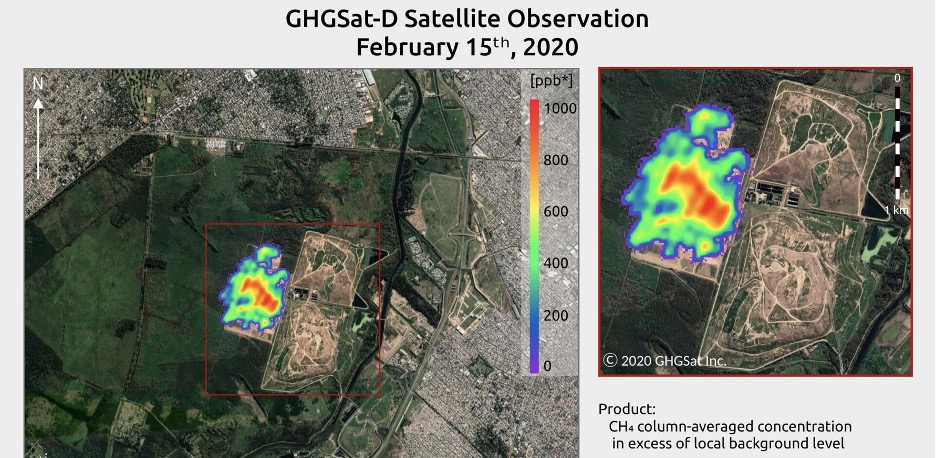
The above methane map records the Norte III site as an ultra-emitter in October 2020, but the landfill's environmental impacts began even before this observation. The European Space Agency's earlier methane mapping data from February 2020 reveal a swarm of emission activity clustered at the landfill's western site. More recent news coverage from Argentina indicates that further satellite imaging from both 2020 and 2021 confirm that the Norte III site remains a methane hot spot. Currently, this lone establishment is responsible for half of all methane emissions from landfills in the country. Estimates from 2022 put the landfill's emissions at about 28 tons per hour, producing the same impact as an added 1.5 million cars on Argentinian roads.
The unequal distribution of emissions activity at the landfill site's western module arises from differences in design and coverage. The western site, accounting for 87 percent of detected emissions in an April 2021 observation, only has an intermediate covering. The site's eastern counterparts, however, were covered in 2014 and 2018 with an active gas collection system. At the western site's active emission surfaces, waste from the city and surrounding areas of Buenos Aires are continuously deposited. The constant deposition of new waste into the system causes the western site's weaker intermediate coverage to reposition, resulting in disastrous emissions impacts. Despite CEAMSE's additions of temporary mitigation tools, methane continues to escape at these weak spots.
CEAMSE is a public enterprise with close ties to government. In June 2021, another satellite image again exposed the western site's impacts. With CEAMSE facing criticism for its contributions to methane emissions, the organization soon set its sights on capturing methane and transforming the gas into a source of power. In late 2021, CEAMSE opened a new power station at the Norte III site, with its executives announcing the beginning of a new age for waste management. Bloomberg reported that this power station would elevate Argentina as a leader funneling methane into power in the Latin American region. Yet they also reported that the station generates only five megawatts, enough to run a few thousand homes.
A deficit remains between the immense damage caused by the landfill's western site and this small positive byproduct of transforming methane into power. Researchers in 2022 reported that the Norte III landfill's emissions concentration on the western side reveals the importance of addressing the site's weak areas. A successful closure of the active surfaces, they put forth, could quickly reduce emissions and prevent superfluous environmental damage. As Lauvaux's research from 2022 points out, taking such actions to address weak areas could yield substantial net financial and environmental benefits. Like Australia, Argentina, itself another bastion of biodiversity — home to the Patagonia region — also eludes the easy solution.
We find ourselves approaching a moment of cognitive dissonance, in which the short-term costs of a long-term solution are threatening, even for an organization so close to Argentina's government. Transparency and further action, beyond sustainably branded gestures, will be necessary as CEAMSE rebuilds trust with the global community and the people of Buenos Aires, many of whom have been increasingly alerted by images of waste rotting away, so apparent even from space.