
DIVORCE COMES TO ANGOULÊME
The law of the revolutionary National Assembly of September 20, 1792, which established divorce and civil registration of births, marriages and deaths in France, had consequences very soon in Angoulême. The rapporteur of the law, and of the law on civil registers, was a lawyer from the town, Leonard Robin, the son of a printer and bookseller, who was baptised in the parish of Petit Saint-Cybard in 1745. The parish registers ceased, for the most part, at the end of 1791. But one register, for the parish of St Pierre, began with a baptism in January 1792, and proceeded throughout most of the year. The baptism of Marie Anne Guimberteau was recorded on November 5, 1792. On November 6, 1792, the register was declared closed, by the episcopal vicar and the secretary to the "citizen bishop;" later the same day – and on the same page of the register – the birth of Pierre Tournier Tancrède was recorded by the new public officer of the town.
Eight days (and four pages) later, on November 14, there is the record of the first divorce in the town of Angoulême. The petitioner was Catherine Dorisse, who cited paragraph 1, article 6 of the new law; she was accompanied by four witnesses. Her husband, Nicholas Valteau, a carpenter, was present. The divorce was pronounced, by mutual consent. Then, with the first civil registry of the town, which started on January 7, 1793, there were more divorces; seven in the course of the year. Some were straightforward and some were exasperating. On June 11, Marie Perigaud, four of her relations, and the public officer waited from eight in the morning until noon for her husband Pierre Bignon to appear. At noon, the clerk wrote in very large letters in the register, "The marriage between the said Perigaud and the said Bignon is dissolved." On June 29, Anne Maurin's husband, Roch Letourneau, appeared as requested, and the marriage was dissolved; Anne and three of the four witnesses signed the register, and Roch declared that he "did not wish to sign." On August 25, the husband of Marie Anne Desbordes, Nicholas Damon, a painter of pottery, declared that he was opposed to the divorce sought by Marie Anne; the public officer determined that since the preliminary acts for divorce had been completed, and the formalities of the law fulfilled, the marriage was dissolved. Nicholas, too, declared that he did not wish to sign. Marie Fougere, a merchant grocer, divorced Pierre Rigaud on September 9, on the grounds that he had been absent for six years, and she had heard nothing from him (she had not received any of his news, or "nouvelles," as per chapter 1, article VI, provision 1 of the law of September 20, 1792.)
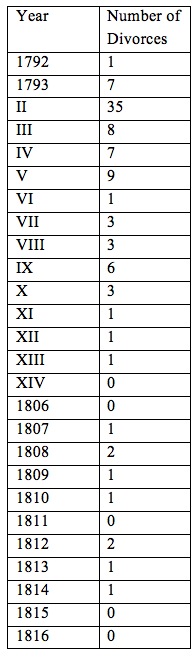
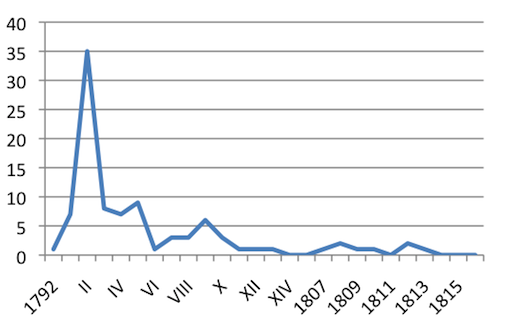
In the following year, year 2 of the French Republic, there were 35 divorces, of which 24 were on grounds of emigration; over the 25-year period during which divorce was legal, there were 95 divorces in the town.
The number of divorces by year is given in the following table:
|
 |
 |
Sources: GG67/31; GG25/47,51-52; 1E2/10,13,22-23,24-25,40,44,47; registers 1794-1816.
Archives Parlementaires, 26 thermidor X, 767.
Lois, et actes du gouvernement VI juillet 1792-mars 1793 (Paris, 1807), 261-275