
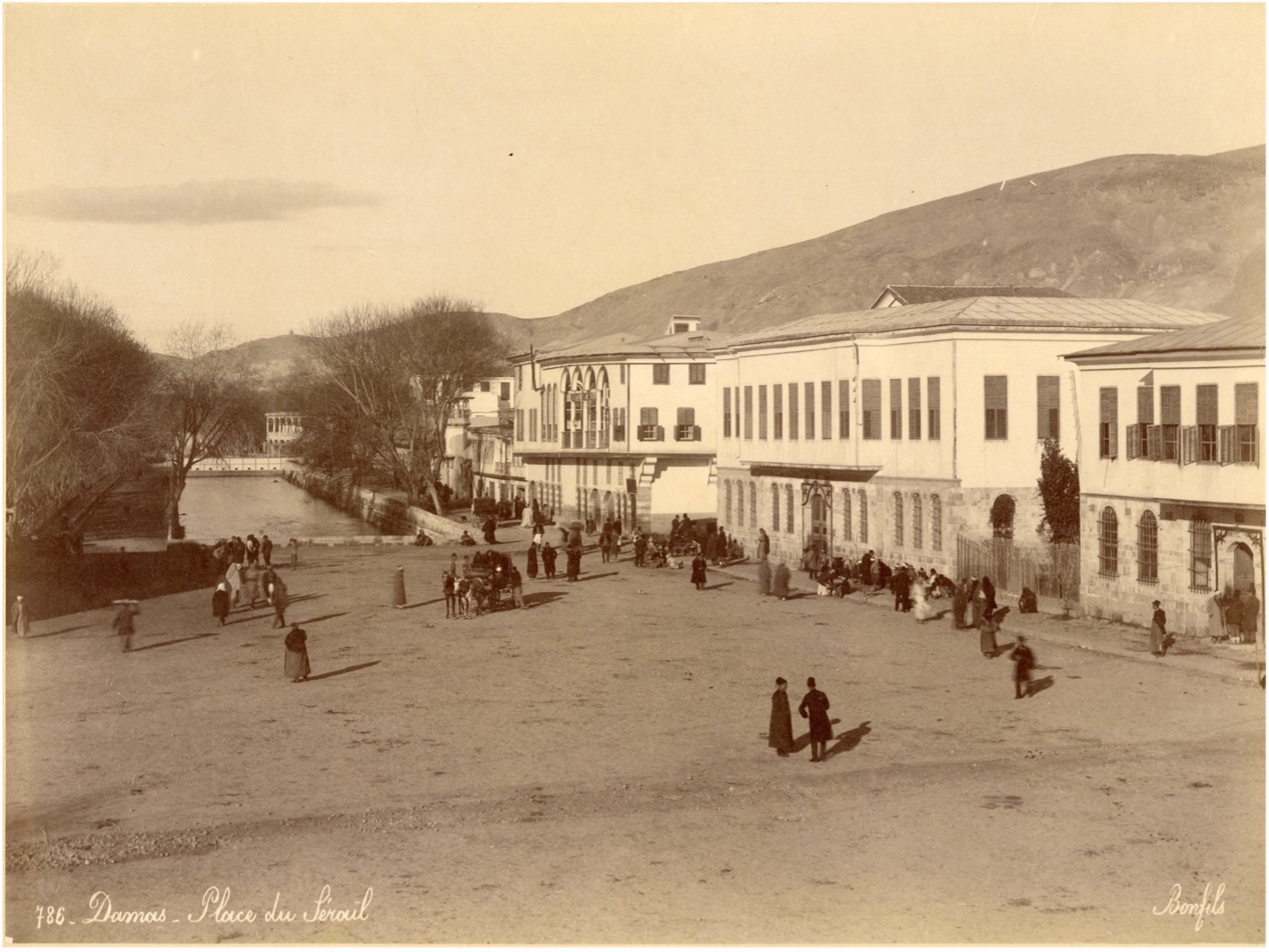
HSM.CC.740 Bonfils 786, Special Collections, Fine Arts Library, Harvard University.
The building in the center of this photograph above was a new Ottoman courthouse known as the Dār al-ʿAdliyya,constructed in Damascus around 1880. It was a large building, two-stories high, about 25 meters across and 20 meters deep, and designed in the Ottoman konak style around a central courtyard. With nine rooms over its two floors, it was also a busy building with up to sixty people employed by the Ministry of Justice working across several courtrooms and offices, not to mention the many litigants or hired legal intermediaries who came every day.
The photograph was taken shortly after the court was built, around 1890, by a French studio, Bonfils et Cie, operating out of Beirut. The studio, established by one Felix Bonfils, mostly photographed landscapes, archaeological sites or produced stylized images of the Holy Land for European buyers, a business that had thrived since the 1860s. But in this case, the photographer captured Damascus' late Ottoman building boom, especially in Marja Square outside the walls of the historic old city. The courthouse shown here was accompanied by a new governor's palace (saray), a police station, and a post and telegraph office. Private enterprises too, like new coffee shops and the Victoria Hotel, were built on what had been an open park outside the western walls of the old city along the Barada river. This spurt of construction reflected the political and economic growth of a city that more than doubled in population between 1880 and 1918. By the early twentieth century Marja Square had gained lasting monuments to Syrian historical memory. The first was a large telegraph column commemorating the completion of the line between Damascus and Mecca. More gruesomely, the square was the site for the execution of Syrian nationalists by Ottoman authorities during the First World War, and again by the French during the mandate. Recently, after the fall of Bashar al-Assad's regime, the square became a focal point for people to gather and to post photographs on the base of the column of some of the horrifying number of Syrians disappeared during the civil war.
I have been interested in what took place inside the Dār al-ʿAdliyya, in order to understand what legal practice meant and how legal change was experienced in the late Ottoman Empire. I am particularly interested in one of its courtrooms, that of the commercial court, to ask a broader set of questions about the relationship between law and economic life. Over the course of the nineteenth century, in the Ottoman Empire, as in France or Italy or Egypt, commerce came to occupy an independent legal jurisdiction and specialized courts were created where bureaucrats and merchants decided cases related to commercial debt. This was a vast enterprise that reflected the profound changes experienced by the Ottoman state and its economy, but one that has not been the focus of much study. To get a sense of this scale, at one point in the late 1860s over 100 of these new courts were in operation in every sizeable city, over 8,000 cases were being heard, and tens of millions of kuruş (an Ottoman unit of currency) were being fought over.
But gaining access to what happened in these court rooms, like the one in Damascus, has proved archivally tricky. Almost no surviving records exist across the Empire, or have yet to be found, for such a vast legal system. Damascus, of all places, has been even harder to research since the start of the long and bloody years of the civil war in 2011, restricting the possibility of access to Syrian archives. Yet, against all odds, this second photograph shown here is an overhead scan from one of the seven kinds of register the scribal staff in Damascus' commercial court kept. Reading these registers together provides a compelling view of what was happening in the Dār al-ʿAdliyya and of how this late Ottoman legal system worked in practice. The originals are in Damascus, but consonant with the ongoing political geography of the Ottoman Empire, digital images have made their way to computer terminals in a research library in Üsküdar, a neighborhood on the Asian side of the Bosporus in Istanbul. They are buried within the huge collection of Ottoman sharīʿa court records and have been little used by historians. It was in this context, in Istanbul, that I was able to find a mostly uninterrupted series of registers covering the years from 1885-1900.
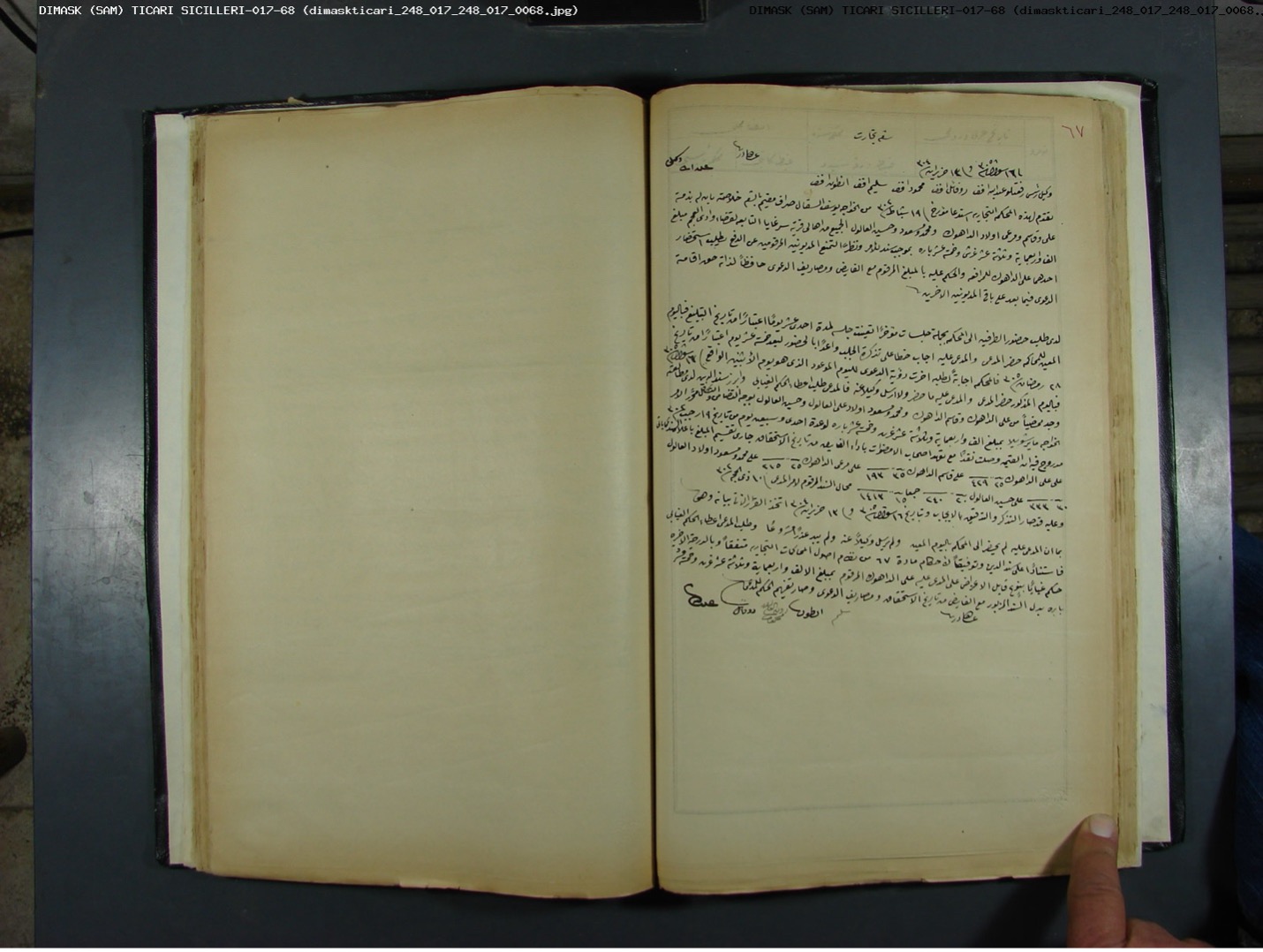
Şam Mahkeme-i Ticaret Sicilleri Vol. 17, 68, 16 Shawwal 1305 / June 26, 1888.
What is present in these documents is a dynamic world of commercial litigation, as some of the cases decided in Damascus in a week in early May 1894 show. One involves two brothers, Muṣṭafā and Muḥammad Ṭiyāda, and their business partners against a certain al-Suʿūd Khazīnat al-Kātibī in which the brothers had won a judgement to declare al-Kātibī bankrupt, have the court imprison him and seize his commercial assets. Another was a judgement in favor of a local company that traded in textiles regionally, Farīj Ṣabbāgh and Muzannar, who sued a merchant from the Mīdān neighborhood, one Maḥmūd Yāsīn, for unpaid commercial bills. At a smaller scale an artisan from the ʿAmara neighborhood, Sheikh Aḥmad Kūlū, received a judgement against another artisan from Bāb al-Barīd, Khalīl Shahāda, for 545 kuruş. A merchant banker, Niqūlā Zalḥaf won his case against three generations of the Shītawī family from a village outside the city after an investigatory committee found that they had signed the promissory notes they were being sued over. The Imperial Ottoman Bank brought a case against the children of a rich property owner in the city, Aḥmad ʿAmr Pasha. Finally, ʿAbdullāh al-ʿAlbas won a case against Muḥammad Āghā al-Nūrī on a commercial bill he had endorsed that related to the collection of the tithe on a village outside the city.
When I first encountered these documents, I was, to put it mildly, thrilled. And, as is familiar to historians, the initial joy of an archival discovery gave way to the harder work of making sense of what was written on the page. What kind of procedures were being described? Who were the merchants and bureaucrats whose names and signatures appeared on the page as judges? Who were the attorneys making complicated legal arguments? What about the array of litigants that came over from the workshops, warehouses and commercial houses in the city, from local textile artisans to notable merchants, landlords or new institutions like the Imperial Ottoman Bank? What about the people who were employed, scribes, bailiffs and others, who ran these courts and generated the pages I was reading? This required slow paleographic work. Dated technology rendered the images at a resolution that doesn't always allow for clear zooming in. Sometimes a magnifying glass came in handy.
But something else animated me as I clicked through this archive. My eye kept being drawn to a detail, in the corner of the page, that belonged to the early twenty first century – a finger. Mostly, this finger appeared as it does here, holding down the page while a picture was taken. In other files, the image leaves a trace of the deep blue jeans of the archivist. Sometimes I could catch a glimpse of a coffee cup, or other small odds and ends, scraps of paper or writing implements, on the scanning table. These intimate imprints have come to be the markers of the personal archives we all construct with our cameras in libraries and archives and are not what we expect of institutional or state archives. The paradigmatic example is Google which, at the start of its great book scanning project in the 2000s, removed pages for further processing that happened to reveal a human imprint in the form of a technician's pink latex covered finger.
In one reading, the visible human trace on these documents from Damascus reflects a quick, rough and stalled digitization process that is symptomatic of the broader lack of investment in Syrian archives even before the civil war. The original registers, along with many older records from over four centuries of Ottoman rule, have been kept since 1959 in Damascus at the Center for Historical Documents (Markaz al-Wathāʾiq al-Tārīkhiyya), once a thriving place to do research on Syria's Ottoman past, increasingly moribund after 2011. In July 2023, the building that housed the archive, the Bayt Khālid al-'Aẓm in the old city, caught on fire and almost burned down. There are no clear answers on what was lost. A former director of the Center, in exile in Turkey since 2011, confirmed that most of the collection's physical documents and registers had already been moved to a different building, while simultaneously lamenting the poor attention the collection had received even before the war. More recently, after the fall of the Assad regime, he has returned to Damascus and called Syria "a state without an archive." The Center has not reopened and as of today, I am unable to find any government website that even points to the existence of these documents, let alone if they are safe. The larger question of a national archive, particularly one that deals with the vast quantity of archival documents produced by the brutal Assad regime, has yet to be answered. As other historical examples have shown, taking care of this archive will be crucial for how Syria moves forward through its many processes of reconstruction. Legal archives, like Damascus' Ottoman commercial court, are only a small part of this. But these kinds of collections are helpful in how they suggest different histories of the past to imagine different kinds of possible future.
But the finger on the page also suggests my own intimate and sentimental attachment to this archive, and to the unknown guardians who left an imprint of their bodies on digital files. Seeing this fragment on a computer screen was, through the long years of the Syrian civil war, as close as I could get to the archive. I read the archivists' presence at the edge of the frame as a note, one that records a moment of insistent hope and deliberate care, when the urge to preserve was carried out at an overhead scanner. The archival image they produced will continue to let historians reconstruct Damascus' rich world of nineteenth century law and commerce, its legal and economic agents, the world that is present in the stylized Bonfils photograph. But, for a moment at least, let us also reframe this image and center its margin.
Salmaan Mirza
November 2025