
On a January afternoon this year, my family and I were in a car threading our way through Joypur Forest, near the 2000-year-old temple town of Bishnupur, 140 kilometres north-west of Kolkata, West Bengal. At some point, 'forest' had given way to 'jungle', and sal, teak, palash, and mahua trees crowded around the rough track to which our rented sedan was clearly ill-suited. Our intrepid driver was cleaving through the sticky red soil characteristic of the region when he came to an abrupt stop. A foxlike animal had emerged from the bushes and walked slowly past the car. Its eyes narrowed suspiciously before slinking away. We pushed on hearing the squawks of jungle fowl behind us.
Armed with Google Maps, I was in pursuit of an abandoned airfield. It was a relic of the Second World War, and I knew from my research that several Allied airfields had been built in undivided Bengal by the British Royal Air Force and the US Army Air Force between 1942 and 1944. Strategically located near inconspicuous railway junctions, bases like Piardoba, Kalaikunda, Salua, Ondal, and Guskara, among others, had played a pivotal part in the war in Asia. Boeing B-29 Superfortress airplanes, heavy bombers designed for low-altitude night bombing, had left these bases to bomb Bangkok, fly over the Himalayan 'hump' to ferry supplies to forward bases in China before going on to bomb Japan. Others participated in photographic reconnaissance missions to Burma. Each had a runway that was about two kilometres long and would have once been part of a much larger base, with buildings that housed sensitive reconnaissance and operational material, bombs and munitions, advanced radio and communications equipment, and troops of multiple ethnicities and nationalities who temporarily transformed obscure rural outposts into cosmopolitan hotspots.

'An overall view of one of the loading strips of the 4th Combat Cargo Group at Chittagong, India, with Curtiss C-46's parked along a loading area. In the foreground British and Indian troops march alongside their parked lorries. 11 March 1945.' NARA, Record Group 342, 342-FH-3A35397-73276AC.
My reason for seeking out abandoned runways was not from any significant enthusiasm for military history, but because they were built by an all-female 'Labour Corps', a contingent of at least 30,000 women employed through military subcontractors for the Allied command. The early 1940s were a period marked by devastating famine in Bengal. In my doctoral research, I have found that women, especially those from lower castes who were already living in economic precarity, were disproportionately affected by the skyrocketing prices of rice and essentials, becoming impoverished at higher rates than men. Many of them coped with displacement by seeking waged work, while others were sold by their families to recruiters who took them—often as young girls—to depots, from where they were sent off to military bases in trucks. This kind of manual labour, however low-waged, provided a life-sustaining income opportunity in a labour market of extreme constraint.
A few years ago, I would have found it inconceivable that several kilometres worth of Second World War runway remained dotted around rural Bengal -- until I found the Guskara airfield by chance in August 2021. I was en route to the university town of Santiniketan when I spied a suspiciously straight road cutting through the surrounding paddy fields and impulsively decided to follow it. In the midst of forests or farmland near small, sleepy towns, these 'airports' were mostly known to motorcycle enthusiasts who had discovered that the long lengths of unused road were perfect for racing. It was through Google reviews and YouTube videos uploaded on to the Internet by these men and women that I knew for certain that the runway in Joypur Forest was still very much around. This was one of two strips in the area, some five kilometres' distance from the Piardoba airfield.
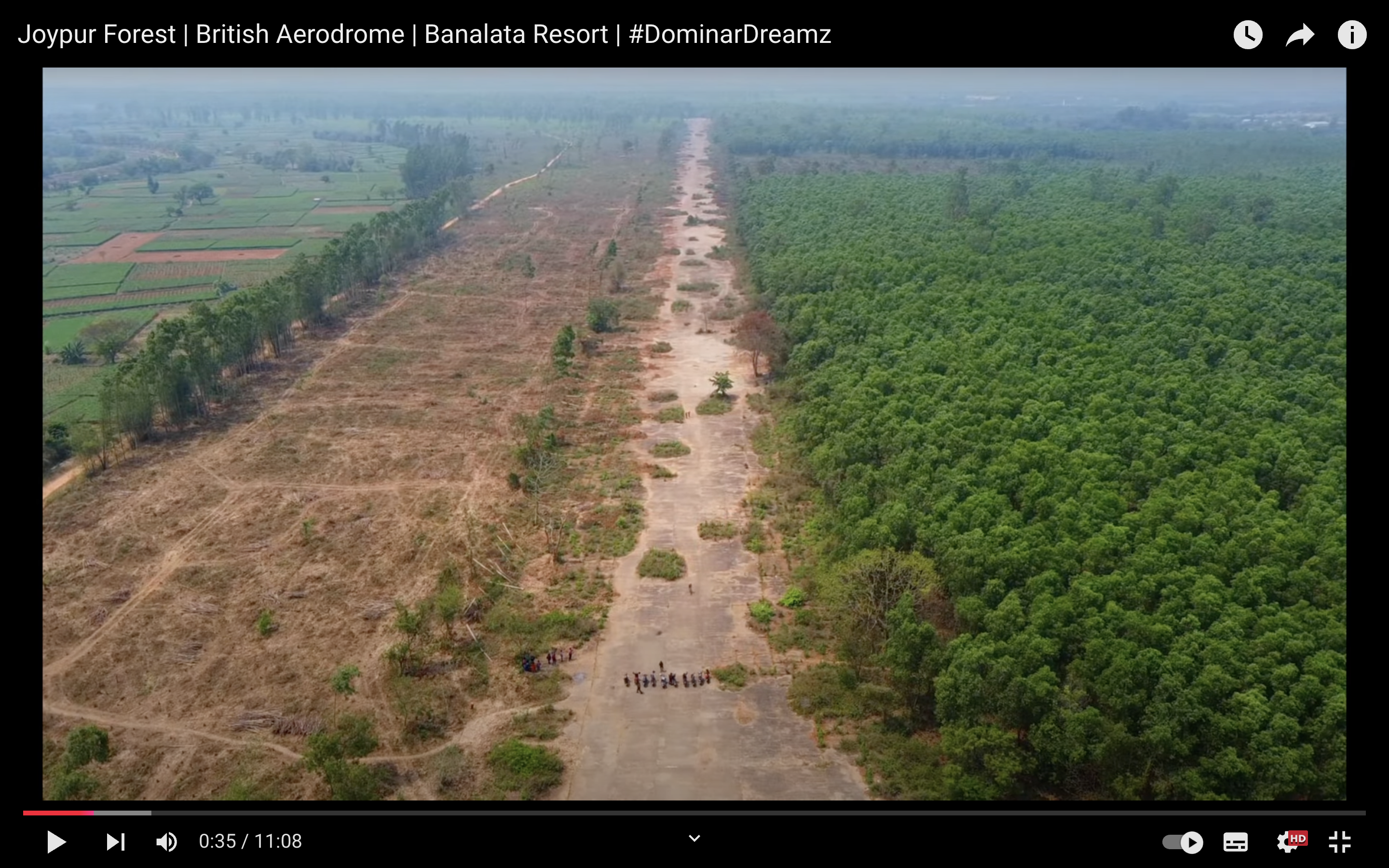
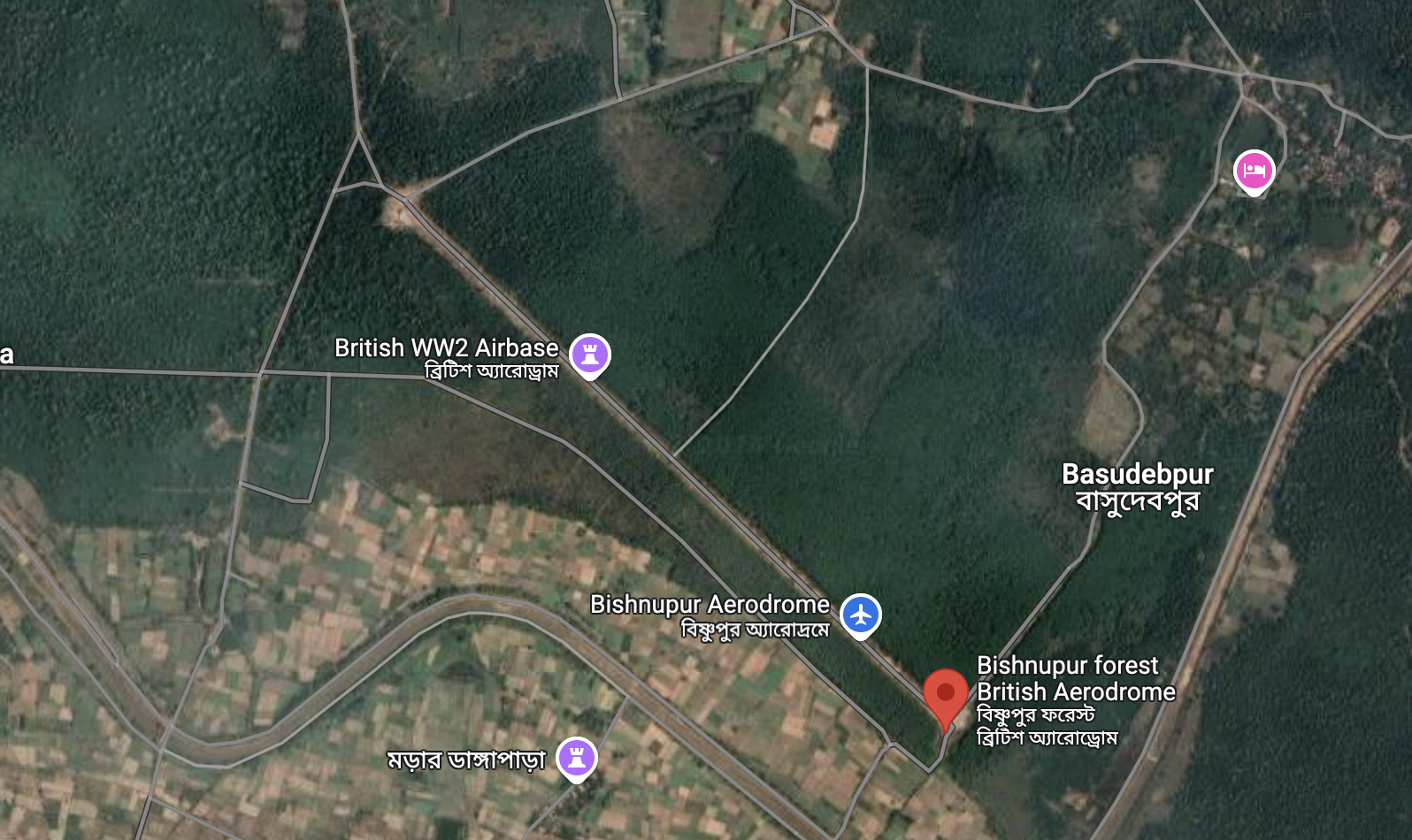
But satellite imagery has its limitations, and what had seemed like a reasonably wide and well-traversed road to the airfield had shrunk into a narrow path that was currently being held hostage by two trees, the space between them creating a narrow, sludgy ditch. I was beginning to regret my foolhardy mission. It was nearly sunset, and it would be disastrous if we got stuck. The driver, however, refused to give up. He plunged on, and for a few tense minutes, all we could hear was the wheels squelching slowly through the mud until we were suddenly free and roaring on.
The jungle around us began to change too. We passed a clearing with a large man-made tank, half filled with water that had turned a shade of burnt orange. The dense forest gave way to younger trees with slim trunks arranged in neat, orderly lines. And then, as if out of nowhere, the trees cleared and a vast expanse of tarmac appeared before us.
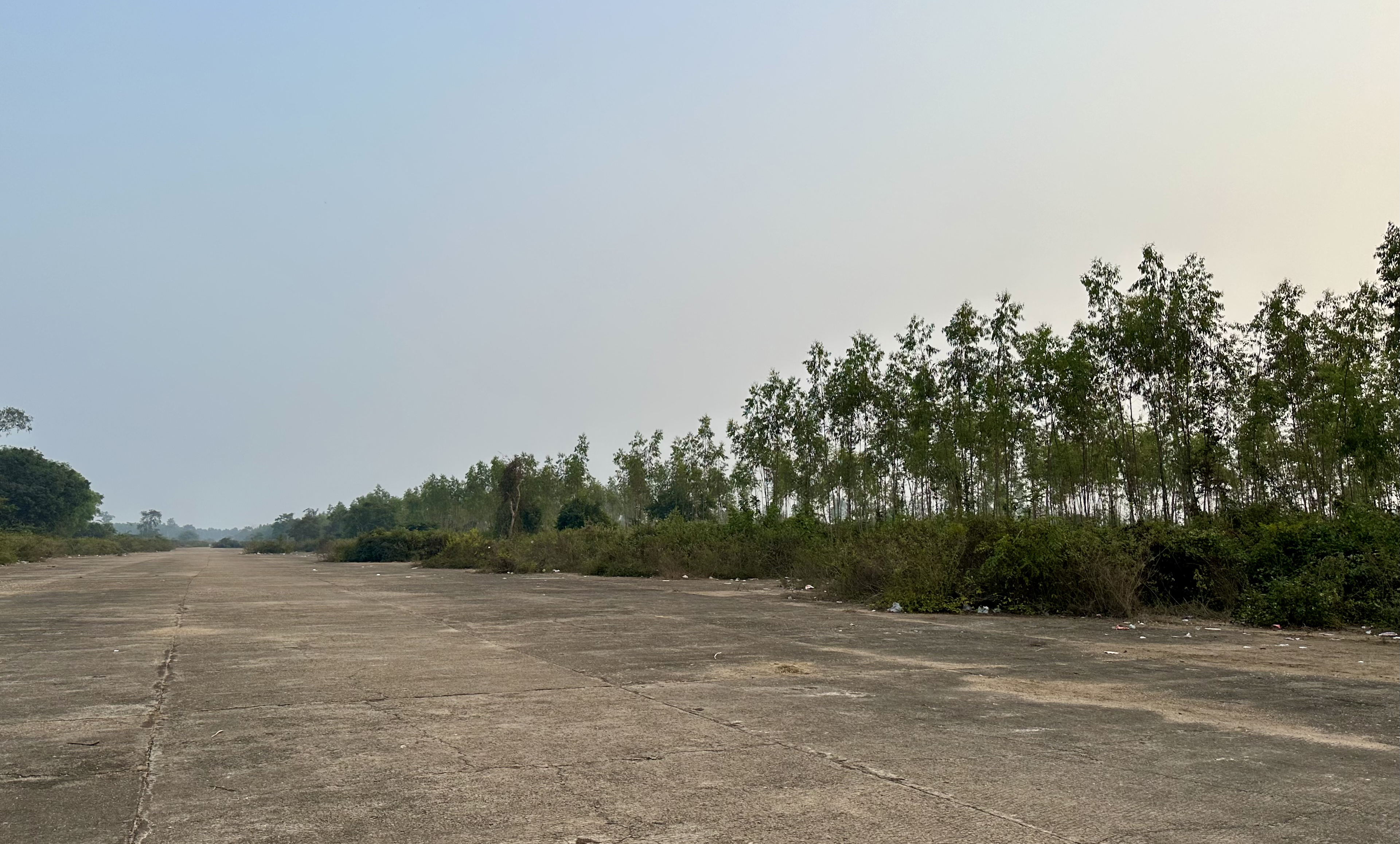
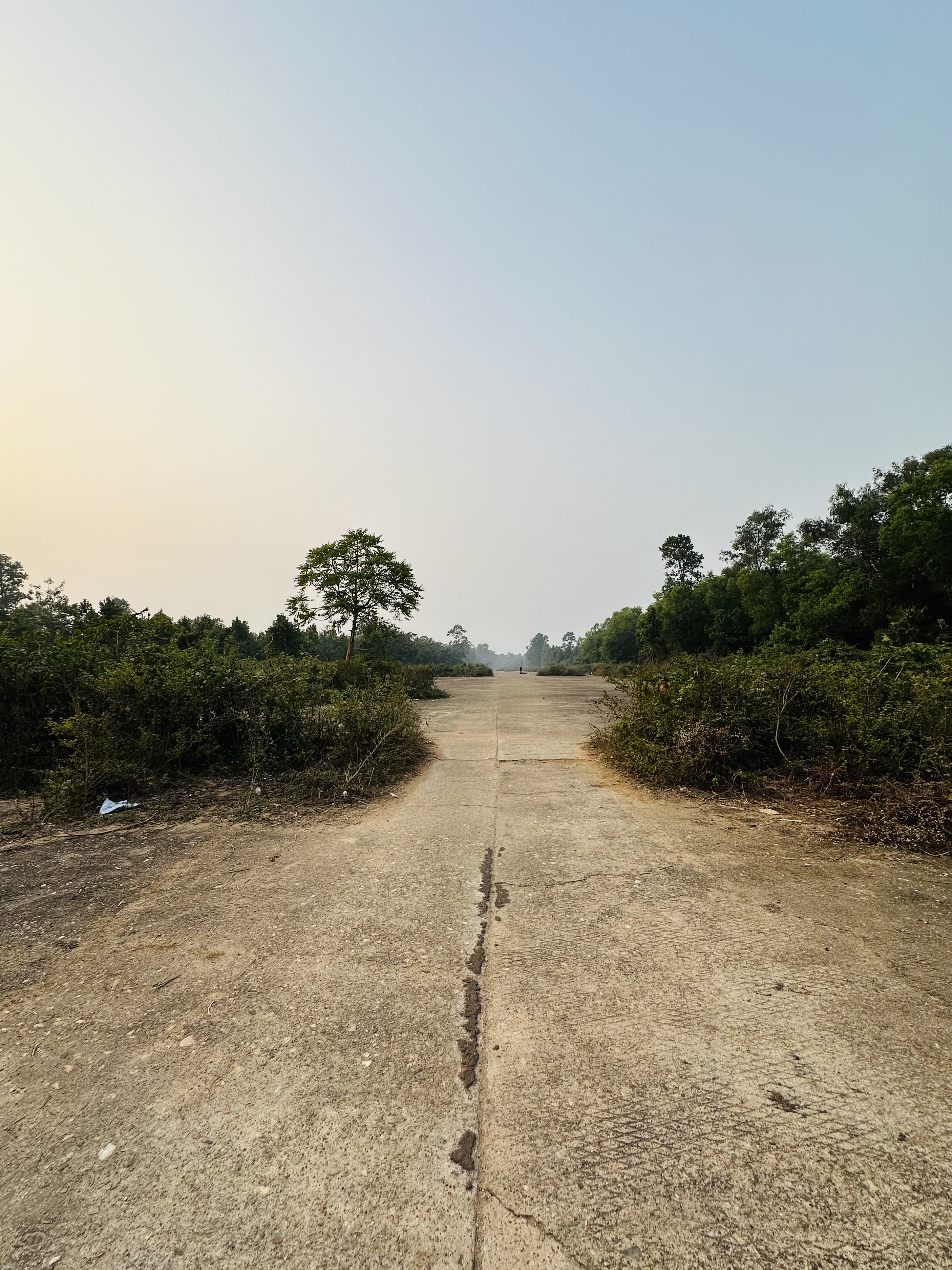
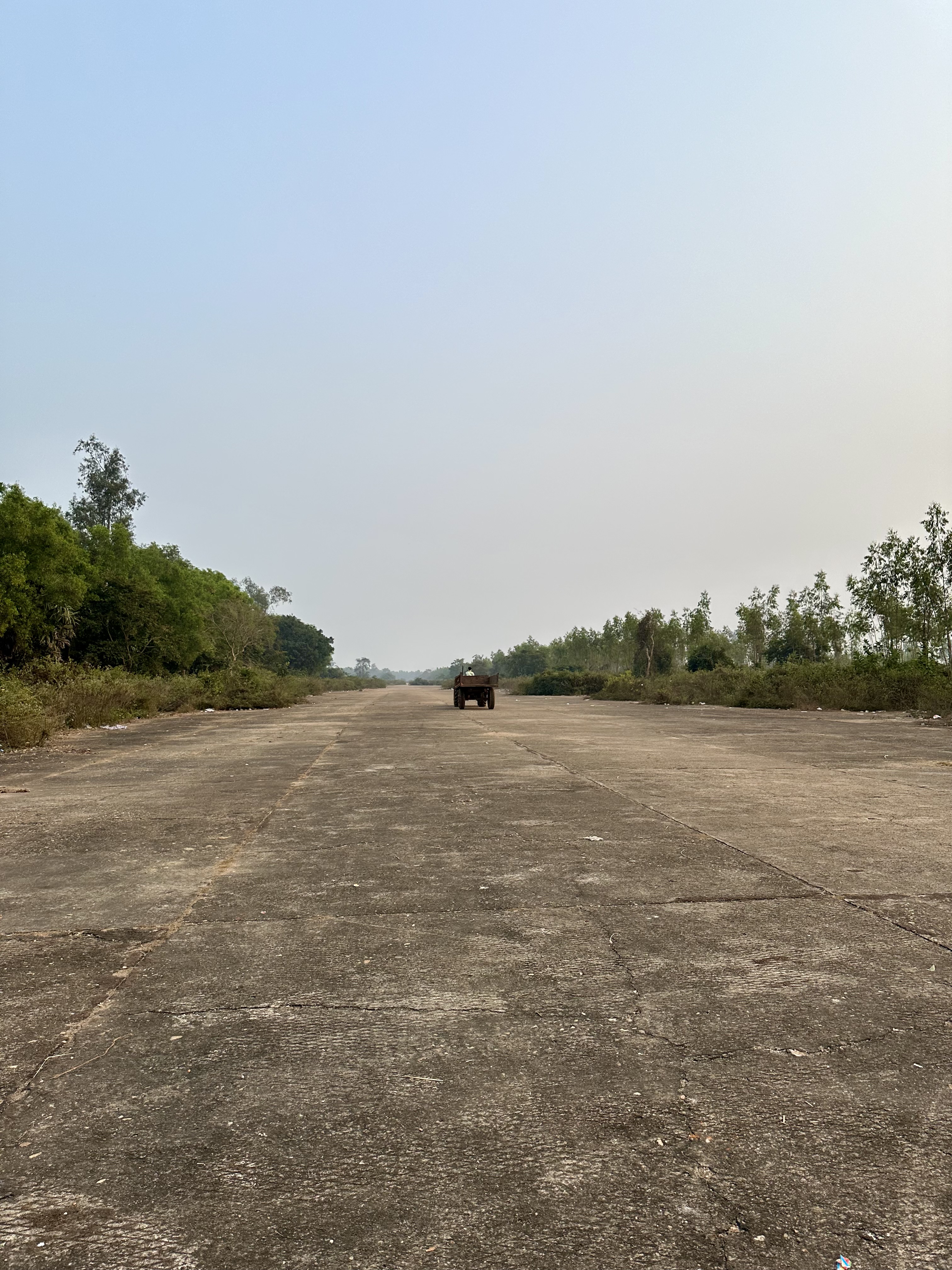
We drove onto the runway, where a group of young men were passing the time with their motorbikes, and stepped out of the car. Clumps of shrub had burst through loose gravel here and there. Bushes and young neem trees had encroached onto the tarmac. But for the most part, it remained visibly a runway. Plastic waste lay littered around the edges, a particular affliction of contemporary India, and shards of glass bottles of alcohol were sprinkled around.
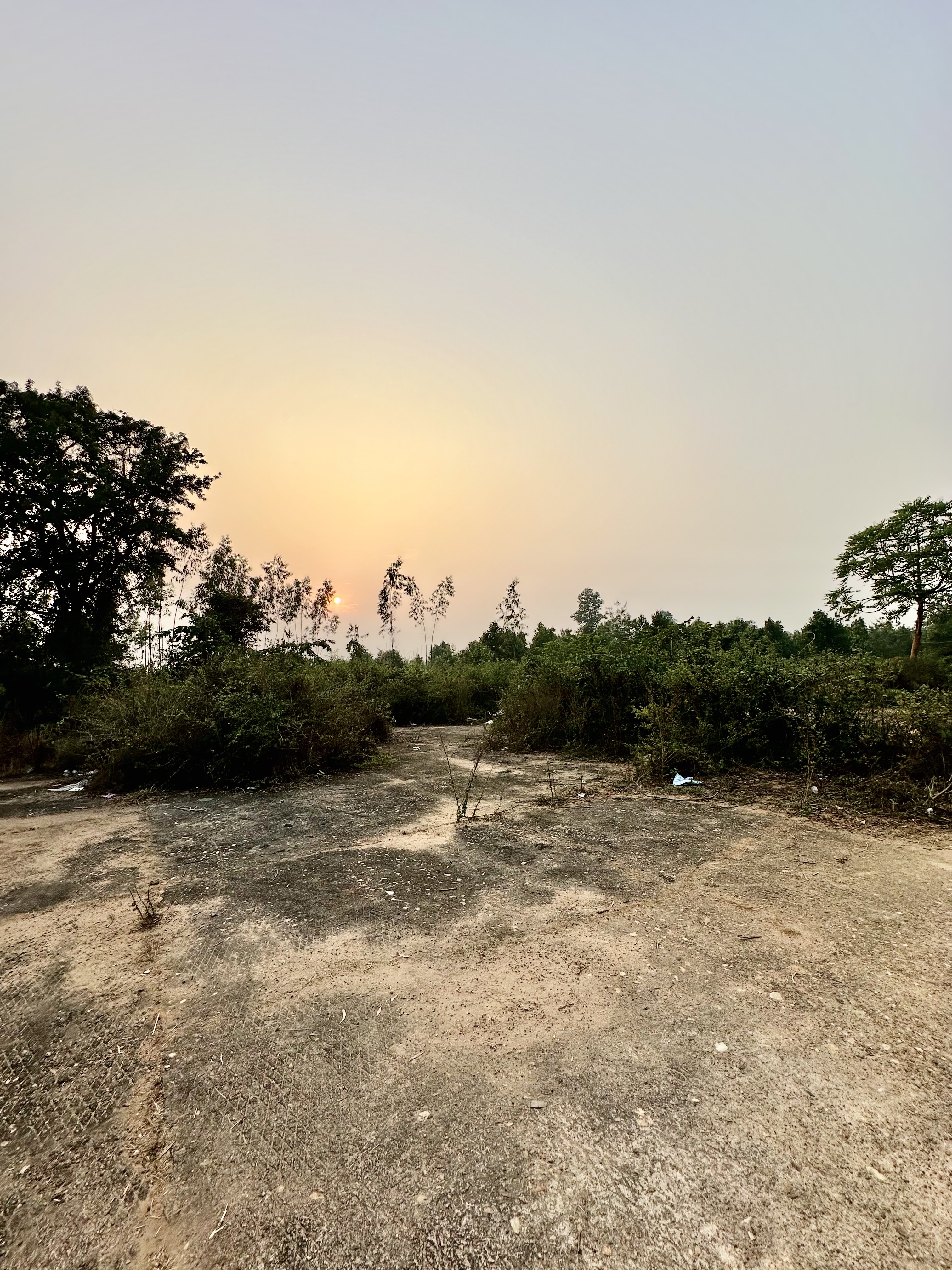 Every part of the scene felt strangely out of time and out of place—the Indian-made Bajaj street bikes, their twenty or thirtysomethings riders, and a historian stumbling out of a sedan. All of us had our smartphone cameras at the ready, a peculiar mosaic brought together by the lure of an eighty-year-old military runway.
During the depths of COVID in 2021, trawling bleary-eyed through thumbnails on the US National Archives website, I had stumbled upon a trove of black-and-white photographs of runways across South Asia being built by Indian women workers. They are pictured at every stage of the process of transforming agricultural land into a military airbase: dredging paddy fields, pounding rocks with mallets to create gravel, transporting concrete from mixers to runways in baskets on their heads, carrying away heaps of crushed stone and dirt, repairing damaged roads, and constructing buildings and railroad sections. These images of women at work in military bases radically challenge the silence of the textual archive, which referred to the people who constructed them simply as 'native labour' or 'coolies'. That deliberate vagueness extends in some ways to this photographic record too, where the captions followed a similar pattern of obfuscation and where the images themselves were staged so that the women's faces were always hidden in shadow. This is a visual register which simultaneously makes visible and veils these unnamed women.
Even though the compositions suggest that it was the fact of their labour—and not the women themselves—that mattered to the anonymous photographers, reading the visual archive against and along the grain allows an unprecedented glimpse into the material experiences of these subaltern actors. Despite the intentions behind this pattern of documentation, the existence of this visual record is empirical proof of the role these women played in laying the foundations of the Allied war machine in the Indian subcontinent.
There is much that can be read from the photographers' construction of these images, their subjects, and these sites. In several photographs, women are pictured in sarees hitched up to their knees as they balance wicker baskets heavily laden with stones and rocks on their heads, walking barefoot on loose gravel, or wading through recently dredged paddy fields. They walk in single file, often against a backdrop of B-29s, some of the captions explicitly framing the photographs as a juxtaposition of the 'primitive' method of transporting materials in wicker baskets and the 'modern' airplane that was ferrying supplies and bombs across borders. These photographs were intended for publication, symbolic of the spirit of international cooperation that was making the Allied war effort possible. Various versions of this configuration appeared as an Associated Press wirephoto, in US Army and Air Force films and publications, and in military engineering journals. Underlying this aesthetic was a messaging around the assumed modernizing impact of American technological prowess that had apparently been benevolently bequeathed upon willing recipients. These compositions belie the fact that the aerodromes were built on land appropriated from villagers who had been summarily evicted, sometimes with as little as twenty-four hours' notice.
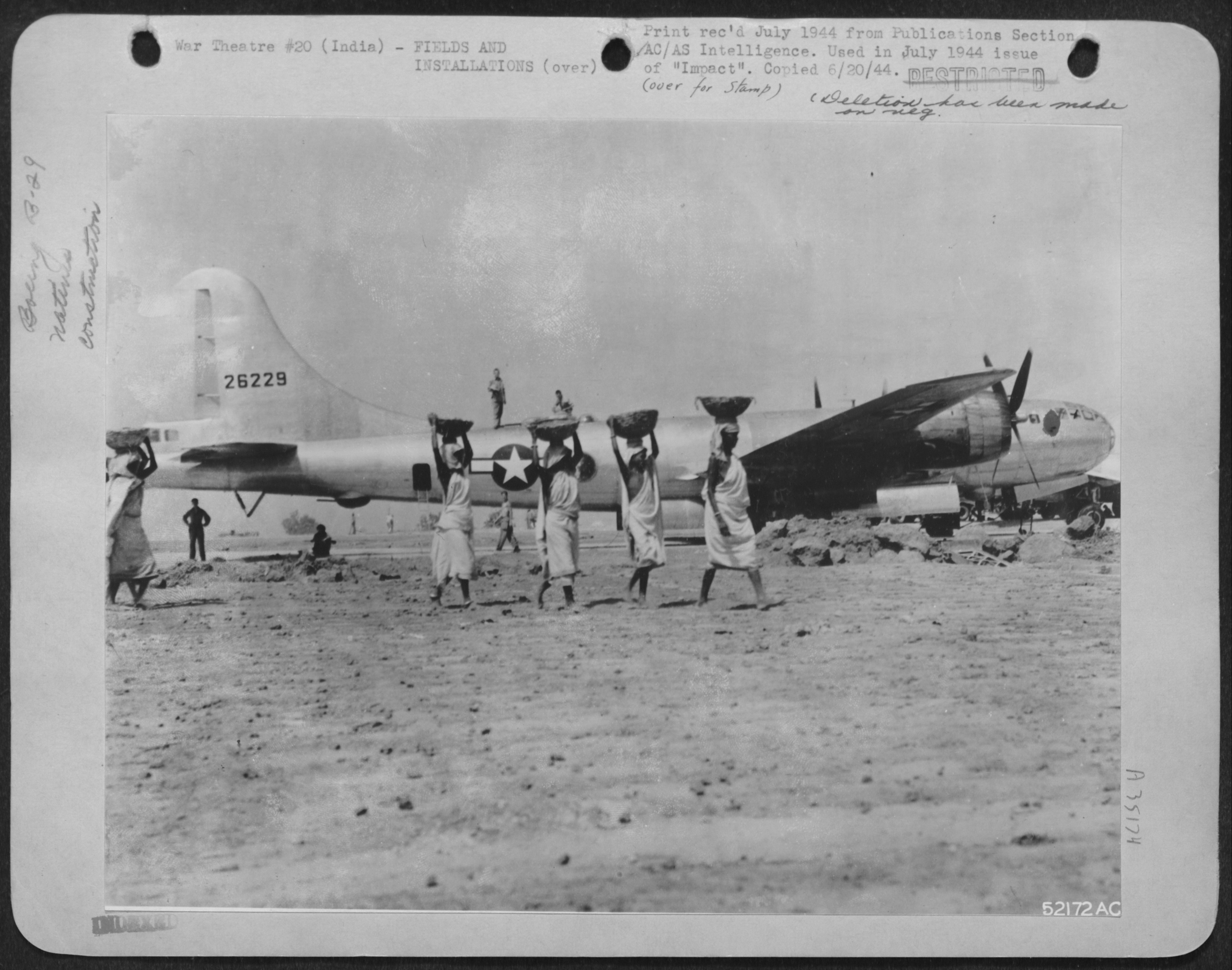
'Women of India cart away dirt and stones in baskets balanced on their heads during the construction of base in India. Hundreds of such women worked alongside the men. Construction was far from completed when the first Boeing B-29 landed.' NARA, Record Group 342, 342-FH-3A35174-52172AC.
Most photographs are not quite so staged and documented the more ordinary moments of work, perhaps to preserve a visual record of how the bases were built. There is hardly a man—Indian or American—to be found in these photographs of military bases, spaces traditionally associated with a hypermasculine presence. We find men in the background, or silhouetted in the distance, or with their backs turned to the camera. Occasionally, we see white American GIs in the backgrounds of these photos, their booted and uniformed figures a direct contrast to the workers who had no footwear and wore a single long piece of rough cloth draped around their frail bodies.
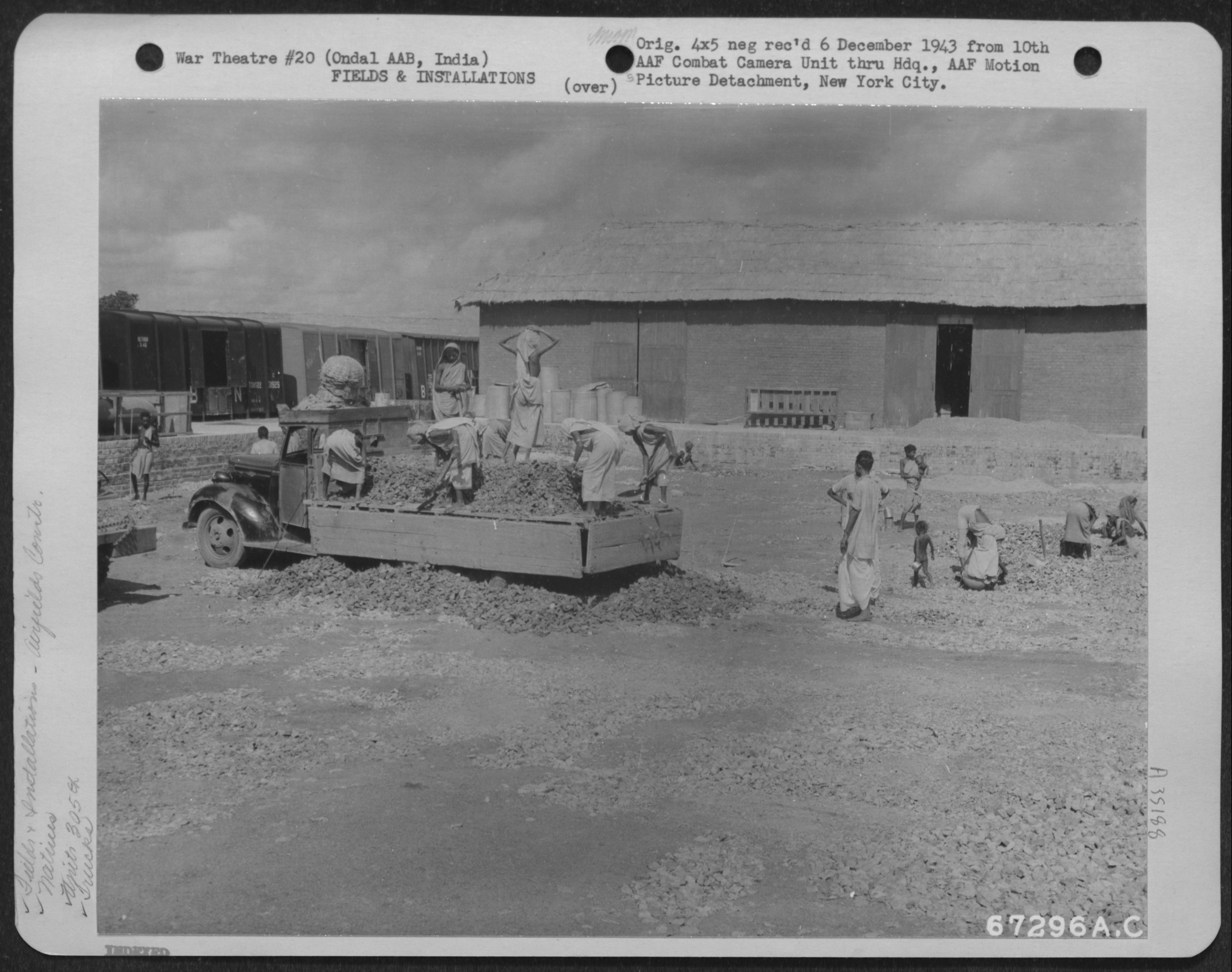
'Natives dump a truck load of crushed stone on the warehouse yard at Ondal AAB in India. The work is under the supervision of the 305th Service Group, 1943.' NARA, Record Group 342, 342-FH-3A35188-67296AC.
One can tell even from the photographs that the construction labour the women were engaged in is strenuous and physically onerous, not to mention the pressures of such work in hot and unbearably humid weather. Everything and everyone appears to be coated in a film of dust. In one photograph, a worker is captured mid-motion as she upturns a basket filled with crushed stone. It must have been heavy—behind her, a worker helps another balance one on her head. A layer of cloth wrapped around their heads is the only thing shielding them from the harsh sun and the jagged edges of stone chips poking through the gaps in their wicker baskets.
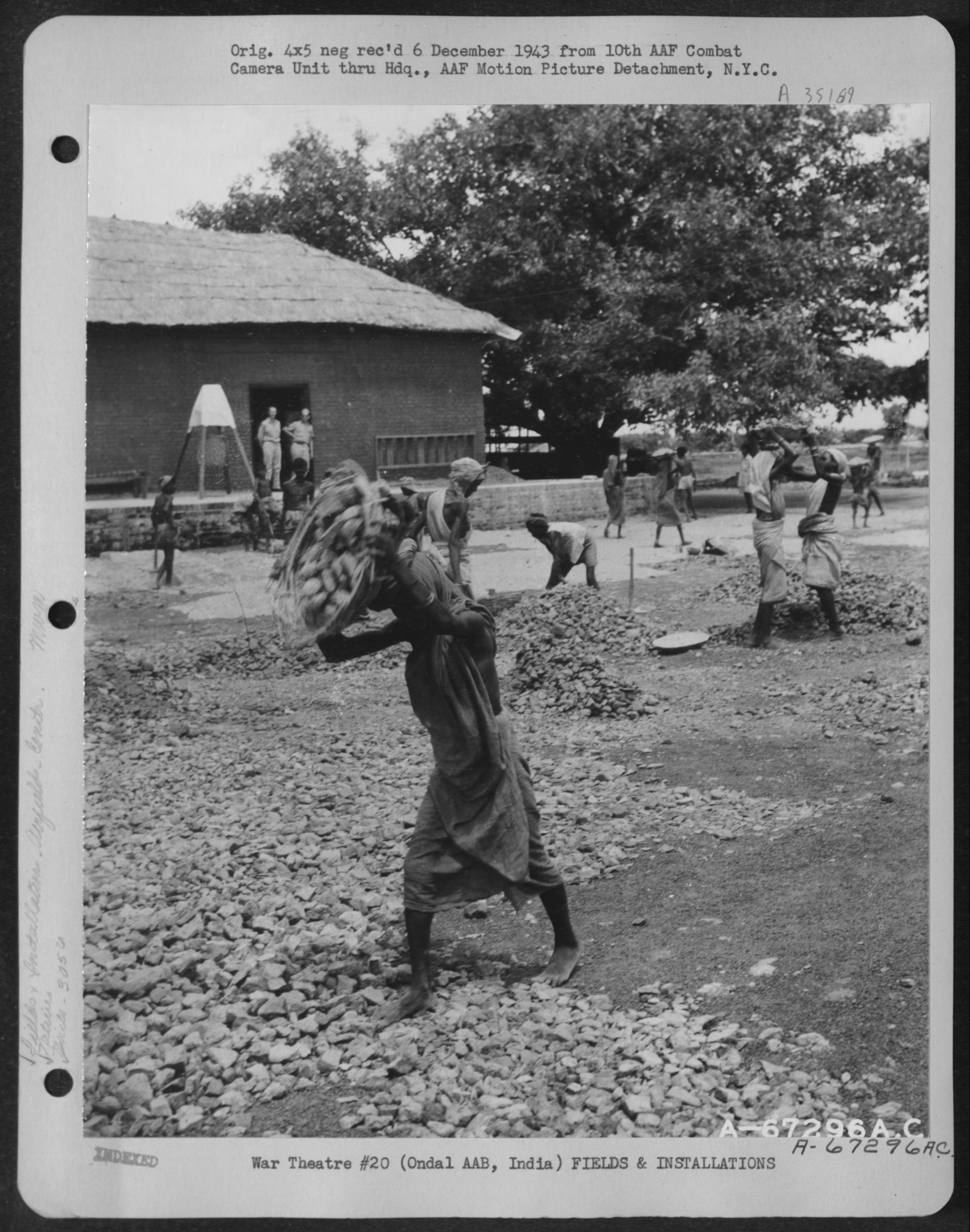
'Native women spread a truck load of crushed stone evenly over the area surrounding the warehouse at Ondal Army Air Base in India. The work is under the supervision of the 305th Service Group, 1943'. NARA, Record Group 342, 342-FH-3A35189-A67296AC.
It is impossible to read their faces, which are often shrouded in darkness. I wonder if the photographers were conscious that they were photographing people, or if they were more intent on capturing the ongoing transformation of a landscape that to them was once exotic, and that was now being wrought and wrestled into familiar terrain. Some scenes are reminiscent of everyday life in India today, where work in construction gangs is an important income-earning opportunity for women navigating poverty.
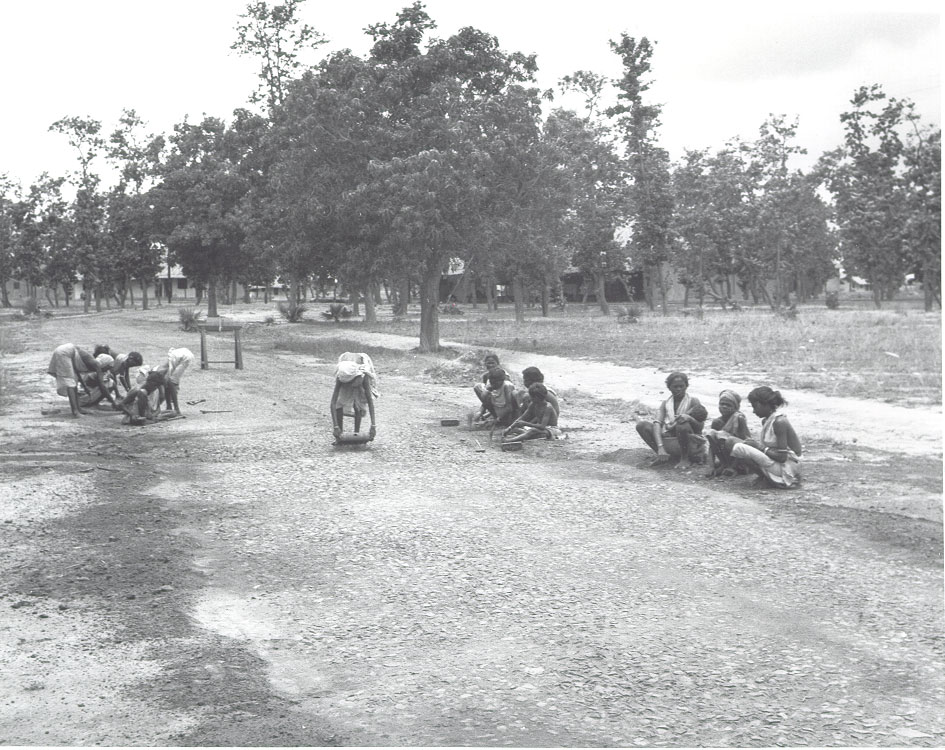
'Women crush bricks by hand to repair a road on the Gushkara air base', Glenn S. Hensley (1944), The Hensley Photo Library, https://dsal.uchicago.edu/images/hensley/ (6 February 2023).
This is also true of another photograph from the personal collection of an American serviceman Glenn S. Hensley, who was part of the 40th Army Photo Reconnaissance squadron, and captured women at work repairing a road on the Guskara airbase. On my visit to Guskara in 2021, I had seen several groups of women working in the paddy fields around, also bent down at the waist or sitting on their haunches, and I had found myself thinking back to this photograph from 1944, wondering if it was their grandmothers who had worked on the base.
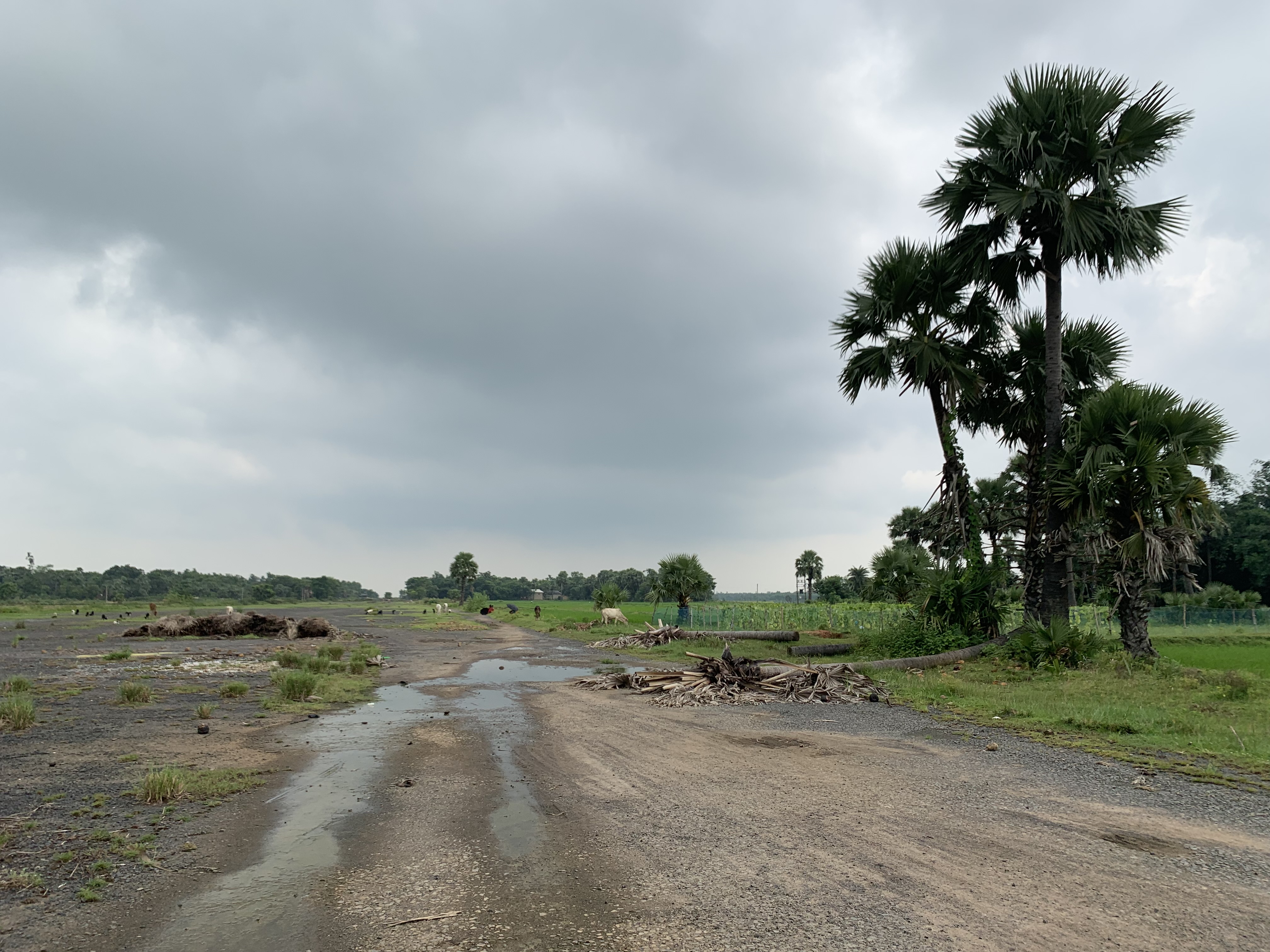
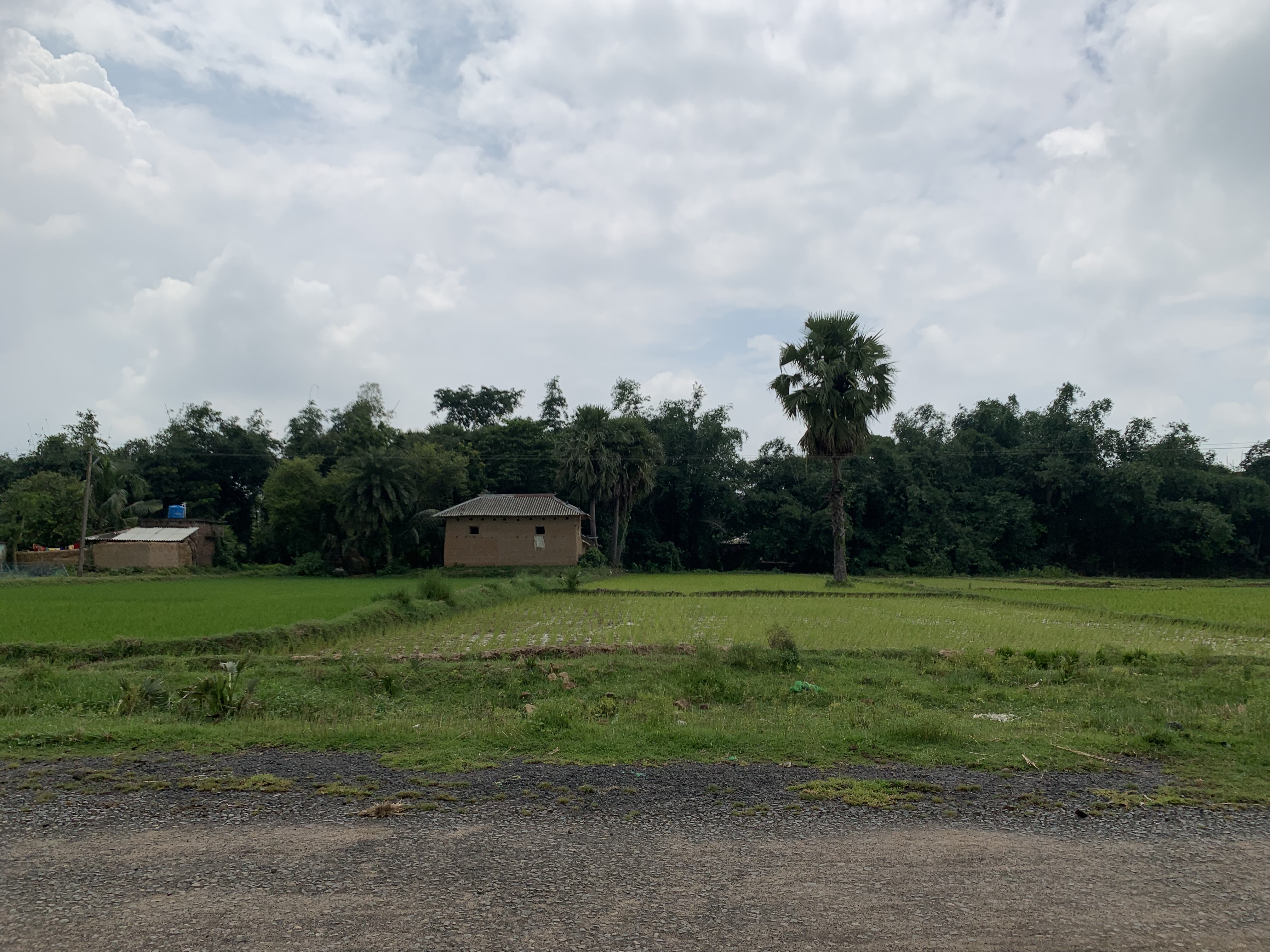
The airfields, which are under the ownership of the Indian Government or its Ministry of Defence, have languished, like the economic fortunes of the region. The areas these bases are located in are chronically underserved and there is very little scope for upward mobility for the people who live there. Only the Andal airstrip, located near the industrial cities of Durgapur and Asansol, was given to the private sector to develop into a domestic airport. Proposals to revive other runways have not taken off.
These stretches of tarmac have weathered many monsoons and shifting moods about colonial legacies. They also occupy a liminal space around a largely unremembered American presence in South Asia. They exist, curiously devoid of context, as permanent encroachments on land that would have otherwise been used to cultivate rice. The shadow of the Bengal Famine looms large behind them, but as pieces of wartime infrastructure they have never been placed in the same frame as this tragedy and failure of colonial policy.
Although only traces of the airbases' administrative and residential buildings remain, the runways have endured, stubbornly resisting being swallowed by encroachers. Overgrown and eroding in places, they appear to represent a sort of reluctant ruination. The crumbling materiality of the runways makes them both an enduring testament to the labour of these women and a metaphor for their tenuous relationship with historical memory.
As a historian of women and work I often deal with the intangible and the invisible, and these bits of literal concrete are among the only durable remnants I have of the historical actors I study. Onto this concrete, I project the stories of struggle, hunger, and desperation that I have found in the archives. I think of the tens of thousands of women who came from all over Bengal with little else but the clothes on their backs and their children in their arms, searching for food, work, and stability during a time of crisis and precarity. For me, the runways have become the stage upon which the macro and micro intersect and constitute each other, where histories from above and below collapse into a single frame.
Urvi Khaitan
November 2024