
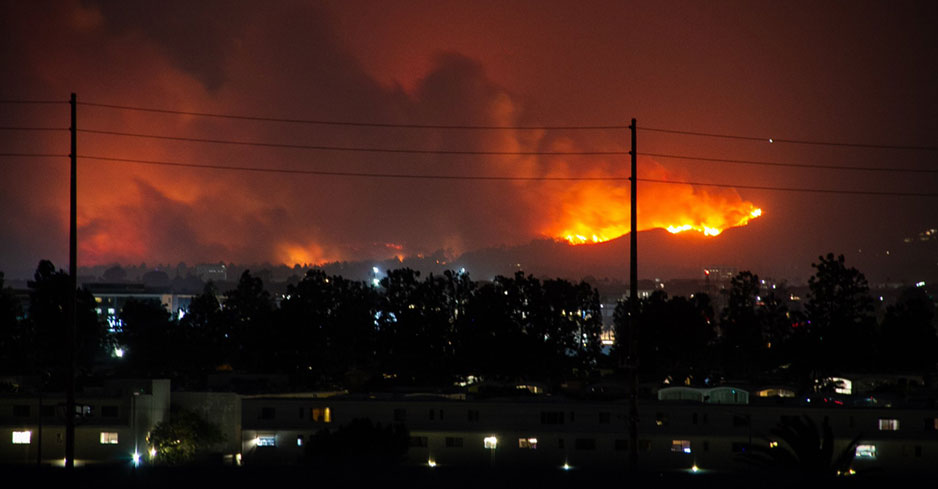

The fire, in George R Stewart's Fire, is at a discreet distance from metropolitan life. The only news of the Spitcat fire that "made the city papers was a brief story of the 'evacuation' of Idylhurst," a tiny settlement with "a dozen or so houses." There were tragic stories of individual loss and of habitations destroyed. But the individuals were squirrels and rabbits and deer, "driven from their homes," a "bed-ground in the thicket," or a burrow in a "favorite covert." It was only in the society of carpenter-ants that an entire community was devastated, as in Stewart's simile of ancient times; "now at last, as when Pyrrhus and the dire Odysseus raged in the streets of Troy, the fall of the city was near."
The great Los Angeles fire of 2025 has unfolded, still, in a world that George Stewart imagined. When Stewart moved to California at the age of 13, in 1908, his family lived in the small agricultural town of Azusa, to the east of Pasadena, at the edge of the San Gabriel mountains. The family grew sweet potatoes and then oranges, and in 1911 they moved to Pasadena, in sight of the mountains and of what is now the Angeles National Forest, where the Eaton fire began on January 7, 2025.
Stewart had just arrived in Berkeley, as a young instructor, when the "Berkeley Fire" blazed down from the hills on September 17, 1923; the first spectacular wildland-urban conflagration in California history, and a fire that began in the hills above the city, at a time of high winds and low humidity, and burned through structures of slate and shingle, concrete and stucco. In the cataclysmic ending of Stewart's novel Earth Abides, "there was a great fire raging in the ruinous city beyond the Bay."
The public officials of region 5 of the US Forest Service, who are the heroes of Fire, and to whom the book is dedicated, are still the heroic figures of the Los Angeles fire of 2025. They know about wind direction and fire coming from the hills; when the meteorologist in Fire, Dave, tells the dispatcher, Arn, that there is a big dome of cold air over the plateau, and that "cold air runs down hill," Arn "knew all about it;" "we used to call it a Santa Ana on the Angeles, and a Mono on the Stanislaus."
Fire is an ecological novel. It is about the connections between pine-cones and squirrels and the beetles who burrow into charred wood, the dry wind and the whirling smoke. The poet Josephine Miles described it as "a new kind of novel," because it "materialized dramatic personae out of the powers of nature," all with "action and character," and "with organization as the abstract hero."
The Los Angeles fire, too, will be an event of large ecological impact, whose effects, like that of the Spitcat fire, in Fire, "would not be undone in a hundred years." (The Eaton fire of January 2025 was larger than the imagined Spitcare fire, and the Palisades fire was more than twice as large.) There are "burned and anxious pets" in the Pasadena animal shelter, and "immeasurable" living beings -- "wildlife" -- who have died. There are naturalists and gardeners in Altadena who are collecting native plants; "Matilija poppy seeds, Engelmann oak acorns, California buckeye, sage and buckwheat seeds."
But the 2025 fire is also an ecological event of a new and insidious nature, unimagined (or almost unimagined) in the mid-20th century. It is the outcome of an inorganic ecology, for the carbon-industrial age. The Los Angeles fire was "a structure fire within a wildland fire," in the vivid description of an official of Cal Fire, the state's fire agency. This was multiplied "by five or 10 structure fires, all at the same time, all being pushed by 100-mile-per-hour wind," in which "the houses became the fuel." The stucco walls burned, and the shingles and the fire retardants; the batteries and the gas stations and the abandoned cars; the laundromats and the pool houses.
Fire, in the 21st century, is a cause as well as a consequence of climate change. The anomalously hot summer and fall of 2024 in Los Angeles, and the "extreme aridity" that followed, can be explained, in part, by climate change. The smoke, carbon dioxide and particulate matter from the Los Angeles fires will contribute, in turn, to the large and growing climate impact of forest fires, in which the carbon emissions from the Canadian wildfires of 2023 are estimated to be have been greater than the annual emissions of Japan and Germany combined. The (upward) vectors of causation from the land to the atmosphere have coincided, in space if not in time, with the (downward) vectors of causation from the atmosphere to the land.
But Los Angeles in 2025 is also a vivid example of the extent to which the causes of climate change are co-located with ordinary or local pollution. As George Stewart wrote in 1967 -- in one of the early public discussions of the "greenhouse effect," or the "closed-car effect" The changes described by the new expression "greenhouse effect," Stewart wrote, should rather be called the "closed-car effect," because "in the modern world, people know rather little about greenhouses and a good deal about automobiles." -- carbon emissions were one among multiple sources of pollution; the waste that was the subject of his last environmental work, initially to be called AIR, and eventually Not so rich as you think.
In early America, Stewart wrote, "smoke was merely smoke, and most of it was from clean oak and birch and hickory." By the time of Fire, in the 1940s, the "acrid" smell of smoke was associated with "red dust and gray dust and yellow dust, and with black soot to boot." There was the prospect, for the fire-fighters, of "'man-made rain'" and "chemical bombs with proximity fuses."
In the wildland-structure fires of 2025, the smoke that covered the city, and was blown by the Santa Ana winds into plumes seen from space, far into the ocean, was a compendium of urban and woodland detritus, heavy and light particles, lead and chlorine and particulate matter. There were toxic substances in the fire-fighters' foam and in the combustion of diesel or electric vehicles that was the fire's own fuel.
There were fires within fires, and the structure fires have a different, distinctive smell; the smell that people who lived in old industrial cities remember from burned-out buildings on a street of tenements, or that people in New York City remember from September 11, 2001, or that is a daily memory near the burning plastic of the landfill sites of South Asian cities.
This is an inorganic ecology "Every living organism inevitably exchanges elements with its surrounding environment that provides essential nutrients for growth and absorbs metabolic waste products. The overall trace element composition of an organism provides therefore direct information on the inorganic ecology of the organism itself and the surrounding chemical composition of the ecosystem. This information is particularly valuable when assessing the environmental impact of xenobiotics and toxic pollutants." https://pmc.ncbi.nlm.nih.gov/articles/PMC3812694/ -- in the histological sense of the exchange between metals and living organisms -- that has flowed into a fire ecology of embers and insects and under-brush. The expression is sinister, and the consequences of the 2025 fires for health and the environment -- an environment that is itself a ecology of human life -- will be studied over many years to come.
But the endless beauty of Los Angeles is that it is a city of hillsides as well as structures; a place where it is possible to live in a great city, with a vista of the ocean and the mountains. George Stewart named the little settlement in the (imagined) Ponderosa National Forest "Idylhurst" -- an idyll on a wooded hill, or hurst -- and the idyll of being able to live in society and in nature, amidst beauty and possibility, is also endless.
In Josephine Miles's observation that "organization" was "the abstract hero" of Fire ("I remember the pine cones and the ants and the catskinner and Bo") there are really two different senses of organization -- as the connectedness of the natural (and human) environment, and as the capacity of individuals and groups to fight fires and build societies.
The reconstruction of Los Angeles, which has already started, will be a prodigy of inventiveness as well as of capacity. The early controversies over the causes of the disaster have so far been eerily reminiscent of earlier fires; of the aftermath of the Berkeley Fire of 1923, for example, which was attributed to a combination of circumstances, including high winds, low humidity, the "lack of fire-breaks in the hills" because of a reduction in public spending (as "a measure of economy"), the "lack of water, due to weakness of the water distribution system," the "inadequacy of fire apparatus," the "large amount of shrubbery," the "over-crowding of the building spaces," and the "failure to secure outside aid promptly."
But the inorganic ecology of the 2025 fires is new, and it requires new sorts of inventiveness. The "cradle-to-grave" (or "cradle-to-gate") estimates in "EPDs" -- the "environmental product declarations" that are, or were, part of policies for sustainability -- could become contingent evaluations of the probability that treated timber, for example, or pipes made of PVC, could end their economic lives not as waste but as the debris of a catastrophic fire.
The immediate problem with which George Stewart was concerned in 1967 -- in his premature study of waste and the greenhouse effect (the "closed-car effect") -- was smog; the "monstrous progeny of urban concentrations, affluence, and the modern capacity to manufacture vast quantities of 'unnatural' materials that are tenacious of life."
Here, too, he was optimistic about the capacity of scientific understanding and social organization. (He was also a premature observer of prospects for "the electric car," which he anticipated would be welcomed, eventually, by "any industry, looking to its own profit," and of which "the chief beneficiaries would probably be the producers of electric power.")
The vanquishing of smog in Los Angeles, over the course of the 1960s, 1970s and 1980s, is in the end a good precedent for the reconstruction to come. For it was a success of science, technology and also of the ordinary, contested, unheroic process of public regulation, of the Clean Air Act and the California Air Resources Board and the Environmental Protection Agency. I first visited Pasadena in 1964, and I had no idea, until I woke up on the clear morning of the second day, that the San Gabriel mountains were even there. The idyll is still possible, and so is the prospect of public organization.
Emma Rothschild
February 3, 2025