
The Limits of Detection: An Interview with Thomas Lauvaux
The 1,800 Histories project aims to understand the history of more than a thousand methane "ultra-emitters" captured via the TROPOMI instrument orbiting the earth on the Copernicus satellite. The TROPOMI data, presented in Lauvaux et al 2022, represents the first quantification of these large methane leaks -- over 25 tons/hour -- which account for an estimated 8-12% of global methane emissions from the oil and gas industry.
Each observation in the TROPOMI data set includes an estimated latitude and longitude of the emissions source. We use these coordinates as the starting point of our investigation, both about the cause of this particular emission, and more broadly about the history of the site and how it came to be a source of large-scale pollution.
In looking at the areas around the coordinates on the basis of available maps, the source of the emissions sometimes seems obvious: a massive oil basin or a coal mine. Other times, it is not so clear. What is the source of a methane leak of 39 tons/hour in the middle of an idyllic Bavarian forest?
Our uncertainty in these seeming edge cases prompts a different sort of question. What do the coordinates mean? How were they generated? What is their relationship to the "true" source of detected emissions? What sources of emissions are we overlooking by focusing on these "ultra-emitters"?
Historians are familiar with the importance of interrogating the source: questioning potential biases, placing a text in the context of other available sources, and thinking about what sources cannot be seen because they do not survive or were never recorded. Scientists deal with similar kinds of problems, expressed in statistical language: sampling bias, detection limits, error modeling, uncertainty quantification.
When Thomas Lauvaux, climate research scientist and author of Lauvaux et al 2022, the source of the data set that is the inspiration for our project, visited Harvard in April 2024, Joule Voelz spoke to him about the limits of the TROPOMI instrument, his methodology for estimating the origin of methane emissions, and the sources of uncertainty in the analysis. More broadly we asked him about what we can't see in the data: how detection limits and our focus on certain technologies limits not only what we can see, but how we conceptualize the problem of greenhouse gas emissions -- and what we act on in terms of policy. The interview has been edited for length and clarity.
Joule Voelz: Methane is a colorless gas. So how is it that we "see" methane plumes with the TROPOMI instrument?
Thomas Lauvaux: In typical images, methane is undetectable, invisible. But when you go into lower frequencies near the infrared, methane has a spectral signature that becomes highly visible in specific wavelengths. The TROPOMI instrument records an image with the full spectrum, and with an algorithm we try to match that spectrum to the amount of methane required to generate it.
What we see is the entire amount of methane in the column, the whole atmosphere. So we don't really know just from the image where it is vertically. It could be a plume of methane near the surface, or ten kilometers in the sky. That's one of the limitations of the satellite. When we do plume identification, we try to make sure this plume comes from a leak near the surface, and not a cloud floating. One way to make sure that we're actually looking at a plume near the surface is to look at the wind near the surface and see if it matches the plume image. The wind tends to change a lot in direction with the altitude, so you can make sure you're not looking at something high in the sky. That's the whole idea.
JV: The TROPOMI dataset includes the latitude and longitude of the probable source for each ultra-emitter event that was observed, with the caveat that the "true" source could be within 15 kilometers of the estimate. Could you talk about how you estimate those coordinates and how you get that margin of 15 kilometers?
TL: Looking from the satellite, TROPOMI measures a 5x7 kilometer pixel, so to begin with you can't be totally sure if the source of a methane plume is in one pixel or another. To find the most likely origin, we model what we've seen using meteorology. We run simulations where we release "particles" and allow them to follow the trajectory of the wind fields. We run it multiple times, assuming that some of the pixels around the observation may have been the source. In the end, we end up with several plumes of different shapes and sizes, and we see which plume is most coherent with the plume we observe. And we define that location as the most probable source.
But it's not exact. So to be conservative, we say the source could be plus or minus two or three pixels from where we've estimated it. When we do the sensitivity test and release particles from different pixels, sometimes the results are very similar, and it's very hard to tell. But most of the time, one pixel matches better.
That being said, the wind fields we use are not perfect wind fields. They come from meteorological analysis, from combining a physical model with observations. In the middle of the desert in Algeria, there are no meteorological observations, and you rely solely on the physics of the model. And so we know that for these reasons, we could be wrong by 5 to 10 km. In a place like North America, we have more data on the ground and can double-check the model. So that's why we're conservative and say globally, let's say 15km.
JV: Apart from the wind fields, what are the factors that might affect the size and shape of a methane plume and your ability to detect it? How do you incorporate these into the model?
TL: So in a perfect world, let's say you're in a flat land. If you release gas, the gas would follow the wind more or less. But in reality, you have infrastructure, buildings, and roads. The landscape is quite varied. The gas being released could also vary a lot. For example, if you have a leak or breach in a valve or compressor, suddenly the gas comes out very fast and it's under pressure, so the decompression would make the gas really cold. You have very cold gas coming out of infrastructure. And this infrastructure could also have its own temperature. For example, we could imagine a dark road surface heating up in the summer. And this might be in a valley or on a hill. The wind will be affected by all of these potential variables.
When we run our model, we cannot take everything into account. We're working with coarse resolution, and we don't have all the buildings. We have the topography to some extent. The winds also vary a lot. If you're near the ground they're slow, because they're slowed down by the roughness of the land. But the wind speed can double as soon as you go twenty or thirty meters higher. So, the plume would extend much further if the air mass goes up. You can also have valley breezes that impact the flow. And we don't have all these details in the meteorological wind fields. We try to model them to understand better, but at this stage, we still lack information. When we see a leak, we don't know if it comes from a highly compressed or low pressure gas. It also could be a warm gas. If you think about a landfill, for example, the bacteria releasing methane are thermogenic. They release the gas at sixty degrees, so it will go up very fast. All these factors can affect the shape and how high the plume will go -- and, therefore, the size of the plume.
JV: Beyond the uncertainty involved in measurement, can you talk about what we're not seeing in this data?
TL: In this data, we only see the tip of the iceberg. We only see very large releases of methane because our detection capability with TROPOMI is limited. If you're conservative, you would say the lower detection limit is 25 tons/hour, which represents a huge amount of gas. It's a very unusual event. Before we mapped the TROPOMI data, there were maybe two or three events at that level that had been documented. For example, the Aliso Canyon gas leak in the LA area in 2015. It was a gas storage facility where for three months the gas was just pouring out. There were very few huge leaks, and most people thought they were extreme events. So, when we looked at the data, we were quite surprised to see so many.
That being said, we know, based on aircraft campaigns, that there are many, many more smaller leaks. It's actually a log-normal distribution [a probability distribution where the logarithm of the variable (in this case, detected emission rates of the leaks) follows a normal distribution]. So for every 1 event at 25 tons/hour, you may have 100 events at 1 ton/hour. And you may have 10,000 events at 10 kg/hour.
Unfortunately, we cannot see these smaller leaks. First of all, the big ones we can see are very large. And you can only see them when there are no clouds, when you're not in high latitudes [which are often cloudy], when you're not over the ocean. So, we have limited coverage, spatially and temporally, with TROPOMI. But to this day there's no other instrument able to detect as many leaks, so it's already a big step forward. But we are far from seeing all the leaks. And that's the remaining question.
JV: Can you explain why TROPOMI can't look at offshore emissions?
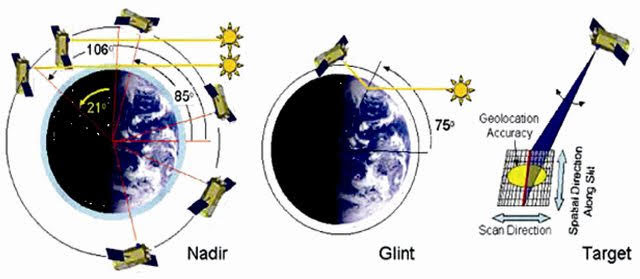
TL: Every time you stare from the top straight down at a water body, the light doesn't bounce back. It's not reflected, so we lose signal. We do have some signal coming back, but not enough. So, the uncertainty on these images is really high. The one way we can observe offshore, an indirect way, is when the light is at a wider angle and can actually bounce back. I always make the analogy of when you're at the beach, and you see these lights in your eyes when the waves are at a low angle. In space science, we call that the glint. At these very low angles, light rays bounce back off the water, and you get an image. But because the light rays are so bent, these pixels are much larger than usual, and the uncertainties are higher than on the land. When we're lucky, we see the methane plume coming out, but it remains difficult. We could only do that if we have what you call an active sensor. You have a laser. You shoot it down, and the beam comes back. That would work. But at this stage, we only have passive sensors, and we measure the sun. So, we lose our images on water bodies, lakes, or oceans.
JV: What do you think is the contribution of super-emitters in terms of overall methane emissions, versus all the smaller leaks that we're not seeing?
TL: It's a million-dollar question, really. At this stage, we have an idea. These super-emitters are rare. They are extreme events, and the chance that you capture them is really low. The only way you see them is if you measure every day, everywhere, nonstop. TROPOMI has amazing spatial and temporal coverage, so it can see these large emitters. Now, other satellites cover part of the globe, but not every day. It's not that the sensor is not able to see super-emitters; it's that your chances of seeing them go down by a factor of one hundred. But they see smaller leaks because they have a lower detection limit.
So, we can see the big emitters from TROPOMI, then the medium emitters, let's say, from the Sentinel-2 satellite. For smaller emissions, we have data from aircraft campaigns that went over Texas, California, and Wyoming. And now we'll get more data with MethaneAIR and MethaneSAT. And when you put these data together, they also follow a log-normal distribution. Now, keep in mind it's in log space, and error bars are huge. But countries tend to line up. Their behavior with high, medium, and low emitters seems to follow a similar distribution.
And there are reasons for this relationship. You can imagine, at the source of gas production, you start with a large pipeline. And this pipeline feeds into two, then four, then eight smaller ones. It's like a fractal almost. So, the number of small leaks you have will be similar to the number of large leaks you have, multiplied by the number of pipes.
Before we looked at the TROPOMI data, people thought these big leaks were accidental. No, it turns out they are not. Many of them are actually maintenance operations. When operators want to fix a compressor, they remove the gas from the facility before they do anything. So, they open the pipe, and this is what we observe as a super-emitter. They do the same thing for the big pipelines and small pipelines. And so, you can totally link the big and small sources. But there might be a point where this log-normal relationship breaks, and we don't know exactly when. Even the aircraft campaigns are limited. Many cannot detect anything lower than 100 kg/hour, something like that.
So any leaks under that are just unknown. How many? We have no idea. With super emitters we're maybe looking at 2% of the total, maybe at 10%, maybe 15%. I don't know. It's not 50% for sure. But it's somewhere between 1 and 20%, something like that. And I hope we can know one day, because we are looking at one far end of the distribution.
JV: But there seems to be a relationship between emissions of all sizes.
TL: Exactly. And I'd love to nail that relationship. And to see if it's true. If we collect data on enough leaks, then we could really constrain that probability distribution and say for sure if we can extrapolate. And so even if you don't see the small leaks, somehow you already see them -- at least some of them. And then you could follow a country's super-emitters year to year to see what the trend is -- assuming the trend is the same for the smaller ones.
But maybe you could imagine that if we extrapolate, then companies or countries would have incentives to reduce these super-emitters, but maybe they won't do anything about the others. That's the danger of relying only on systems that look at large emitters.
JV: Could you talk about the other technologies that can be used to detect these kinds of emissions, especially smaller ones?
TL: The most common one has been infrared cameras. The problem with an infrared camera is that you cannot see very far. Within a range of ten to twenty meters, you can see methane. But you don't know how much is coming out. Some people have also done car measurements. You can stick a little tube on top of your car and drive back and forth along the road near the site. Then, you'll have a plume signal, and you can measure the wind at the same time. So then you can try to quantify the size of the leak. People have put an instrument on a helicopter, and then they'll fly along a pipeline. More recently with drone technology, you can fly downwind of a leak and measure many transects [cross sections of the area to be measured]. And then you measure the wind at the same time, and get the total.
For diffuse sources, people have used flux towers. You set up a tower or a mast, maybe five to twenty meters tall, and you install your wind sensor, your methane sensor. And then you directly measure the flux [flow of gas per unit area]. We've done it for a farm, for example. For a landfill it also works. The advantage is you can stay as long as you like. You can get the seasonality, the night and day. It's more complicated to set up, and the instrumentation is not cheap. But that works really well. And then there are concentration towers. You can measure not the flux directly, but the concentration [of methane in the air]. That works well for cities, for big industrial areas. You can also put an instrument similar to TROPOMI on the ground, facing upward. [This will take an image of the whole atmospheric column, but from the ground looking upward instead of from space looking down.] We did this near a giant feedlot with one hundred thousand cows in Chino, near LA. We surrounded the feedlot with three ground sensors.
JV: We've talked about how the TROPOMI instrument can't look at certain places, particularly offshore, in the tropics, or in northern latitudes. If you could look at those places and see what they're emitting, where would you want to look?
TL: Yes, at this stage tropical areas. The wetlands, the landfills, the farming, the rice paddies, and also a lot of cattle. All of these places are potentially huge sources of methane. They're wet and hot, and fermentation is fast. But they're difficult to observe for a couple of reasons. First of all, the ground is quite dark usually, as there's a lot of vegetation. There are artifacts in the data that make plumes harder to catch, and satellites often fail. On top of this there's a rainy season, so for three to four months a year you have zero data, sometimes more because small clouds can be a problem, and we don't really have the capacity with the satellite.
Then there is the question of high latitudes -- Alaska, northern Canada, Siberia -- and a lot of gas and oil fields are in the north. There we have a double problem. Because we don't have much light, and it's very cloudy, the signal-to-noise ratio is really low. So then we really struggle. But I would rather go to the tropics now -- it's really where we are missing a lot.
JV: In your opinion, why is it important that we collect this kind of data about methane emissions?
TL: Methane as a whole is an easy problem. First of all, because methane has value. Emitting methane is wasting resources. To me, among all the greenhouse gasses that we emit, if there's one we want to save, it's the one we can use. Compared with CO2, it also has a very short lifetime and a big impact in terms of global warming. If we were to stop methane emissions today, just because of chemical destruction in the atmosphere methane would be gone ten years from now. So, reducing methane is very efficient. Considering that we are very tight in terms of deadlines until we reach a 2 or 2.5 degree warming target, acting on methane is smart. When we did the social cost calculations for the paper, we calculated that if we stop all the leaks -- including the cost of capturing emissions -- we could save billions of dollars. So there is no reason not to do it.
And it's easy to stop five hundred super-emitter spots. Stopping five hundred leaks a year could save you a lot of methane. We will not face something easier than that. CO2 is much more difficult. If you take CO2, just the state of Massachusetts has two thousand hotspots of CO2. If you consider that Turkmenistan is leaking methane every single day at thirty locations, and these thirty explain 80% of Turkmenistan's emissions, it's easy to fix. We know exactly where the leaks are, we know how to stop them, and we know how much it costs. To me, methane is the main target for all these reasons. It doesn't mean that if you solve the methane problem, you're done. Far from it. But that's the easy first goal.
JV: In terms of methane or other greenhouse gasses, are there other things we should focus on? Is there something else we haven't thought about here?
TL: On the methane problem, we have obsessed about the oil and gas industry -- and for good reason. Historically, it's been the big industry, it's already been a problem. But there are other sectors in methane that we haven't really touched. This is about food. It's about raising cows. It's about rice. Now it's not one company that's responsible, it's many small farmers around the world. Oil and gas is dominated by ten major companies. How are we going to stop small rice farmers from producing methane every day to feed large countries? The agricultural sector is larger than oil and gas in terms of anthropogenic emissions. So are we ready to tackle that? I'm not sure. How are we going to stop it? I'm not sure either. We need to feed people. The waste management issue -- that's also a big problem. It's a much harder problem.
All the new satellite missions have been about oil and gas -- basins, fracking, bituminous oil. But we haven't talked about farms, especially in tropical areas. Right now, we're also designing all our systems for large emitters. A small farm will never be visible. So, we have to think about which technology is going to be able to track millions of small sources, instead of a few big ones. Rice production is increasing every year, so there is going to be more and more methane. Demand is growing. And as the planet is heating up, you get more methane the warmer it is. And you won't be able to recover the gas because the concentrations are too low. You cannot flare for example, as in the oil and gas industry. So, what do we do with that very low-concentration gas that comes out? These are going to be long-term issues we have to face.
And the fix is not simple. It's not going to be about fixing a pipeline, it's going be about agricultural practices, waste management -- complicated issues that no one wants to deal with because they cost a lot. So that, to me, would be the next step now. It's to look into the other sectors producing methane, and not just oil and gas. What does it take to manage and reduce these methane emissions? That's where I'd start.
Joule Voelz
Thanks to Ju Chulakadabba