
Waste Pickers Help Reduce Methane Emissions: The Case of Landfills in Delhi, India
Dumpsites and landfills around the world are a major source of methane emissions, particularly in lower income countries Recent evidence suggests that methane emissions are higher in the US than earlier estimates suggest - and increasing (Ramirez 2024). where biodegradable waste, especially but not exclusively food waste, comprises a relatively large share of waste and is often not segregated from non-degradable solid waste. The situation would be worse if it were not for the waste pickers and waste dealers in the informal recycling sector who collect, sort, segregate, process and sell recyclable waste materials -- paper, cardboard, plastic, glass, metal and more – for use by industry as raw materials or packing materials; as well as reusable waste – clothing, cutlery, crockery, glassware, electronic goods, car parts and more – for sale to secondhand dealers or at flea markets ( WIEGO 2012 and 2011). If not reclaimed and recycled by the waste pickers, many of these materials -- including paper, cardboard, clothing and some plastics -- would generate methane over long periods of time as they decompose and decay in dumpsites and landfills (Ibid.).
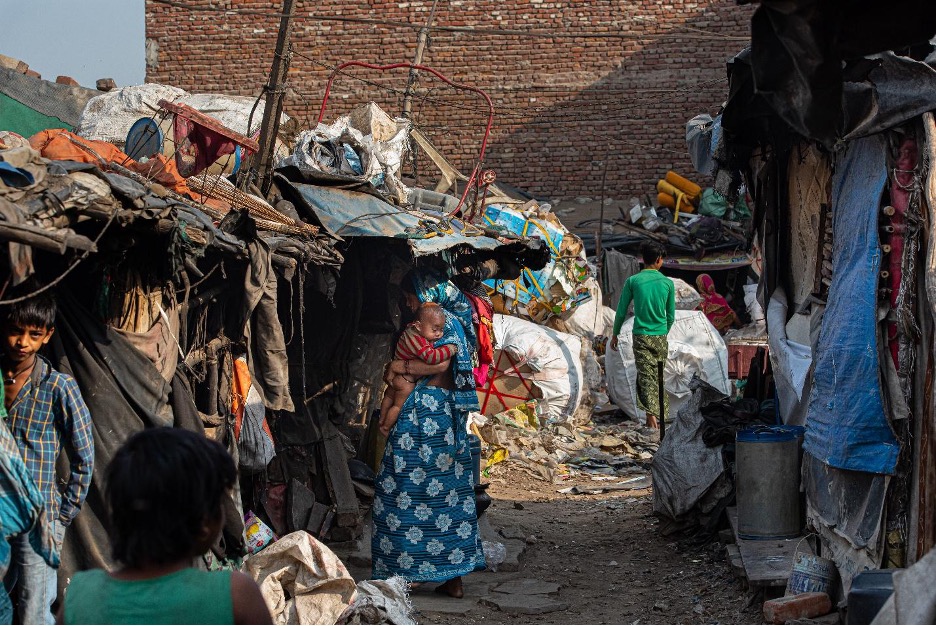
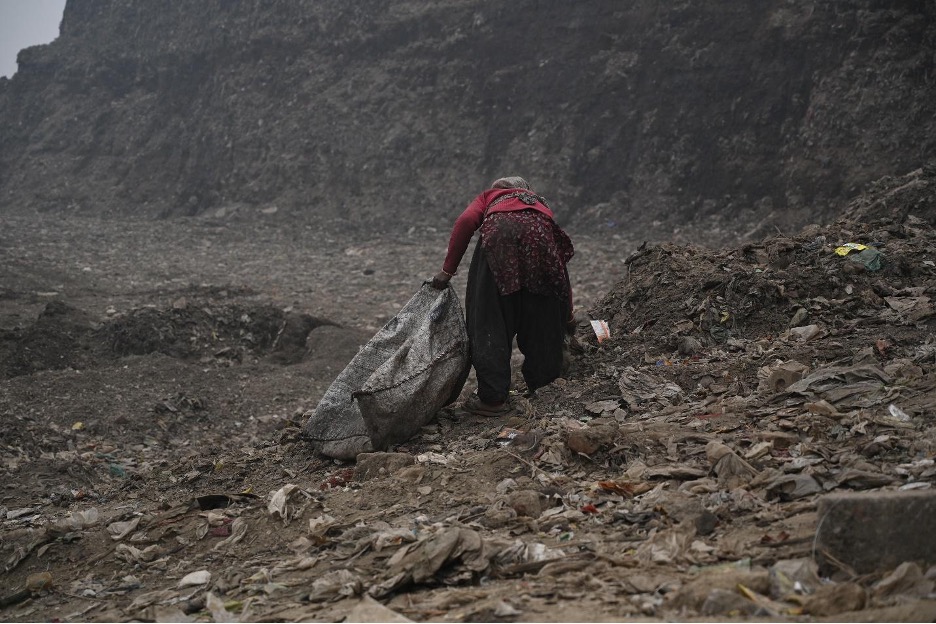
The Women in Informal Employment: Globalizing and Organizing (WIEGO) network supports waste picker organizations around the world and has helped build an International Alliance of Waste Pickers. WIEGO collaborated with Green Partners, an environmental consulting group, to develop a methodology and calculator tool tested by member organizations of the Alliance for estimating how much greenhouse gas emissions are averted by waste pickers. The Greenhouse Gases Emission Calculator measures the greenhouse gas emissions prevented by waste pickers by reclaiming waste that would otherwise decay or be burned; by substituting recycled materials for virgin raw materials and packing materials; and by using energy-saving manual collection and sorting methods as well as energy-saving transportation. The tool calculated that each year in Pune city, India, the nearly 4,000 members of the local SWaCH waste picker cooperative avert the emission of 167,301 tons of equivalent CO2 (eCO2) "Equivalent CO2" (eCO2 is a unit of weighted greenhouse emissions that allows emissions of greenhouse gases of different strengths to be added together. by collecting waste which would otherwise be open burned in underserved communities; and another 1,424 tons of eCO2 by operating manual pushcarts rather than conventional waste collection trucks.
However, while helping to reduce emissions of methane and other greenhouse gases, the waste pickers are exposed to the health and safety hazards of these emissions at the sites where they work, particularly those who work at dumpsites or landfills (Chintan 2016). Methane contributes to air pollution and particularly to high ozone levels. It is also combustible, causing frequent, sometimes deadly, fires at dumpsites and landfills especially during heat waves. Moreover waste pickers, if they work at dumpsites and landfills, are often harassed and exploited by government officials, private contractors or dealers, or the groups who control the sites. If they collect and sort waste on streets or other open spaces, they are often stigmatized and harassed by the police and the general public. The recent outsourcing of waste management services to private firms across India has, in many cities, eroded the livelihoods of waste pickers, reducing or eliminating their access to waste. As one waste picker put it: "Waste is to a waste picker what land is to a farmer."
Waste pickers should be recognized as environmental agents who help reduce emissions and be better integrated into municipal solid waste management systems, with far better outcomes for the environment, urban economies and urban livelihoods. For instance, they could be engaged in efforts to "mine" methane emissions at dumpsites and landfills as a source of energy.
This micro-history examines these interrelated issues through the lens of waste pickers who work at large landfills on the outskirts of Delhi, the capital city of India.
Landfills in Delhi
Estimates suggest that Delhi produces over 11,000 tons of waste per day. Since 1975, the city's waste has overflowed and exhausted the carrying capacity of 16 landfills, leading to their closure and capping. Recently, nearly 40 per cent of Delhi's waste has been deposited at three large over-filled landfills which function more like unregulated open dumping sites: Bhalaswa, Ghazipur and Okla. For the disposal of municipal solid waste, there are open unregulated dump sites, landfills regulated or managed by government and "sanitary" landfills (with proper linings and covers) managed by government or private companies. Sanitary landfills tend to have separate areas for disposing organic, solid, industrial and hazardous waste. The three major landfills in Delhi are managed by local government but do not adequately (if at all) segregate waste, are over-filled and not sanitary. Methane emissions from the Ghazipur and Okla landfills are a possible source of emissions captured by TROPOMI at (28.62, 77.40) in East Delhi and at (28.50, 77.36) and (28.48, 77.37) in southeast Delhi, respectively. The current Municipal Corporation of Delhi (MCD) has promised to close these landfills, having identified sites for new landfills and designed a scientific sanitary landfill for the capital. But progress is very slow. The deadlines for closing the existing sites have been extended to 2024 for Okla, 2025 for Bhalaswa, and 2026 for Ghazipur.
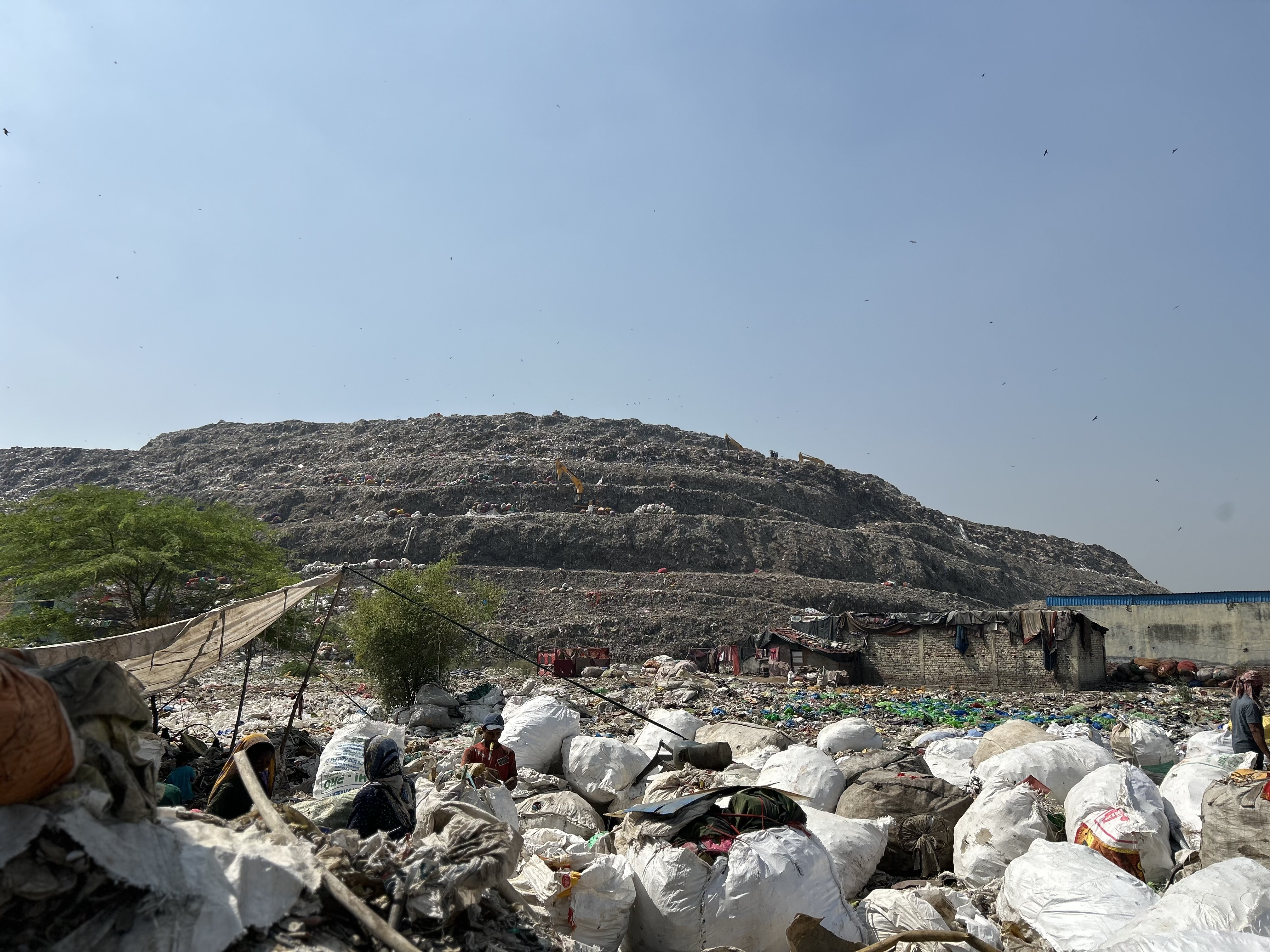
Huge volumes of Delhi's municipal largely non-segregated solid waste have been deposited at these sites for 30 years or more: the Ghazipur site was opened in 1986, Bhalaswa in 1994. and Okla in 1996. Each of the sites has become a mountain of countless layers of decomposing and decaying waste, with treacherous narrow roads carved around the mountain side for the garbage trucks and bulldozers to drive up. When fresh waste is first deposited, hundreds of waste pickers, many of whom live at the base of the mountain, scramble up the mountain side to forage through the fresh waste to reclaim what they can before the bulldozers come to compact and flatten the most recent deposit. The waste pickers sort and segregate the waste they have collected at the landfills, at their homes, or in open spaces. They have to carry or otherwise transport gunny sacks filled with reclaimed waste to the sorting sites and to the waste dealers who buy what they have reclaimed.
Waste Pickers at the Landfills
Across Delhi, pre-COVID, an estimated 150,000 waste pickers were engaged in the informal recycling sector, collecting, sorting, and selling recyclable and reusable waste. The same estimates suggest that waste pickers collected 15 to 20 percent of Delhi's total waste (measured in weight) and recycled about 2,000 tons of the city's waste every day, thus helping to clean the city. On average, each waste picker reclaimed over 60 kilograms of recyclable waste per day and earned 8-10,000 rupees a month. In doing so, the informal waste workforce saved the city over 10 million rupees ($120,000) per day that it would otherwise have to spend on waste collection and disposal, and reduced 3.6 times more greenhouse gas emissions in Delhi alone than all of the waste projects across India that receive tradeable carbon credits for reducing emissions.
The waste pickers make these significant environmental contributions and earn a meagre living against great odds. Consider the case of the waste pickers at the Bhalaswa landfill, the second largest in Delhi after Ghazipur.
Waste Pickers at Bhalaswa Landfill
The Bhalaswa landfill covers about 78 acres in North Central Delhi, close to the border with Haryana state. In 2019, the mountain of old "legacy" waste at the Bhalaswa landfillwas estimated to weigh 8 million tons and to reach a height of 65 meters (213 feet).
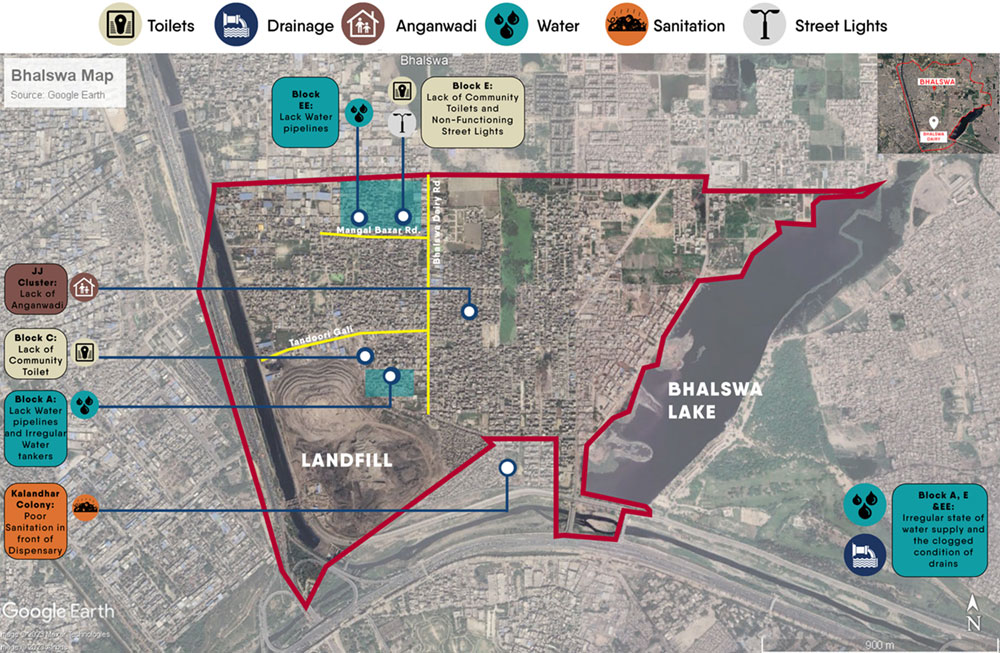
According to Safai Sena and SEWA Delhi, which both work with waste pickers at the Bhalaswa landfill, some 5 to 6 thousand waste pickers, mainly Muslim migrants from Assam and West Bengal states of India, make a living picking, sorting, and recycling waste from local communities around the Bhalaswa landfill. Another 1,800 make their living at the landfill itself (SEWA Delhi 2024). By doing so, they not only earn a living, however meagre, but also prevent a significant amount of waste from remaining permanently in the landfill, thereby reducing emissions and increasing the volume of waste reclaimed for industrial and other uses. But in their work, they are exposed to significant health and safety risks, including exposure to air pollution, hazardous materials, fires, and cave-ins. Also, because many of the waste pickers live in an unauthorized colony at the base of the Bhalaswa landfill, they lack access to basic infrastructure services (water, toilets, and sanitation), as well as basic social services (schools and health clinics) (Ibid.).
Most fundamental to their livelihoods, the waste pickers at the landfill face significant challenges in collecting, sorting, and selling waste. The main gate of the Bhalaswa landfill is the entry point for the Delhi Municipal Corporation (DMC) garbage trucks. This gate is guarded by municipal corporation staff who do not let the waste pickers into the site, claiming that the waste deposited there has already been sorted at material reclamation centers in the city. One possible explanation for the DMC's deeming of waste picking at the landfills to be illegal is that the Corporation does not want to bear responsibility for the frequent accidents that befall waste pickers on the landfill. As a result of the ban, the waste pickers have to enter the landfill illegally at the back and scramble up the mountain. In 2023-24, a local scrap dealer began to control the waste pickers' access to the landfill and to force waste pickers to sell their reclaimed waste to him at low prices by hiring a gang of 40-50 "goons" or thugs to intimidate and harass the waste pickers. The "goons," many of whom are drug or alcohol addicts, sometimes resort to physical or sexual violence (SEWA Delhi 2024; Bal Mukund, personal communication).
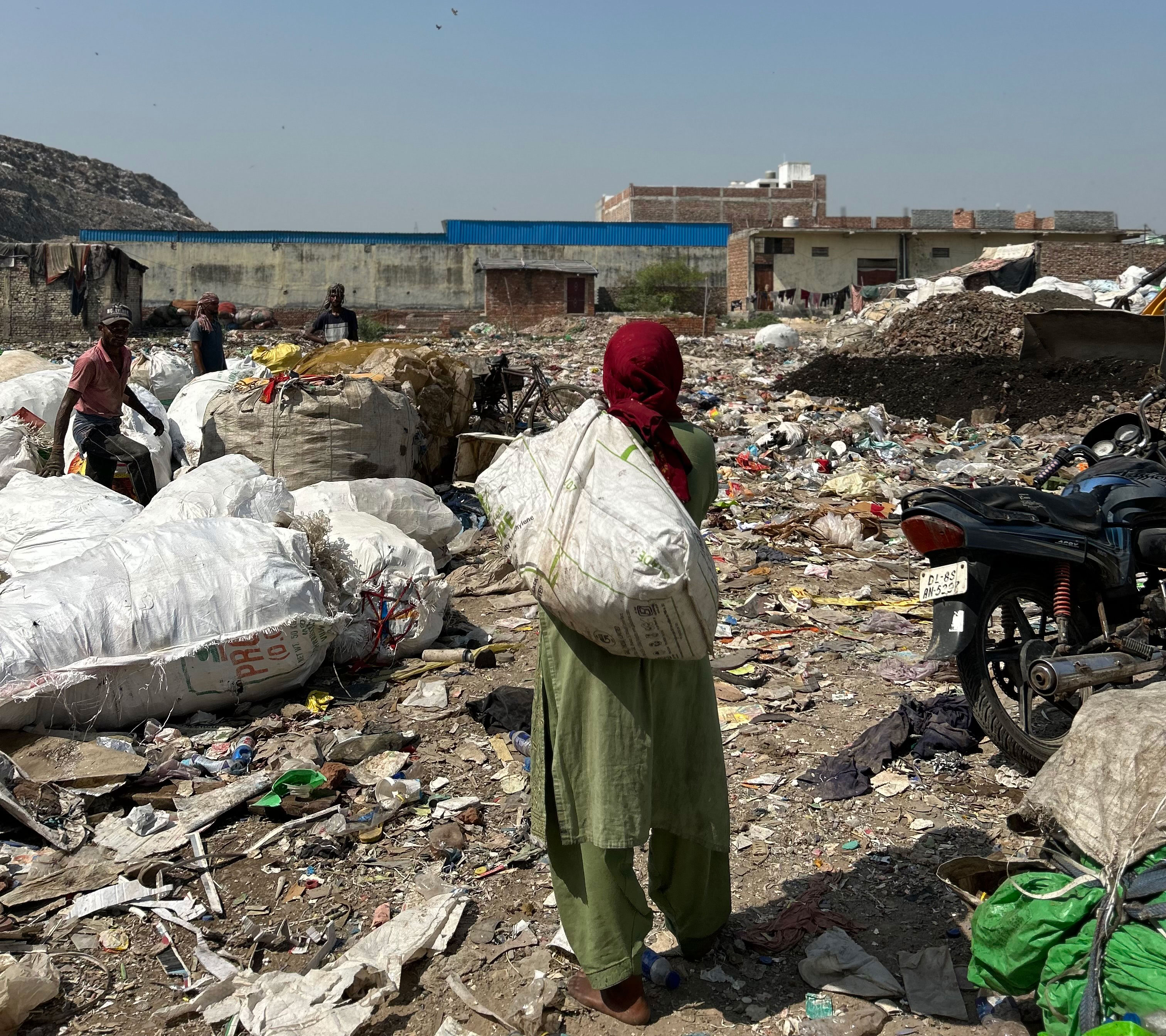
Shalini Sinha of the WIEGO network described the major challenge of "illegality" faced by waste pickers at Delhi landfills as follows: "They are not allowed legally to access waste and bring it down from the dumpsite for sorting, and because they operate under the radar of the law, they are more prone to exploitation and harassment by the municipal officers, private companies, and local mafia, often in collusion with one another. If they sort at the dumpsite itself, which they often do, they have to sell to waste recyclers present there. These recyclers are often affiliated with the local goons (thugs) at the site, and the waste pickers must sell to the recyclers at a pre-determined price that is often lower than the market rates" (Sinha 2024, personal communication). Sinha also noted that the increasing privatization of solid waste management in Delhi reduces waste pickers' access to waste along the whole chain of waste collection, disposal, and recycling, as well as to decentralized sites for segregating waste (called dhalaon). Bal Mukund of Safai Sena added that the Delhi Municipal Corporation has contracted the demolition and cleaning of the existing landfills to private companies who hire outside labor -- rather than the waste pickers -- to sort the old waste for what can be reclaimed before the remaining waste is ground up and otherwise disposed of.
These current challenges notwithstanding, the future for waste pickers at the existing landfills looks even more bleak. They will lose their current source of livelihood when the landfills are closed. For instance, there are no more waste pickers at the Okla landfill. Many left when a waste-to-energy plant was set up in 2019, and the rest were evicted in advance of the closure of the Okla site initially planned for 2023 but postponed to 2024 (Bal Mukund, personal communication). The closure of the Bhalaswa landfill is now planned for 2025; it is not clear what the fate of the waste pickers on that landfill or the surrounding area will be.
Way Forward: A Better Deal for Waste Pickers
 Going forward, a better deal for waste pickers could be a triple win: more waste is recycled and reused, emissions of greenhouse gases and toxic gases are reduced, and waste pickers' livelihoods become more secure and remunerative. What is needed are more decentralized waste management systems which focus on segregating, recycling and composting as much waste as possible before the remaining waste is deposited at dumpsites/landfills or burned in incinerators and waste to energy plants. Waste pickers who are experts at sorting, segregating and reclaiming recyclable waste should play a central role in such decentralized management systems.
Building on the demands of organizations of waste pickers, the following specific measures have been proposed for a better deal for waste pickers along the entire waste collection, segregation, recycling and disposal chain: allow waste pickers greater legal access to waste from different sources; allow waste picker organizations to provide doorstep waste collection services and charge user fees for this service and to bid for municipal solid waste management contracts; provide space (open areas and warehouses) for waste pickers and waste dealers to sort/segregate, store, process and sell recyclable waste; integrate waste pickers displaced by the closure of dumpsite/landfills into other roles in the waste management and recycling system; and integrate waste pickers into municipal solid waste management plans, and integrate routes for waste collection and spaces for sorting, processing, storing and selling recyclable waste into city and town master plans.
In sum, as recommended in the WIEGO position paper on dump closures: "Any change to the way solid waste is managed— whether upgrading from dumps to controlled landfills, introducing recycling schemes, or 'modernizing' a system—must begin with a comprehensive plan that considers the needs of the informal workers who are already engaged in gathering, sorting, and recycling waste. Any suppressed activity should be replaced with another of at least equal value to waste pickers. And waste pickers must be involved as equal partners in all phases of planning and implementation."
Fortunately, a series of policies and rules enacted in India starting in 2006 recognize the contributions of - and mandate support to – waste pickers, including: the 2006 National Environmental Policy, the 2008 National Action Plan for Climate Change, and the 2016 Solid Waste Management Rules. A first major step towards a better deal for waste pickers would be to implement these policies. The national Alliance of Indian Waste Pickers and its affiliated organizations and allies, which together advocated for these policies and rules, stand ready to work with local, state, and central governments to ensure that the policies and rules are implemented.
The author is grateful to Shalini Sinha of WIEGO, Anshu Jha of SEWA Delhi and Bal Mukund of Safai Sena promoted by Chintan for sharing information on waste pickers at Bhalaswa and other landfills in Delhi and for reviewing early drafts of this article. The author is also grateful to Lucia Fernandez, Sonia Dias and Taylor Cass Talbot of WIEGO for their helpful inputs and edits to early drafts of this article. More importantly, the author grateful to all of them, for their dedicated work in support of waste pickers and their organizations in Delhi and elsewhere around the world.
| « Introduction | Fire at the Ghazipur Landfill » |