
San Juan County: The Implications of 100 Years of Oil and Gas
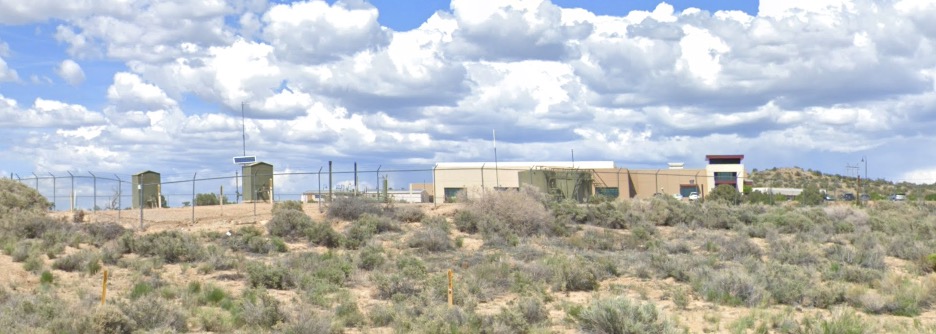
As in many oil and gas boom towns, the discovery of oil in the San Juan Basin was accidental. In 1911, pioneer Henry F. Brock struck oil while drilling for water, discovering something that would change the fate of small towns in northwest New Mexico and eventually the entire state. In 1922, the Aztec Oil Syndicate successfully drilled the first commercial gas well in the basin, which blew out so strongly that it "could be heard in Bloomfield and 10 miles down the river in Farmington." By the late 1940s, the El Paso Natural Gas Pipeline was completed, transporting gas to California and transforming the tranquil desert into a hotspot for energy production. Since Brock's discovery, the industry has shaped the lives of those who lived there — and the future generations who will follow in their footsteps.
In the past decade, the San Juan Basin has ranked third on a list of top sites for methane pollution from the oil and gas industry. In 2014, scientists from the University of Michigan and NASA examining satellite data discovered a "permanent… methane cloud" the size of Delaware, making it the largest "hot spot" in the country at that time. This plume was estimated to represent $100 million in valuable natural gas lost in one year due to gas flaring and leaking on federal and tribal lands. Statewide, gas flaring represents a waste of $180 million, with a loss of $26 million in annual tax revenue. Since 2016, the non-profit Carbon Mapper has observed methane plumes via aircraft and satellites, recording 262 plumes in the San Juan Basin, 95% of which are attributed to the oil and gas sector. More recently, on October 31, 2019, the TROPOMI instrument captured a methane superemitter in the basin at (36.82, -108.09), also likely the result of oil and gas extraction.
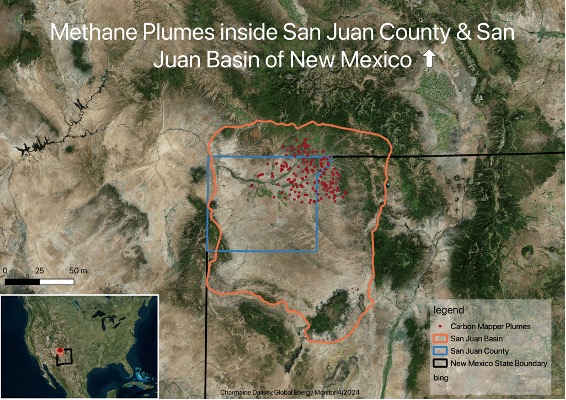 In 2021, the New Mexico Energy, Minerals and Resources Department (EMNRD) instituted a rule to ban methane flaring and venting, with an additional goal of having a 98% capture rate per company by 2026. As of 2022, 62% of companies have sent in reports that met and even exceeded those standards, but it is unclear how that was done. A local investigative journalism non-profit, Searchlight New Mexico, surveyed leaks at sites that reported to have captured all methane emissions, calling attention to the effectiveness of self-reporting. Even when being faced with flaring and methane leak fines, oil and gas companies at times do not face enough incentives to meaningfully clean up their emissions profile. If a gas company is found to be in violation of emissions standards, paying off the fines can be cheaper than fixing the issues.
The Proximity of Extraction
On the ground, other pollutants continue to have negative effects among residents in the San Juan Basin. The basin is home to three small towns -- Farmington, Bloomfield, and Aztec -- that have long relied on the oil and gas industry for economic prosperity. Even today, the sector employs more than any other except healthcare and retail, according to regionalcensus data. As of October 2023, these towns are dotted by 18,970 active oil wells and three active coal-fired power plants. Residents of these towns not only work in the oil and gas industry; they live amongst the wells themselves.
With an average of eighty-five oil wells within a 2.5 mile radius of public schools in the basin, fossil fuels and education have become linked in a very concrete way. Research has shown that living within about 2.5 miles of even a single oil or gas well can notably increase one's exposure to toxic air pollutants such as VOCs and air toxics. In the basin, over 24,000 children live within half a mile of an oil well. There are 119 oil wells within a 2.5 mile radius of 23 public schools in Farmington, 96 oil wells surrounding 6 public schools in Aztec, and 39 oil wells near 6 public schools in Bloomfield. Compared to adults, children are more vulnerable to environmental contaminants. In San Juan County, 10% of children ages 12-17 have asthma, a rate that is higher than the
national average of 8.7%.
In response to growing concerns over exposure, the Commissioner of Public Lands Stephanie Garcia Richard issued an executive order in 2023 banning oil and gas operations on state land within a mile of public schools. Representative Debra Sariñana, a former teacher, filed three bills in 2024 that would amend the state's 1935 Oil and Gas Act. One bill, HB32, would implement "Children's Health Protection Zones" and enforce a one mile setback between oil wells and schools. The eventual hope is to ban operations within these zones by 2028. However, the New Mexico Oil and Gas Association (NMGOA) is fighting against the implementation of buffer zones and the Clean Futures Act, both of which would decrease the proximity of oil wells to schools and reduce pollution.
In the San Juan Basin, pollution concerns go beyond school zones and even beyond oil and gas. The coal-fired Four Corners Steam Plant, New Mexico's largest source of air pollution, has been embroiled in clean air legal battles for years. In the American Lung Association's 2021 State of the Air Report, San Juan County was one of four counties to receive an "F" for air quality due to high ozone levels, a secondary pollutant that harms humans and ecosystems at the ground level. Dr. Lauri Costello, a family physician interested in the influence of fossil fuel extraction on public health, has documented the rise of cancer and autoimmune diseases in people who are exposed to higher levels of ozone. In a letter to the EPA, she states that "benzene that is concomitantly released [from methane leaks] likely plays a role in increased childhood cancer rates in drilling dense areas in rural Colorado." She highlights that children and the elderly are the most vulnerable, especially those of Native American descent. Citizens of the Navajo Nation, who are indigenous to the area, are two times more likely to live within a half mile of oil and gas infrastructure. As a result of historical and contemporary policies, many indigenous populations face a lack of healthcare access and clean water, meaning their susceptibility to negative implications of the industry is far greater than other populations.
In the "Unearthed" docuseries, activists with Climate Advocates Voces Unidas (CAVU) interviewed residents of Farmington about public health issues related to local drilling. Resident Sug McNall reported that she became "wobbly" one day when she went outside to get her mail, stating that the smell in the air was "unbearable." The smell in the air was hydrogen sulfide (H2S), a neurotoxin that smells like rotten eggs. Workers on oil and gas well pads wear a meter that sounds an alarm when the concentration of H2S is too high, signaling them to leave immediately. "If it's safe, how come these workers wear these meters?" says Daniel Tso, a former Navajo Nation Delegate. "Navajo residents endure this, and we don't have anybody to come and say, 'Hey here's meters and they'll tell you when to evacuate.'" Tso's comments highlight how Native Americans, the region's first inhabitants, are left behind in the conversation. 41% of the child population in San Juan County are Native American, and 49% of children in the Navajo tribal area live in poverty.
The Funding Facade
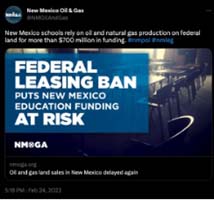
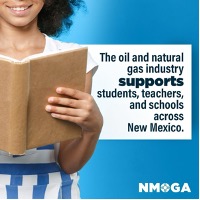
Despite the unwelcome effects of residential drilling, the oil and gas industry remains entrenched in state politics, funding the very schools they drill next to. The industry has historically contributed to the state's revenue, accounting for about 25-30% of the New Mexico General Fund's annual income. This fiscal year, it is predicted that the state will bring in $3 billion in oil and gas production, with about 48% of this revenue going towards public education. In light of the Biden Administration's 2021 pause on oil and gas leasing on federal lands, the New Mexico Oil and Gas Association (NMGOA) launched their campaign "Stronger & Safer." The campaign's slogans proclaimed that "the oil and natural gas industry supports students, teachers, and schools across New Mexico,'' and that "oil and natural gas production is a significant source of revenue for K-12 education in the state of New Mexico." While NMGOA boasts about education funding, New Mexico has ranked last in the nation in educational outcomes for the past eight years as reported by the child-focused non-profit Anne E. Casey Foundation.
Outside of classrooms, even the fortunes of most residents are tied to the boom and bust cycle inherent to the extractive industries. In the early 2000s, a drilling boom prompted the establishment of yet another coal-fired power plant in San Juan County, allowing for an increase in the salaries of Farmington School District teachers. But during the 2008 recession, the market crashed, 75% of oil wells became idle, and five thousand jobs were lost. Just a few years later, environmental lawsuits forced the San Juan plants to idle and install pollution-control equipment. In 2017, it was officially announced that both the San Juan Generating Station and San Juan Coal Mine would close in 2022, resulting in 450 jobs lost. Within the past five years, big oil companies divested from the San Juan Basin and shifted towards the Permian Basin in the southeast of the state, enabling private equity firms to purchase and take control of wells and mines. And of course, like many other sectors, oil production slowed during the peak of the COVID-19 pandemic, with San Juan seeing the temporary closure of 672 gas wells, 46 oil wells, and the approval of only 28 well drilling permits.
San Juan County has been experiencing a decline in population since 2018. And with these residents went teachers, caretakers, and local economic stability. In 2021, a group of teachers who remained in San Juan County signed a letter claiming that the boom and bust cycle of the industry is harming the state of public education. "For education to succeed," they wrote, "we need our elected leaders to diversify our revenue sources so that teacher salaries and classroom resources are not taken for a ride every time there is a boom and eventual bust cycle in the oil and gas industry." Since the 2008 bust, oil and gas prices and revenues of the state's General Fund (the largest source of funding for most public schools) have fluctuated in tandem. Meanwhile, aging infrastructure and a migration to other basins such as the Permian, where drilling is cheaper, has made the once desirable San Juan Basin unprofitable to investors. During the San Juan Basin Energy Conference in 2021, speakers noted that the past decade saw "the worst downturn in the San Juan Basin's history." The negative impacts of busts have forced local leaders to think about diversifying the local economy and to realize what is at stake if they continue to rely on the industry.
The relationship of San Juan County with the oil and gas industry is a story of what it means to be at the mercy of fossil fuels. One hundred years of oil and gas production has turned the state known as "the land of enchantment" into the land of fossil fuels, as plumes continue to hover over the San Juan Basin. The extraction of oil and gas is a paradox: it constructs a reality in which it supports children's education through donations, while simultaneously threatening their health. Although New Mexico has recently tried to make progress on reducing methane emissions and limiting the proximity of fossil fuel infrastructure to schools, the industry's economic and political influence is still deeply entrenched in its communities.