
Penzenreuth-Ponds
Joshua Steib
Nestled within the tranquil nature reserve "Eschenbach Weihergebiet" lie the Eschenbach ponds, their origins dating back to the 15th century when monks from a nearby Premonstratensian (or White Canon) monastery created these water reserves. Recognized for its ecological importance, this area was among the first in Bavaria to be designated as a nature reserve. Stretching across approximately 1.03 km2, this natural sanctuary includes a variety of ponds in all different sizes as well as woodlands. It is a thriving ecosystem that holds national significance for biodiversity, aquatic and amphibian communities and serves as a crucial resting and feeding place for migrating birds. (Regierung der Oberpfalz, n.d.).
Could the methane leak be caused by this very ecosystem, or more specifically the many ponds of the nature reserve?
While small ponds make up only 8.6% of the global area covered by lakes and ponds, they contribute significantly to the environmental impact of global wetlands, accounting for 40.6% of diffusive methane emissions (Holgerson & Raymund, 2016). The term diffusive methane emissions refers to the release of methane from sources where the gas diffuses directly from the ground or water into the atmosphere without being captured or controlled through a specific emission point.
Shallow waters, high sediment, and edge-to-water volume ratios, along with frequent mixing, contribute to high methane emissions from these small ponds, limiting efficient methane oxidation. Methane oxidation is a natural process of neutralizing methane (CH4) by converting the potent greenhouse gas into carbon dioxide (CO2) and water (H2O) through biological or chemical reactions.
Given that the nature reserve is financially supported by the European Union, a comprehensive examination of the small ponds was conducted in June 2016. At that time, they observed that the water ponds suffered from acidification and eutrophication (Amtsblatt der Europäischen Union, 2016). Eutrophication is a process in which nutrients accumulate in a body of water, resulting in increased growth of microorganisms, algae, and plants. Despite thorough research, no mention of measures taken against these effects could be found. The established link between these phenomena and increased methane emissions is well-documented (Sepulveda-Jauregui et al., 2018; Beaulieu et al., 2019; Nijman et al., 2021).
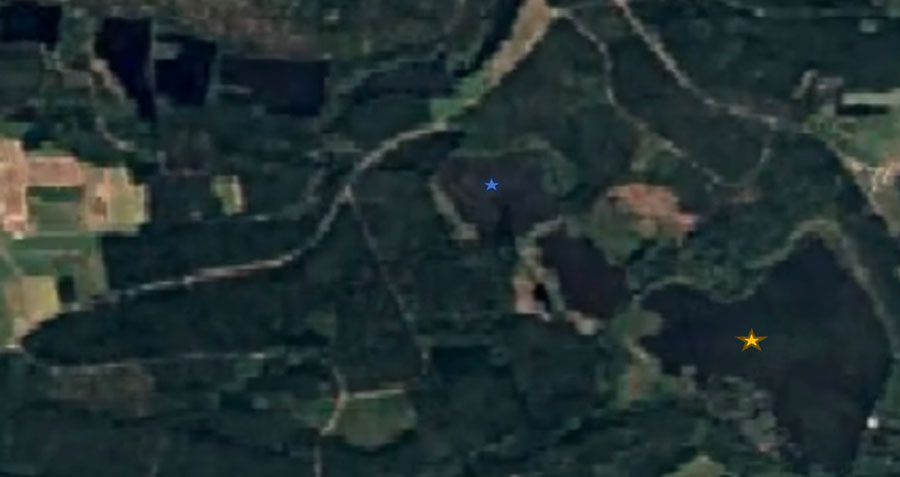
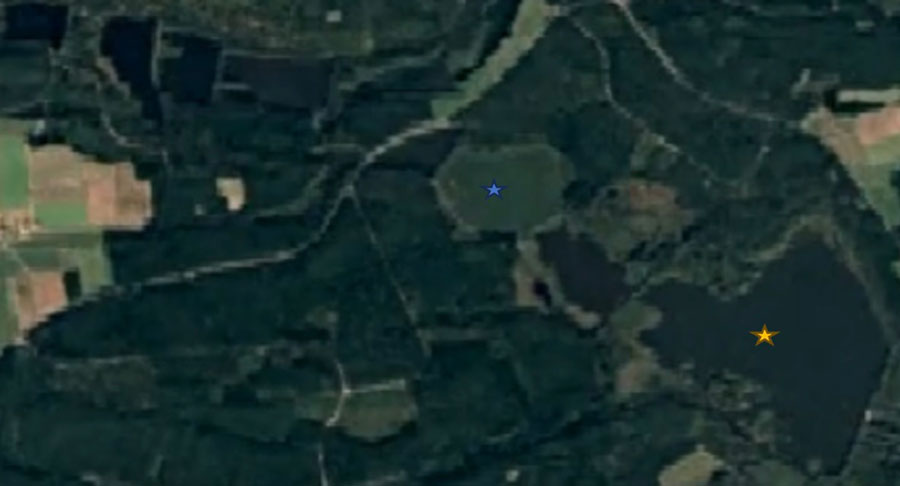
Satellite images from the region also indicate eutrophication of the natural ponds. In the following pictures, a visible difference in the color of the "Häuselweiher" (★) can be observed, changing from a darker color to green. Additionally, surrounding ponds like the "Großer Rußweiher" (⭐) also exhibit a greener shade, although the difference is not as noticeable as with the "Häuselweiher." The methane leak was measured in 2019.
The most probable cause of acidification and eutrophication is the overuse of artificial fertilizers. The excessive use of nitrate and phosphate fertilizers in agriculture leads to water enrichment through runoff from farms. (Knight, 2021; Zhang et al., 2022; Yang, 2022). Most of the space around the nature reserve is occupied by agricultural fields. Additionally, this area has been marked as nitrate-polluted by the Bavarian government (Bayerisches Landesamt für Umwelt, 2022).
However, it remains unlikely that these small ponds can emit the amount of methane emissions measured in 2019: 39 tons per hour. Although methane emissions in smaller aquatic reservoirs are highly variable, measurements indicate that diffusive methane emissions from wetlands usually fall within the 5 to 35 milligrams per hour range – far short of what would be required to amount to 39 tons per hour.
In conclusion, while the hypothesis linking the methane leak to the Penzenreuth ponds within the Eschenbach Weihergebiet nature reserve appears improbable given the measured emission levels, the methane measurement and subsequent research can shed light on a pressing issue in Eschenbach: eutrophication affecting the Eschenbach ponds in the nature reserve.
Sources
Amtsblatt der Europäischen Union. (2016). Standard-Datenbogen für besondere Schutzgebiete (BSG). Retrieved February 11th from
Bayerisches Landesamt für Umwelt. (2022). Gebietskulisse der mit Nitrat belasteten Gebiete in Bayern 2022 (nach AVDüV). Retrieved February 10th from
Beaulieu, J. J., DelSontro, T., & Downing, J. A. (2019). Eutrophication will increase methane emissions from lakes and impoundments during the 21st century. Nature communications, 10(1), 1375.
Google Earth Timelapse. (n.d.). Eschenbacher Weihergebiet 2017-2019. Retrieved February 12th from https://earthengine.google.com/timelapse/
Knight, C. A. (2021). Causes and Consequences of Eutrophication, which are leading to Water Pollution. J. Prev. Med, 6(10), 118-119.
Nijman, T. P., Davidson, T. A., Weideveld, S. T., Audet, J., Esposito, C., Levi, E. E., ... & Veraart, A. J. (2021). Warming and eutrophication interactively drive changes in the methane-oxidizing community of shallow lakes. ISME Communications, 1(1), 32.
Regierung der Oberpfalz. (n.d.). Eschenbacher Weihergebite. Retrieved February 12th from
Sepulveda-Jauregui, A., Hoyos-Santillan, J., Martinez-Cruz, K., Anthony, K. M. W., Casper, P., Belmonte-Izquierdo, Y., & Thalasso, F. (2018). Eutrophication exacerbates the impact of climate warming on lake methane emission. Science of the Total Environment, 636, 411-419.
Zhang, Y., Yang, K., Fang, Y., Ding, J., & Zhang, H. (2022). Removal of phosphate from wastewater with a recyclable La-based particulate adsorbent in a small-scale reactor. Water, 14(15), 2326.
| « Deep Drilling | Conclusion » |