
Contamination Today
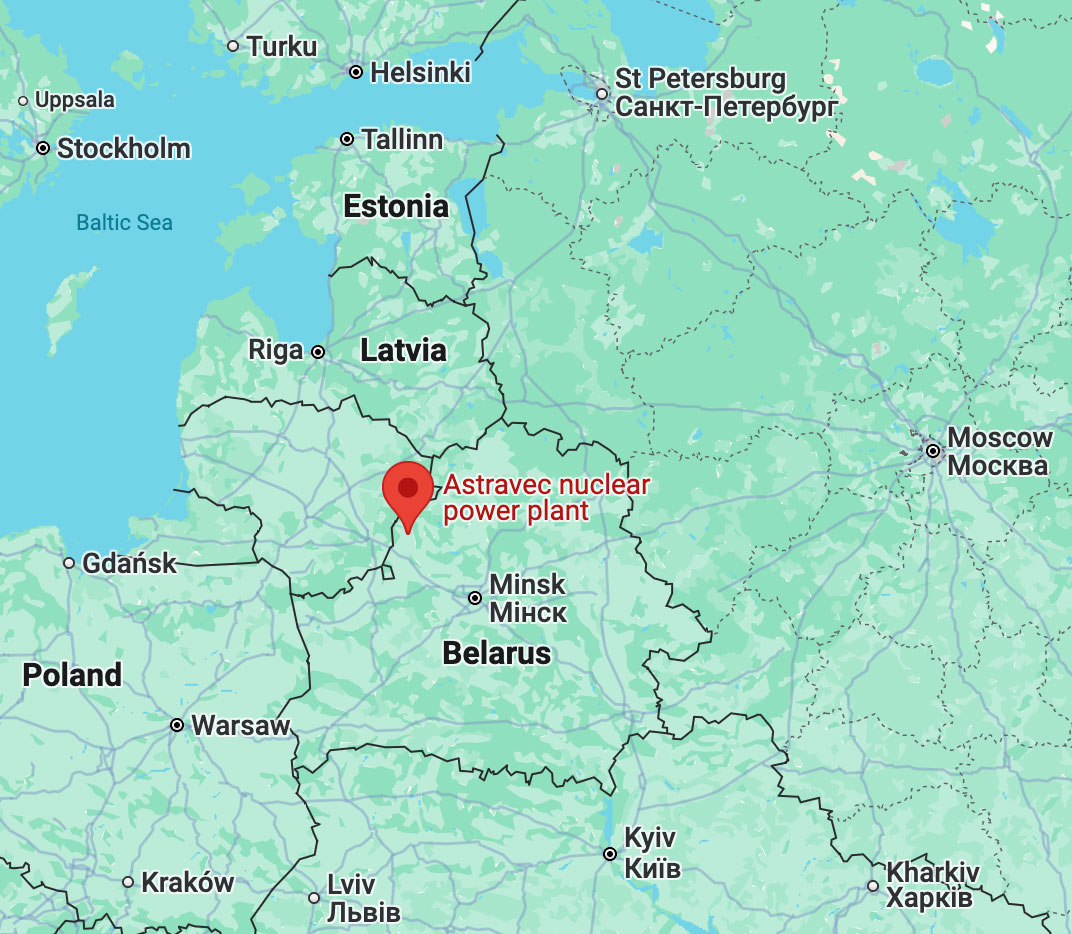
Fast forward 15 years in time. In 2021, the Astravets Nuclear Power Plant began its commercial operation. The plant is located near the Belarusian-Lithuanian border, about 40 kilometers east of the Lithuanian capital, Vilnius. Planning for the plant began in the 1980s, but it was temporarily halted after the Chernobyl accident in 1986. Critics argue that the short- and long-term consequences of radioactive contamination should have been a warning to the post-Soviet, independent government of Belarus, but they were not. Aleksandr Lukashenko, Belarus' authoritarian ruler since 1994, has little interest in a critical reckoning with the legacy of Chernobyl. The government has cracked down on opposition to the Astravets Nuclear Power Plant, trying to silence those who point to technical problems and raise concerns about the plant's safety. Official news media such as BELTA continue to publish articles about Lukashenko's visits to areas affected by radioactive fallout from the Chernobyl accident. They present an upbeat story of recovery and growth, showing pictures of schoolchildren, dairy farms, and construction in what are still contaminated areas. During a visit to the Polesian State Radiological-Ecological Reserve in 2021, Lukashenko tasted local products and stressed the need to further develop agriculture, forestry, and tourism in the districts of Bragin, Khoiniki, and Naroŭliia. The lands of the reserve, Lukashenko said, "must be recovered." The abandoned village of Teshkov in the reserve is now home to an apiary. According to the Belarusian president's office, Quoted from: "Visit to Polesie State Radiation and Ecology Reserve." President of the Republic of Belarus, April 24, 2021, https://president.gov.by/en/events/poseshchenie-polesskogo-radiacionno-ekologicheskogo-zapovednika, last accessed June 19, 2024. "the apiary produces high-quality honey even on the contaminated land. The head of state believes that this area can be further developed, as there is still a huge untapped potential."
The Polesian State Radiological-Ecological Reserve was established to prevent the spread of radioactive nuclides. Scientists can conduct research in the zone, and as of 2019, tourist visits For a 2021 journalistic account of a visit to the reserve, see: Nikolai Gradiushko, "Puteshestvie v proshloe. Pobyvali v belorusskikh derevniiakh, gde vremia zamerlo vesnoi 1986-go." Onliner.by, July 22, 2021, https://realt.onliner.by/2021/07/22/zapovednik-2 , last accessed June 19, 2024. are allowed, too. These visits must be authorized in advance, and visitors to the zone must pass through official checkpoints. Yet as our spontaneous foray into the reserve showed, the reserve is not fenced off, making illegal entry into the zone possible, too. Over the years, some former residents, mostly elderly, have returned to their homes, See the journalistic account of a 2016 visit to the village Gridni inside the reserve and its last inhabitants: Andrei Rud', "Aisty uleteli. Reportazh iz 'chernobyl'skoi' derevni, kotoruiu pochti ozhivili samosely." Onliner.by, April 26, 2016. https://realt.onliner.by/2016/04/26/gridni , last accessed June 19, 2024. although they are technically prohibited from doing so. They grow their own produce, vegetables, and fruit, as is common in rural households in Belarus. The inhabitants of the abandoned villages also keep their own livestock, chicken, some pigs and cows, and produce and consume their own meat and milk. In many parts of eastern Europe, it is traditional for families to go berry-picking in the forests over the summer and mushroom-picking in the fall. Yet mushrooms, berries, and milk were the most radioactive food Brown, Manual for Survival, 235. after the Chernobyl accident – and most of the radioactive dose received by people came from ingested food. The consumption of radioactive food was not limited to the regions most affected by the nuclear fallout. Through Soviet food distribution networks, Brown, Manual for Survival, 99-102. the meat of contaminated animals from the zone reached cities throughout the Soviet Union, including Moscow, where it was bought and consumed by city dwellers.
The circulation of radioactive food did not end with the demise of the Soviet Union. Since 2014, wild blueberries, cranberries, and mushrooms from the Ukrainian part of Polesia are being shipped to Poland for processing, where the goods then enter the European market (probably sold as organic produce). Almost 40 years have passed since the Chernobyl accident. However, the Polesian marshes – with their mix of marshy, sandy, and clay soils – provide almost perfect conditions for radioactive fallout to pass from the soil into plants. In other words, radioisotopes decay slower in Polesia than elsewhere. This means that the berries picked from the Polesian marshes today are still significantly contaminated Brown, Manual for Survival, 301-5. – and those who pick them are exposing themselves to radioactivity. This also applies to those who sell them and, to a lesser extent, those who eat them. Prior to the purchase, wholesalers measure the berries' gamma ray emission. The berries that exceed the permissible limit are bought anyway, though, just at a lower price. They are then mixed with less radioactive berries Brown, Manual for Survival, 304-5. to bring them below the permissible limit.
| « Human Neglect | Legacies of Chernobyl » |