
The History of Ash
Trona, or (Na2CO3·NaHCO3·2H2O), is a white, crystalline alkali that has been the object, from time to time, of wild enthusiasm. It is one of the principal naturally occurring sources of sodium carbonate, or soda ash, which has been an input into industrial production over more than two millennia. It is used in the essential industries of enlightenment -- in the production of glass, soap and paper -- and, at least in prospect, in the lithium and sodium batteries of the new green economies of the 21st century.
What does soda ash mean, for most people, the chemist Jean-Baptiste Dumas asked in 1883? Jean-Baptiste Dumas, quoted in Auguste Anastasi, Nicolas Leblanc, sa vie, ses travaux, et l'histoire de la soude artificielle (Paris. 1884), pp. 159-162. It means nothing, he concluded, and yet the discovery of artificial soda ash had in his account been, together with the steam engine, one of the "two great economic innovations" of the century. The benefits of the two inventions were evenly balanced, for Dumas, and while steam-powered machines were used -- "noisily" -- in trains, factories and warships, soda ash had penetrated, "silently," into all workshops and all homes.
In 1889, in the (interested) view of the Solvay Soda Company, the consumption of soda ash by different nations could be considered Soude et produits chimiques : exposition universelle tenue à Paris en 1889, ed. Solvay (Paris, 1889), p. 8. The Solvay process, patented by Ernest Solvay in 1872, has been the main technique used in the production of artificial soda ash over the past century. as "the index of their degree of wellbeing and of their civilisation, as well as of their commercial prosperity." For the Solvay Company in 2023, Solvay 2023 Annual Integrated Report, https://www.solvay.com/en/investors/financial-reporting/annual-reports soda ash was critical to "clean and green technologies:" "we are mastering the elements essential to our world. From glass windows, solar panels and micro-chips to electric vehicle batteries, hemodialysis treatments and green tires... subtly enhancing everyday life."

A business history of trona in Wyoming
The area corresponding to the five ultra emission sites in Sweetwater County in the 1800 Histories map includes four established trona mines, with their associated processing plants, and they offer a panorama of contemporary multinational enterprise. The names -- and the ownership -- of the mines have changed repeatedly since the industry began in Sweetwater County in 1947. "Trona Trail Interpretive Plan," undated, available at Wyoming State Historical Preservation, https://wyoshpo.wyo.gov The northernmost of the mines, the "Big Island" mine, now owned by the Turkish industrial conglomerate Şişecam, has had eight corporate owners As listed on the Şişecam website, they are: Stauffer Chemicals, Cheseborough Ponds, ICI, Unilever, Rhône-Poulenc, OCI and Ciner. See https://www.sisecamusa.com/en/about-us/our-history since it started operation in 1962, including ICI (the former Imperial Chemical Industries), the Korean conglomerate OCI (the former Oriental Chemical Industries), and the Turkish glass and energy group Ciner.
The mine on General Chemical Road -- which has its own coal-fired power plant U.S. Department of Energy, The Energy Information Administration (EIA), EIA-923 Monthly Generation and Fuel Consumption Time Series File, 2024 March, https://www.eia.gov/electricity/data/eia923/ -- has been owned since 2008 https://www.tatachemicals.com/operations/north-america/company-profile-north-america by the Indian conglomerate Tata. It was developed by a subsidiary of the American chemical company General Chemical was one of the constituents of Allied Chemical when was formed in 1920; in 1931, Time magazine wrote that "there is no more secretive publicly-owned corporation in the U. S. than Allied Chemical and Dye Corp." https://time.com/archive/6746702/business-allied-chemicals-secret/Allied Chemical and Dye Corporation, and started mining in 1966; "Allied plans Wyoming natural soda ash plant," Chem. Eng. News 1966, 44, 34, 19 August 22, 1966 https://doi.org/10.1021/cen-v044n034.p019 in 2023 Tata announced that it had reached an agreement https://www.tatachemicals.com/upload/content_pdf/2023-tata-bwxt-agreement-ftfr.pdf AND https://cowboystatedaily.com/2024/12/13/wyoming-trona-mine-closer-to-being-powered-by-8-tiny-nuclear-reactors/ to develop "small-scale nuclear reactors" to meet its "energy needs" in Wyoming.

The oldest of the trona mines in Sweetwater County, which started operations in 1947, was developed by a West Virginia chlorine manufacturer, Westvaco, https://www.wvencyclopedia.org/articles/1124 that was acquired the following year https://apps.sos.wv.gov/business/corporations/organization.aspx?org=191738 by an insecticide and canning equipment company, https://www.fmc.com/en/company/our-history "Food Machinery Corporation" (FMC). It was sold to a titanium company, Tronox, Tronox was itself — prior to its brief encounter with the trona of Wyoming — part of the long and convoluted history of the American chemical industry. The American Potash and Chemical Company (AMPOT), which was founded in the 1920s in Trona, CA, was bought in 1967 by Kerr-McGee, the Oklahoma oil drilling company. TRONOX was the name of a titanium dioxide pigment produced by AMPOT. In 2005-6, Kerr-McGee disposed of its entire chemical business subsidiary — by then called Tronox — in an initial public offering and separation ageement. Tronox was sold together with its "liabilities for environmental remediation and restoration costs"(Kerr-McGee Annual Report, 1967, 2005). Kerr-McGee was then sold to Anadarko Petroleum, and Tronox filed for bankruptcy in January 2009. In May 2009, Tronox sued Kerr-McGee and Anadarko for fraudulent conveyance. In December 2013, the U.S. Bankruptcy Court for the Southern District of New York ruled in its favour, and in 2014 a settlement was agreed with the US EPA. In the summary of the EPA, "the Court awarded damages between approximately $5.2 billion and $14.2 billion to the plaintiffs which, even at the low end of the damages range, is the largest amount ever awarded in a bankruptcy proceeding for governmental environmental claims and liabilities. Approximately $4.5 billion to $12.4 billion will go toward cleanup at contaminated sites across the country." https://www.epa.gov/enforcement/case-summary-court-decision-tronox-bankruptcy-fraudulent-conveyance-case-results#facts in 2015, and in 2017 to a Houston-based offshore pipeline company, Genesis Energy. Genesis also owns a smaller nearby mine, "Genesis Granger," that was built in 1976 by Texas Gulf https://www.tshaonline.org/handbook/entries/texasgulf (formerly the Texas Gulf Sulphur Company), sold to the French oil company Elf-Aquitaine, then to FMC and eventually to Genesis. The history of the Genesis mines is recounted as part of the description of "adjacent properties" in the technical report summary attached to US SEC 10K for Sisecam Resources LP in March 2022. Available at https://minedocs.com/22/Sisecam-Resources-10-K-12312021.pdf
The southernmost mine, at the end of Tenneco Road in Sweetwater County -- it is the facility https://maps.app.goo.gl/j9knYabGDkxj1dxu9 with a spectacular evaporation pond, visible on the 1800 Histories map close to the ultra emission site at {41.48, -109.77}-- is owned by Ernest Solvay's old company, the Belgian-French company Solvay. It was developed by Tenneco See "Historical Information," at https://findingaids.lib.uh.edu/repositories/2/resources/274 (the former Tennessee Gas Transmission Company), starting in 1979, Tenneco Annual Report 1979, p. 9. and sold to Solvay "Tenneco Inc.: Sale of Mineral Subsidiary to Solvay Unit Is Completed," Wall Street Journal, 28 May 1992; Kenneth Bertrams et al., Solvay: history of a multinational family firm (Cambridge University Press, 2013), chapter 18. -- as a joint venture with the Asahi Glass Company -- in 1992; Solvay bought Asahi's share in 2022. https://www.solvay.com/en/press-release/solvay-secures-sole-ownership-its-green-river-wyoming-natural-soda-ash-operation The operation is now known as American Soda. https://www.agc.com/en/news/detail/1202898_2814.html In a case against American Soda before the Federal Mine Safety and Health Review Commission, the decision, of February 2, 2024, noted that "at the time the citation was issued [in 2020] and during the proceedings before the Judge [in 2021], American Soda was known as Solvay Chemicals, Inc." https://fmshrc.gov/about/news/american-soda-llc accessed on October 19, 2024.
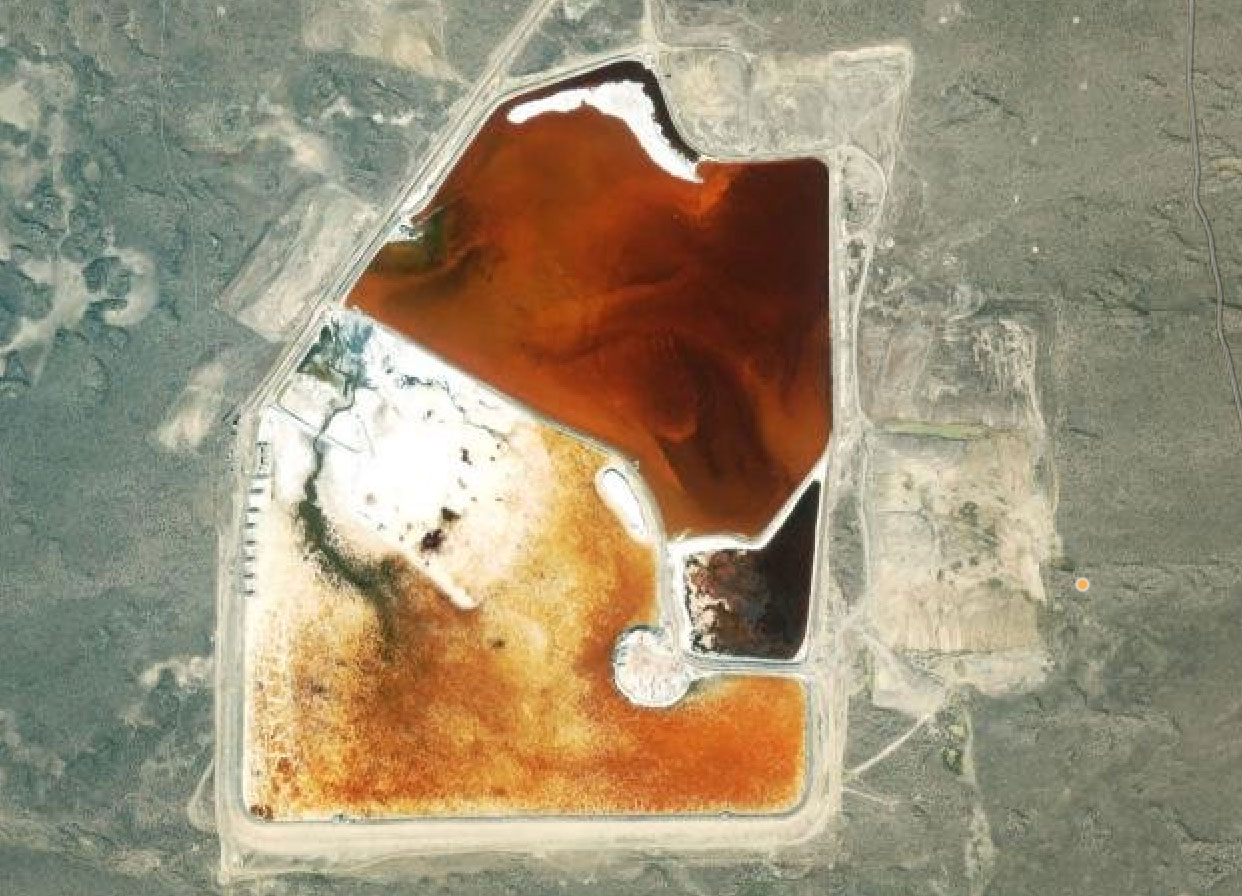
The two vast new projects are to the south and west of the Solvay plant, and they are less complex in their multinational history. A permit application to the Wyoming "Industrial Siting Council" was submitted in February 2024 "Public Notice: Notice of Request for a Permit and Hearing Filing Information Before the Wyoming Industrial Siting Council Docket Number DEQ/ISC 23-02," https://content.govdelivery.com/accounts/WYDEQ/bulletins/38d6537 on behalf of the "Project West" mine (proposed by "West Soda"); the cost of the project was estimated in the Wyoming press to be $2.6 billion. Cowboy State Daily, February 27, 2024 https://cowboystatedaily.com/2024/02/27/project-west-puts-2-6-billion-cost-on-massive-wyoming-trona-plant/ The other mining project, "Dry Creek Trona" (proposed by "Pacific Soda" and "Atlantic Soda") is expected to be developed, in part, on land administered by the US Bureau of Land Management (the BLM), which started a process of Environmental Impact Assessment in 2022; Project Milestones, "Dry Creek Trona Project," https://eplanning.blm.gov/eplanning-ui/project/2016395/510 ; https://eplanning.blm.gov/public_projects/2016395/200519818/20060220/250066402/DRAFT%20February%202022%20Mine%20Plan.pdf the project cost is estimated to be "nearly $6 billion." Cowboy State Daily, March 11, 2024 https://cowboystatedaily.com/2024/03/11/wyomings-trona-boom-continues-with-proposed-6-billion-mine-near-green-river/ This is the project which was the subject of the December 2024 hearing.
The Cowboy State Daily described the projects, with their uninformative local names, as having been proposed https://cowboystatedaily.com/2024/03/11/wyomings-trona-boom-continues-with-proposed-6-billion-mine-near-green-river/ by "rival operator[s]." But the two operators are Şişecam and Ciner, the two Turkish companies who are the most recent owners of the Big Island trona mine. Project West https://www.wesoda.com/information/press-releases/new-greenfield-soda-ash-project-in-wyoming-usa is "100 percent owned by WE Soda," and WE (West East) Soda is the holding company for the soda ash interests of the Ciner Group, https://www.cinergroup.com.tr/en/news/haber/3385874-we-soda-sells-60-of-its-us-soda-ash-business who sold Big Island to Şişecam. Dry Creek Trona was developed by Pacific Soda and Atlantic Soda, which were described as "60:40 joint ventures" https://pacificsoda.us.com/about-pacific-soda/ between Şişecam and WE Soda; Şişecam, in November 2024, was reported https://cowboystatedaily.com/2024/12/02/turkish-company-offers-285-million-to-buy-interest-in-huge-wyoming-trona-mine/ AND https://tr.tradingview.com/news/reuters.com,2024:newsml_L5N3N016M:0/ accessed on December 16, 2024. to be buying the Ciner Group's shares in the trona projects. The Project West industrial siting application Project West Permit Application [ISC Project West], 2024_ ISC Docket 23-02_ Project_West.pdf, available at https://content.govdelivery.com/accounts/WYDEQ/bulletins/38d6537 , 180/1296, 195/1296. notes that the Dry Creek project is "adjacent" to the Project West site, and "will depend on some of the Project's infrastructure."
A mature commodity
The soda ash industry, amidst all this elaborate activity, is a small part of the US economy. The value "Soda Ash," US Geological Survey, Mineral Commodity Summaries, January 2024, https://pubs.usgs.gov/publication/mcs2024 of US soda ash production was $1.9 billion in 2023, or less than .007 percent of US GDP; the US accounted for about 17 percent of world production. Soda ash is a "nonfuel mineral," in US classifications, and it is not a "critical mineral." It is grouped See https://www.naics.com/naics-code-description/?v=2022&code=212390 in the 2022 classification, and on the potash, soda and borate grouping, see https://www.naics.com/naics-code-description/?code=212391 The manufacturing of sodium carbonate, boron compounds, and/or potassium salts is classified in a different industry, with a similarly bland name, Other Basic Inorganic Chemical Manufacturing. with other alkalis, "Potash, Soda, and Borate Mineral Mining," as part of the industry "Other Nonmetallic Mineral Mining and Quarrying."
"Soda ash is considered to be a mature commodity," an expert witness from the US Geological Survey concluded in 2004, when a subcommittee of the US Senate Finance Committee met "International Trade and the Impact on the U.S. Soda Ash Industry," April 15, 2004, https://www.finance.senate.gov/imo/media/doc/95475.pdf pp 12,19,29,42. in Rock Springs, WY to consider the "major economic hardships" of the trona industry. The last synthetic soda ash plant had closed in 1986, because of higher energy prices and the "costs of anti-pollution equipment." Another witness, from the trona committee of the Wyoming Mining Association -- he was the "resident manager" of the FMC facility -- described natural soda ash from Wyoming as the "most environmentally friendly source of soda ash in the world today." But it was "an industry under threat." He was asked about "new opportunities": "I wouldn't invest my money if I was asked [Laughter].... I can't, in my wildest dreams, imagine anybody starting up a brand new facility."
Soda ash is obscure in a different sense as well. It is an "intermediate input," in that it is sold almost entirely to other industries, and not to households. It does not count, in an economic sense, because it is assumed, in the conventions Aggregate value added, which is equal to GDP, is a "nonduplicative measure of production," in which intermediate inputs are subtracted from gross output to avoid double- or triple-counting. Inputs of capital and labor, which are "primary" or "value-added inputs," count; inputs of energy, materials, and services, which are "secondary," do not. Horowitz, Karen J. and Mark A. Planting, Concepts and Methods of the Input-Output Accounts (US Department of Commerce, April 2009), chap. 5, p. 1. of national accounts, to be used up, like other intermediate inputs, over the course of a year. The industry of which soda ash is a (small) part, NAICS 212390, sold output US Input-Output Use Tables, 2017, available at https://www.bea.gov/industry/input-output-accounts-data worth $26.3 billion to "intermediate use" and the equivalent of only 0.4 percent of that, or $113 million, to final demand in the form of personal consumption expenditure. Soda ash is itself an implausible object of consumer desire, although there is a modest market in trona as a "healing mineral," as in the "fluorescent trona crystal from Texas Gulf Soda Ash Mine, Wyoming," that was recently on sale on the Etsy website. https://www.etsy.com/au/listing/1232643463/fluorescent-trona-crystal-from-texas accessed on June 1, 2024.
Even the economic history of soda ash is obscure. A story of technical innovation in manufacturing that begins in the factories of Old Kingdom Egypt Pamela Vandiver, "Egyptian Faience Technology," in Ancient Egyptian Faience, ed. A. Kaczmarczyk and R.E.M.Hedges (Warminster, 1983), pp. A-1 to A-137. (c. 2500 BCE), proceeds to eastern Anatolia Gonca Dardeniz, "Was Ancient Egypt the only supplier of Natron? New Research Reveals Major Anatolian Deposits," Anatolica 41 (2015), 191-202. c. 100 BCE, and unfolds in the monasteries of early medieval Iberia, David J. Govantes-Edwards, Chloë N. Duckworth & Ricardo Córdoba (2016) "Recipes and experimentation? The transmission of glassmaking techniques in Medieval Iberia," Journal of Medieval Iberian Studies, 8:2, 176-195, https://doi.org/10.1080/17546559.2016.1209779 fits only awkwardly into the familiar macro-histories of the rise of inventiveness over the course of the 18th-19th century "industrial revolution" in western Europe. The most successful use of (natural) soda ash in the 19th century was in the production of soap, in Nablus Beshara Doumani, Rediscovering Palestine: Merchants and Peasants in Jaba Nablus, 1700-1900 (Berkeley, CA, 1995), pp. 182-232, 252-258. in Ottoman Palestine.
"Histories of organic intermediary goods as crucial components of a wider ecological history remain, for the most part, to be written," as Paul Warde wrote in his important history of potash, Paul Warde, "Trees, Trade and Textiles: Potash Imports and Ecological Dependency in British Industry, c .1550–1770." Past & Present 240 (2018): 47–82, p. 77. and the economic history of inorganic alkalis -- from the "natron" found in the brine of Egyptian or Californian or Kenyan lakes to the synthetic soda ash of nineteenth-century innovation to the trona found in what was once, 50 million years ago, a giant lake of the Eocene era in the modern Wyoming -- is also largely unwritten. (Soda ash has itself had an even less eventful history than potash, in that potash, at least, has been the occasional object of geopolitical frenzy, as when a committee There was economic melodrama; the committee heard the dire story of an individual "whose official title is propaganda manager for the German Kali [potash] Syndicate," and who appeared repeatedly in early 1917 in the offices of the "American Trona Corporation" -- then seeking to develop potash production at a briny lake in Searles, California -- in an attempt "to dishearten, discourage, threaten, and intimidate the officers and stockholders" of the corporation. US Congress, 65th Congress (1919), United States Senate, Committee on Mines and Mining, Domestic Potash Production (Washington, DC, 1919), pp. 10-11. of the US Senate, in 1919, lamented the power of German potash producers "to starve America," because of its use in fertilizers, and to inflict military defeat because of its use in munitions; "there would be no shrapnel or high-explosive without it.")
Jean-Baptiste Dumas' dichotomy of 1883 -- the noisy, clanking innovation of machinery, with its insatiable demand for coal and eventually oil, versus the silent, insidious innovation of the chemical industry -- corresponds to the continuing preferences of economic historians (or of historians of capitalism.) But it corresponds, too, to the continuing obscurity of intermediate goods in a wider economic sense. Intermediate goods are not visible and audible, in the sense that railroads or automobiles are visible or audible. They are not consumed by individuals, in the sense that individuals buy (or bought) tickets to travel on trains, and buy or lease or rent cars or dishwashers or air conditioners. They are still of central importance, as will be seen, in economic as well as ecological history.
| « Introduction | Methane Emissions, Mine Safety and Pollution » |