
Trona and Climate Change
So how does the micro-history of trona fit in to the large or macro-transformation of economic and environmental life, and why is it a disorienting story? The development of Sweetwater County, in particular, has been a history, over the past two decades, of lost hopes and new ventures.The new euphoria of the trona industry in the 2020s is the outcome, in part, of worldwide economic growth over the past two decades. When the subcommittee of the US Senate Finance Committee met "International Trade and the Impact on the U.S. Soda Ash Industry," April 15, 2004, https://www.finance.senate.gov/imo/media/doc/95475.pdf pp 12,19,29,42. in Rock Springs, WY in 2004 -- the meeting to consider "an industry under threat" -- one of the trona industry representatives, asking for relief from royalties, taxes, and (overseas) tariff barriers, described "International Trade and the Impact on the U.S. Soda Ash Industry," p 18. soda ash as an object of ordinary desire: "you look at this commodity, it just doesn't impact the guy at the top of the economic ladder. It impacts the guy at the very bottom; the guy that wants to have a window in his house; the guy that wants to have detergent to wash his clothes."
It is this demotic character of soda ash -- together with the worldwide expansion of environmental regulation -- that has inspired the vast new projects that have been the subject of such elaborate evaluation over the course of 2024. The trona mines and projects in Sweetwater County are owned by Turkish, Indian, Belgian-French and American companies; the new mining technologies being assessed in the sagebrush steppe were developed in central Anatolia; the principal markets US production of soda ash was 4.81m metric tons in January-May 2024, and US exports of soda ash were 3.12m metric tons in the same period. The major markets, in the period, were Mexica, China, Brazil, Chile, Malaysia, Indonesia and Vietnam. https://www.usgs.gov/centers/national-minerals-information-center/soda-ash-statistics-and-information accessed on August 5, 2024. for the natural soda ash of Wyoming are in Mexico, China, Malaysia and Vietnam.
Trona -- from deposits in Turkey, Egypt, Kenya or the United States -- is still, plausibly, as it was described "International Trade and the Impact on the U.S. Soda Ash Industry," April 15, 2004, https://www.finance.senate.gov/imo/media/doc/95475.pdf p 19. in 2004, the "most environmentally friendly source of soda ash in the world today." But its destiny, as the micro-history of Sweetwater County suggests, poses unfamiliar questions, about intermediate goods, about production and consumption in relation to climate policies, about economic growth, and about the unpoetic ideal of environmental regulation, in a new epoch of overflowing, aleatory information.
The 1800 Histories project, which is an effort to understand some of the causes of climate change -- emissions of methane -- on a local scale, place by place, looks at methane together with other kinds of pollution, and it connects micro- and macro- histories. All pollution is local, in the sense that pollutants, even if their consequences are global, emanate from a particular place, and pass through local environments, as they drift over very long (vertical and horizontal) distances. These are the vectors of contiguity in space and time that connect local and global pollution. But there are also vectors of economic contiguity, flows of commodities or intermediate inputs that go from one enterprise to another (or within a single enterprise) over the vast distances of the global economy.
Methane, like soda ash itself, is a quintessentially intermediate commodity. It is an output in the process of production (or an unsold and unwanted input into the final demand of households, now and in the future.) As in Marx's description Karl Marx, Capital: A critique of political economy, transl. Samuel Moore and Edward Aveling (London, 1970), vol. 1, p 203. of variable capital, it is like "the coal burnt under the boiler [which] vanishes without leaving a trace; so, too, the tallow with which the axles of wheels are greased." All the ultra-emission sites identified by the TROPOMI instrument, and depicted in the 1800 Histories map, are or have been sites of production (or distribution): they are located near coal mines, shale wells, refineries, factories, pipelines, the landfill sites that produce or process waste. It is enterprises and not households that produce methane, or at least households made up of individual human beings. If one thinks, as one should, of the universe of individuals affected by climate change, then there are other living beings, ruminants, who do produce methane. They too are individuals, and not "inputs," variable capital, into the output of agricultural production. But the methane emissions from cattle feed-lots are too diffuse to be observed by TROPOMI.
The exchanges of intermediate goods are an important, underestimated condition of economic history Emma Rothschild, "Where is Capital?," Capitalism: A Journal of History and Economics 2, 2 (2021), 291-371, https://muse.jhu.edu/article/798746 and the history of technical change. They are even more important in histories of climate and the environment. These histories start in a particular place. But they are also about the other, often distant places with which events in one location -- Sweetwater County -- are connected via successive exchanges, each of which has environmental consequences.
The trona from the mines in Sweetwater County is transported to processing facilities to be made into soda ash; the soda ash is transported to factories (in Colorado or elsewhere) to be made into bicarbonate of soda, or to the ports of Vancouver or Portland to be shipped to glass factories in Brazil or Indonesia. In the incipient economy of green batteries, the vectors or supply chains will be even longer. These are all intermediate or inter-enterprise exchanges, and sources of unsold (environmental) outputs.
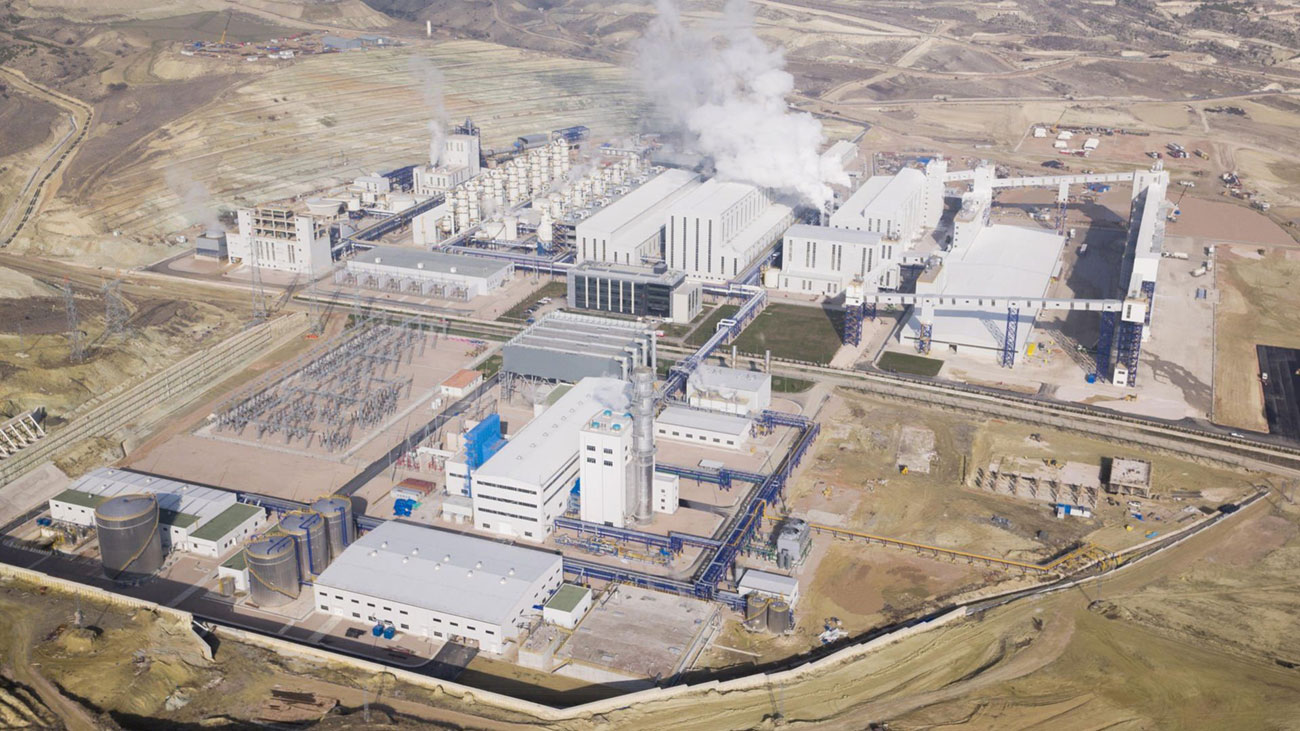
It is not methane, for the most part, that is emitted along the long chains of transactions -- except to the extent that the processes of further production, which are energy-intensive, involve leaks of natural gas -- but rather the other kinds of pollution that are co-located or co-produced with methane and other greenhouse gases. Sweetwater County is thus connected to other places by the relationship of capital -- as in the advanced solution mining facility in Kahramankazan, https://www.cinergroup.com.tr/en/news/haber/1838229-opening-ceremony-of-kazan-soda-elektrik in the Anatolian plateau, that is for the Turkish part-owners of Dry Creek Trona the prototype "Eti Soda and Kazan Soda in Turkey have been mining trona using the horizontal solution mining method [since] 2009 and 2018... Kazan Soda mines are at similar depths as proposed for the Project... As solution mining technology developed in Turkey, multiple cavern sizes were evaluated before optimization. The caverns anticipated for this Project are similar to the optimized conditions at these existing facilities. Due to the lack of geological faults identified at Eti Soda and Kazan Soda, the development of the Project trona beds will be simpler.""Mine Plan - Dry Creek Trona Project," 68/698. of future production in Wyoming -- and also by a relationship of production, or the destination of the intermediate outputs that it produces. The business history of Sweetwater County has been a narrative of multiple, interconnected industries, mining, oil and gas, coal and chemicals. The sites observed by TROPOMI are associated with trona mines, although with different relative prices, in this local geology of intercalated strata, they could have been methane mines or shale mines or shale wells. (Even natural gas had a negative price [FN1] , in parts of the United States in the summer of 2024.) The projected Dry Creek Trona mine is itself a cluster of "wells," in the new universe of solution mining in which all that is solid melts into air, or into a liquid, brine or solution of caustic soda, "confined, not released" (as the projectors of Dry Creek Trona assert, "this is not fracking [FN2] .") || [FN1] https://www.nytimes.com/2024/08/08/business/energy-environment/natural-gas-negative-prices-texas.html || [FN2] https://pacificsoda.us.com/wp-content/uploads/2024/05/The-Dry-Creek-Trona-Project.pdf
The perspective of production
The causes of climate change are local, in the perspective of the 1800 Histories project. They have a history; they are not the outcome of vast, abstract conditions like modernity or civilization or capitalism or economic growth. This is a perspective, in turn, which is concerned with production as much as with consumption.
The rhetoric of climate policy has been preoccupied, for more than a generation, with consumer choices and consumer responsibility. This is even the "currency," as it were, of calculations of GHG emissions. Methane itself, the most intermediate of GHGs, is made intelligible by being compared See, for example, the US EPA's "Updated Coal Mine Methane Units Converter," in which methane measured in cubic meters is described as "equivalent to GHG emissions from either one of the following: Gasoline-powered cars driven for 1 year [or] Miles driven by an average gasoline-powered passenger vehicle.") https://www.epa.gov/cmop/updated-coal-mine-methane-units-converter accessed on August 2, 2024. to miles driven in an "average gasoline-powered passenger vehicle." The discussion of incentives, and of ethical dilemmas, has for the most part been about individuals and households: how can I, personally, contribute to reducing the pace of global climate change? What can "we" (a society or a government) do to increase the cost of carbon-intensive consumption? What do I, or we, owe to individuals in other societies whose economic development has been obstructed, in the past, by our own economic history?
These are deep, compelling questions; how could they not be? But from the perspective of production, rather than consumption, there are other, smaller questions, and other possible solutions. Where exactly are the large emissions of GHGs happening, and why they are happening there, in those particular places? The point of MethaneSAT and other satellite observations is to answer the question of where, and the point of the 1800 Histories project is to answer the (historical) question of why. This is an inquiry into local conditions, local costs -- including the costs of other kinds of pollution and loss -- and the possibility of local mitigation.
Trona, the whitish, enlightened mineral, enters into the long vectors of the worldwide economy, in the end, in an innocuous sort of way. The cursory observation in the 2024 BLM Environmental Assessment that "trona mined in the U.S. has a lower (nearly 36%) GHG footprint than Chinese synthetic soda ash" is hardly conclusive; which production facility, of the many in China, and with which new
technologies? On the Tianjin Bohua Yongli Chemical Co., Ltd. (Tianjin Soda Factory), based on the Hou process, and its worldwide activities, see https://www.cn-ctbe.com/en/comprehensivestrength/sodaash/ accessed on August 31, 2024.
and what are the (intermediate) costs of
transporting The "nearly 36%" figure may be an estimate of GHG emissions in the mining and manufacturing processes alone. A "Wyoming Trona Industry Overview," published by the Wyoming legislature in 2017, thus included the summary "Greenhouse Gas (GHG) footprint 37 percent less than Chinese synthetic soda ash when leaving their respective manufacturing sites and its GHG footprint is less than Chinese synthetic soda ash even when delivered to customers around the world." https://wyoleg.gov/InterimCommittee/2017/09-0629APPENDIXC.pdf
the soda ash from Tianjin, for example, to Vietnam, or from Vancouver? But the white fugitive dust in the port of Oregon, and the effluent from glass factories in Brazil, are not the most terrible or toxic forms of pollution anywhere in the world.
A green economy?
The history of trona, in the perspective of production, is a window into a much more momentous sequence of connections. This is the supply chain for the worldwide production, use and disposal of electric vehicles (into which the sodium carbonate of Project West and Dry Creek Trona may itself, in prospect, be an input.) To see the electric vehicle economy as a sequence of economic and environmental vectors -- vectors of contiguity -- is to look with caution at some of the contemporary rhetoric of the new green economy.
This is the cautiousness that is implicit in the European Union's climate reporting requirements, in respect of direct, indirect and "very indirect" emissions. How do the EU institutions and bodies calculate, reduce and offset their greenhouse gas emissions? (2014) and, on the corporate reporting regulations that are being phased in from January 1, 2024 to January 1, 20228, see https://corpgov.law.harvard.edu/2023/01/30/eu-finalizes-esg-reporting-rules-with-international-impacts/ "Scope 1" are direct emissions, such as "own fuel combustion"; "scope 2" are indirect, such as "purchase of electricity"; and "scope 3" are very indirect, such as "supplies and services." The outcome will be a torrent of information. As in the EU "battery passport," to be required of all large and vehicle batteries from February 2027, Regulation (EU) 2023/1542 of the European Parliament and of the Council of 12 July 2023 concerning batteries and waste batteries, available at https://eur-lex.europa.eu/eli/reg/2023/1542/oj the principle is of understanding, or information, about the manufacturing and supply -- "material produced from lignin to substitute graphite," "cobalt, lead, lithium and nickel," hazardous chemicals, "mercury, cadmium or lead," "repair, repurposing and dismantling" -- required for the entire enterprise of the "green economy" of electric vehicle production, use and disposal.
The perspective can be extended to the supply chains not only of batteries but of the vehicles themselves; to the factories, in Monterrey https://siila.com/news/agp-eglass-supplier-tesla-opens-factory-nuevo-leon/531/lang/en and see https://siila.com/news/teslas-factory-construction-suspension-monterrey-beyond-political-factors/7238/lang/en or Ohio, https://fuyaousa.com/ that produce automotive glass, the inputs they use, and the outputs, to the environment and to the workplace, of hazardous and other waste. It extends to the energy used in transporting the inputs from one place to another -- the intermediate services of railroads and container ships, together with the intermediate goods that the transport companies use, in the form of diesel oil On the fuel consumption of Canadian railroads, see https://www.viarail.ca/en/plan/faq/our-trains/how-via-rail-trains-powered or marine fuel -- and in the data processing required in the logistics of worldwide supply chains.
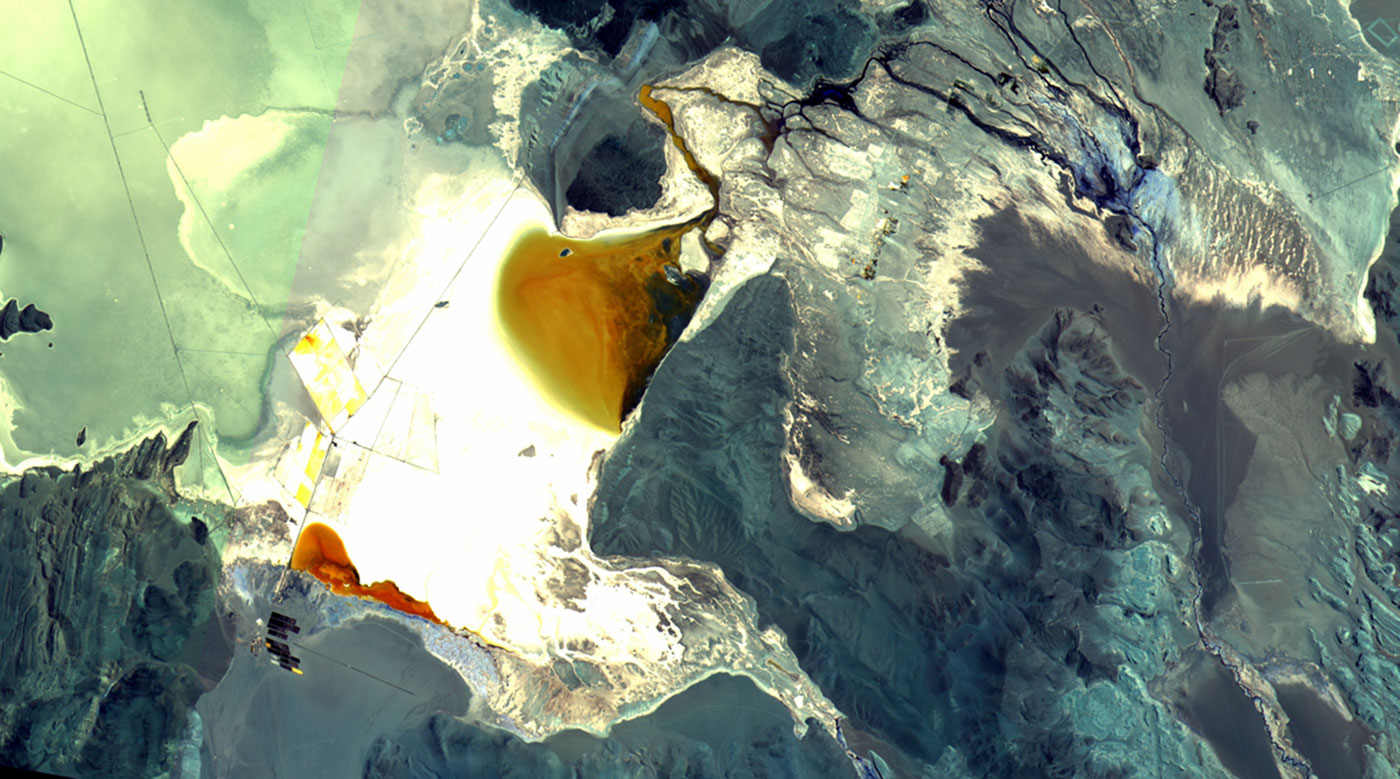
The perspective of production is larger, in turn, or more historical, in that it is about the circumstances of particular, named places, distant in space and connected in (economic) time. These are places of which some are now notorious, in part of because of the actions of local communities and in part because of international reporting: the cobalt mines https://www.washingtonpost.com/world/interactive/2023/ev-cobalt-mines-congo/ of the Democratic Republic of Congo and the lithium flatlands https://english.elpais.com/climate/2024-01-28/the-rise-of-lithium-mining-threatens-the-andean-flamingo-in-argentina.html of Argentina. Some are obscure, in Fuqing http://en.xfxglass.com/ or in Lahore. https://www.ahmadglass.com/ and, on the environmental effects of packaging glass production, see https://www.sciencedirect.com/science/article/pii/S0195925523001610 They are all places about which there is information, and of which there are pictures or descriptions; places that can be imagined, like the "beautiful fish in the ocean" that was for David Hume, David Hume, A Treatise of Human Nature (1739) (London, 1882), 2 vols., vol. 2, pp. 99-100. writing in 1739, an entity that "neither belongs, nor is related to us," but of which the "idea... hang[s] in a manner, upon that of ourselves."
The European Union regulation about battery passports is circumspect in respect of its likely consequences for reducing carbon emissions; "information and clear labelling requirements... [are] not expected in itself to lead to the behavioural change necessary." A climate-conscious society in which everyone thought about supply chains all the time, or at least before "driving a mile," would be a dystopia of anxious deliberation. Reflection Bernard Williams, Ethics and the Limits of Philosophy (Cambridge, MA, 1985), pp. 170-171. takes up "social space," just as it takes up "psychological space;" individuals have a choice of "the amount of time and human energy to be spent in reflecting."
But the "behavioural change" of consumers is only part of the problem, in the perspective of climate change seen as the outcome of production as well as consumption. The more immediate problem -- and the one in which the long supply chains and the distant places are of essential importance -- is to do with government policy. For the "global green economy" of electric vehicles has been the object of vast and sustained subsidies, in the fiscal and industrial policies of all rich countries, and in the policies of almost all international organizations. This choice, at least, should be the object of critical and long-term reflection, in respect of an (extended) battery passport, from mining to dismantling, from the materials used in highway construction to the decommissioning of power plants, and from soda ash in Portland, Oregon to bullet-proof, tinted windows in Nuevo Leon, Monterrey.
Economic change over time and space
The micro-history of Sweetwater County has become a window, here, into the largest choices of climate responsibility and climate policies. It is a window, too, into a large panorama of economic growth and economic history. The emissions from trona mining are innocuous -- at least in relation to the long history of soda ash production -- and soda ash is itself an innocuous, enlightened commodity. This has been the position of the industry, from the Solvay Company in 1889 (soda ash as the index of "wellbeing" and "civilisation") to Rock Springs in 2004 ("it impacts the guy at the very bottom; the guy that wants to have a window in his house,") and it is a plausible position today.
How could it not be a better state of the world if everyone without exception had access to glass and soap and paper? The recovery of the soda ash industry, in the 21st century, has been the outcome of rapid economic growth in relatively poor countries. As in the counterfactuals that are also part of the new idiom of reflection, would it not be better if more of the world's population -- if all the world's population -- had access to sodium batteries? It would be a dystopia of growth if everyone in the world, or every "household," had an electric vehicle. But should not everyone have access to clean electricity? Or to air conditioning? There should be access, in particular, to efficient air conditioning, as well to the new architectural, landscaping and engineering technologies of adapting urban — and rural— life to the high temperatures of the coming decades.
So the soda ash and the batteries will have to be made somewhere. The micro-history of trona has been a story of worldwide investment and worldwide technical change. But it is also a local history, about a particular place, with its own (amazing) geography and its own industrial history.
The 42,000 or so people who live in Sweetwater County are surrounded by space. There are 1.56 people https://data.census.gov/profile/Sweetwater_County,_Wyoming?g=050XX00US56037 per square kilometer in the county; in Vietnam, the ratio is 296 people per square kilometer, and in Lazio (where I followed the environmental assessments of the trona mines in the summer of 2024) the ratio is 342 people per square kilometer. Sweetwater is at the same time a relatively industrialized county. 25.2 percent of the employed population CAEMP25N, available at apps.bea.gov worked in mining, construction and manufacturing in 2022, compared to 16.8 percent in the United States (and less than 15 percent in Wyoming as a whole.) There are two United Steel Workers of America locals, 15320 and 13214, at the Tata and Genesis plants. see https://www.greenriverstar.com/story/2024/07/03/county/union-approves-contract-with-genesis/11767.html and https://www.msha.gov/petition-docket-no-m-2022-009-m In the Project West siting application, ISC Project West, 1219-1283/1296, 1255/1296. there are 65 pages of letters of support from local organizations ("our hospital is a strong supporter of economic growth.")
In this semi-rural, modern community, the projected expansion of the trona industry has been welcomed, so far, with optimism; this is at least what can be observed from afar, or in the Cowboy State Daily, greenriverstar.com and sweetwaterNOW. There has been public participation in the large meetings about the new projects ("please avoid or minimize harm to wildlife and their habitat") and there is concern about the impact of commercial grazing https://www.greenriverstar.com/story/2024/08/01/news/new-study-looks-at-blm-efforts-to-manage-sage-grouse-habitat/11862.html on the habitat of the sage-grouse. There are comments Project West Right of Way, July 2024, 298-405/2094. expected from the US EPA and the Wyoming Department of Environmental Quality, and more reports to come.
The new projects, seen from Sweetwater County in 2024, have been assimilated into an implicit long history of economic and environmental change. The mines and the "facilities," the co-generation plants and the ponds, will be there for thirty years, or for "25 to 75" years (as in the Dry Creek assessment), and then they will be gone. They will be covered over with uncontaminated topsoil, and the landscape will be planted with "appropriate" native vegetation. The golden eagles will return. ISC Project West, 33,218,230/1296. It will be as though Project West and the Dry Creek Trona Mine had never existed.
The fluctuating fortunes of the Wyoming trona industry are a natural circumstance of economic growth, in this perspective, or of the large economic destiny of the American west. "The 'alkali plains' of the western territories," a traveller wrote "Natron deposits in Wyoming," The Galaxy (New York), December 1875, pp. 854-855. in 1875, "resemble those vast plains of South America upon which such quantities of natron are yearly gathered in containing both lakes of soda lye and also vast deposits of dry carbonate of soda;" "only the difficulties of transportation have interfered with the utilization of these soda lakes hitherto." There was a soda rush, of sorts, in the 1870s; Lammot Dupont, Norman B. Wilkinson, Lammot du Pont and the American explosives industry, 1850-1884 (Charlottesville, Va, 1984), pp. 158-164. visionary of explosives for the French-American Dupont de Nemours company, was an early investor, and gave the distant lakes the evocatively industrial names of "New York," "Philadelphia," 'Wilmington," "Wilkes Barre" and "Omaha."
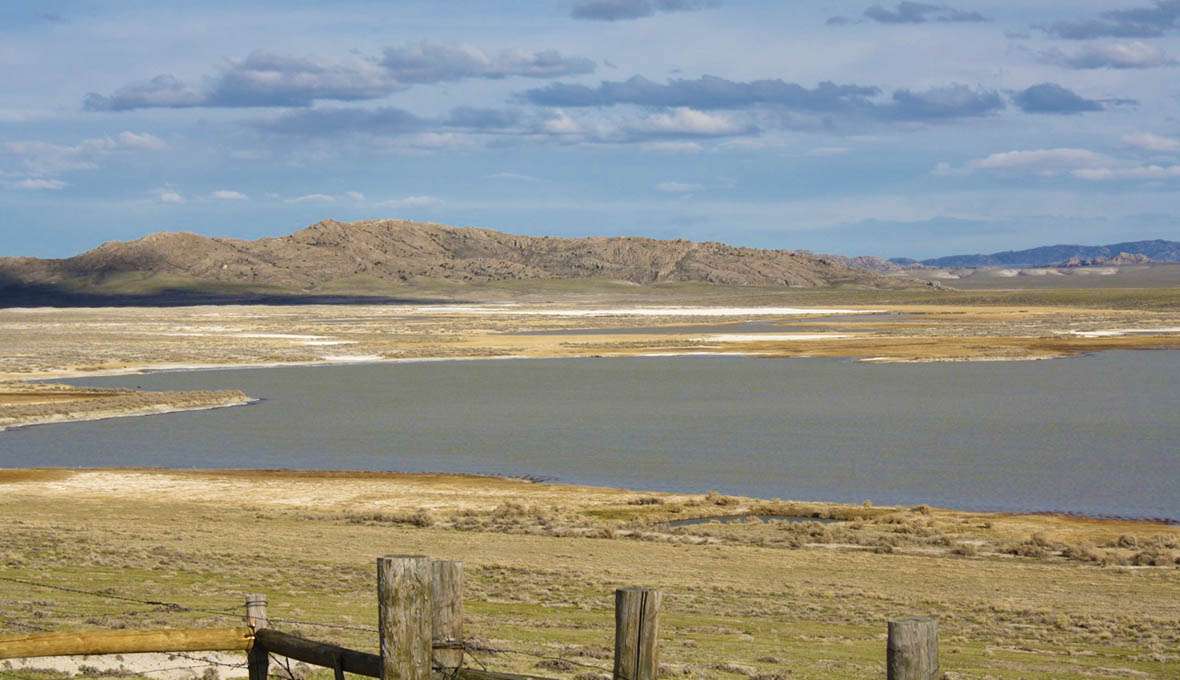
The Union Pacific Railroad passed, in the end, to the south of the soda lakes, and the eventual economic boom in central Wyoming was founded, as so often, on fossil fuels; coal and then natural gas in Carbon County, https://www.wyohistory.org/encyclopedia/carbon-county-wyoming and oil in Natrona County. https://www.wyohistory.org/encyclopedia/natrona-county-wyoming But even the "natural" soda of the old lakes of Carbon County could be part of a new minerals boom over the generations to come, like the "natural" trona of Sweetwater County, with its new (Anatolian) technology.
Economic thought, pollution and economic history
One of the possible destinies of the mining counties of Wyoming, in a long view of economic history, is thus to become the "hewers" of scarce and less scarce minerals for distant, expanding economies. Sweetwater County is more industrial, 8 percent of the employed population of Allegheny County worked in mining, construction and manufacturing in 2022, and 24.6 percent of the population of Wyoming County, the historic site of West Virginia coal mining. CAEMP25N, available at apps.bea.gov in the new geography of North America, than Allegheny County, PA (another site https://histecon.fas.harvard.edu/1800_histories/sites/allegheny.html of ultra methane emissions) or than the old coal mining economy of Wyoming County, West Virginia. It has access to open spaces, and to new technologies for reclaiming contaminated land, as well as to Indian, Belgian and Turkish capital, innovation, and expertise.
The doctrine of free trade, according to a notorious argument for protectionism in nineteenth-century Europe, had made great nations into the dependent labourers of more industrial countries. "In vain did the Germans humble themselves to the condition of hewers of wood and drawers of water for England," Friedrich List Friedrich List, National system of political economy, transl. G.A.Matile (Philadelphia, 1856), pp.117, 459. wrote of the period before the protective tariffs associated with the Zollverein; the "insular monopolists" had even "refused the poor Germans what they granted to their Hindoo subjects," themselves a "people," for List, "so numerous, so frugal, and so favorably situated for manufacturing industry."
The new green supply chains, in which Wyoming or Nevada can become hewers and drawers for the world, are a counter-example, on this view, to an old (and long-disputed) view of the presumed "economic logic" This is the language of (economic) "logic," under-pollution and the income-elasticity of demand "for a clean environment for aesthetic and health reasons" of the (ironic) "Toxic Memo" of 1991, by Lant Pritchett and Larry Summers. See https://eml.berkeley.edu/~webfac/harrison/e181_s04/181s04summers.pdf and https://www.researchgate.net/publication/286992796_Potenttal_gains_from_trade_tn_dirty_industries_Revisiting_lawrence_summers'_memo of opulence and under-pollution. They suggest, in particular, that the expanding, densely populated economies of South and Southeast Asia, with their hundreds of millions of consumers of soap, glass and paper, and their surplus capital, should export pollution to high-income countries, or at least to the places in rich countries which are presumed to be "under-polluted." Or rather, to places, like Sweetwater County, where the demand for "a clean environment" is a function, not of levels of income but of an elaborate local political economy (as in the letters of support for the new trona projects) and of a protracted, reflective assessment of environmental costs, how they can be reduced, and how long they will last.
This would be an almost-Texan destiny for south-west (or north-central) Wyoming. The ephemeral, acquisitive "Republic of Texas" https://www.tshaonline.org/handbook/entries/republic-of-texas of the mid-nineteenth century claimed territory almost as far north, in what is now Wyoming, as the alkali lakes that were later so captivating for Lammot Dupont. By far the largest concentration of methane ultra emission sites, in the 1800 Histories map, is in the Permian Basin area of oil and gas production with hydraulic fracking. On the history of the "fracking revolution" in Texas and Oklahoma, see https://histecon.fas.harvard.edu/1800_histories/sites/spring.html It is a place of intense air, land and water pollution, in a rich region of a rich country, distant from major markets. The ranchers of the Permian Basin, in Texas and Oklahoma, are the hewers of wood and drawers of liquid natural gas for France, Japan and India. https://www.eia.gov/dnav/ng/ng_move_expc_s1_a.htm This is the very long economic-environmental-business history The fracking revolution of the early 21st century happened in (parts of) the United States, and not in Europe or elsewhere, because of a distinctive political economy -- a "petroleum-friendly tax environment," "less regulation," and an "environmental community [that] is less radical and somewhat less influential than its European counterparts," in a contemporary assessment -- and because it developed, for the most part, in the "least densely populated states." Owen L. Anderson, "Shale Gas Revolution or Evolution: Opportunities and Challenges for Europe," Oil and Gas, Natural Resources, and Energy Journal 3, 2 (2017) [reprint, first published 2013], https://digitalcommons.law.ou.edu/onej in which the production of Wyoming soda ash is a small, evolving story.
| « Two (or Three) New Mines | Regulation and Information » |