
Regulation and Information
The micro-history of Sweetwater County, WY has been a winding and disconcerting journey. There have been good emissions of methane, in that the "liberation" of potentially explosive gases has made the trona mines safer for the people who work there. There has been good economic growth, in that hundreds of millions of people have access to paper, soap and glass. There is environmental destruction that is "good," in prospect, or at least welcome, in that the projects that will be destructive of the local landscape (for a time) are supported by local residents. There is even a good history of the chemical-mining-energy industrial complex, in that the production of soda ash has become less destructive over time (as the Leblanc process was replaced by the Solvay process, and the Solvay process was improved by new technologies, and replaced, at least in prospect, by new and more "natural" production.)
It is this dialectic of improvement in industrial production -- of pollution, objections to pollution, regulation and technical change -- that has made the micro-history of trona an optimistic story, in the end. Methane, and other greenhouse gases, can be seen in a local as well as a global perspective; they are sources of pollution, and like other pollutants, they can be reduced, and eventually removed, in the long, unpoetic process that constitutes the ordinary life of environmental regulation.
The procedures of regulation are an unlikely object of hope, now, in respect of the vast risks of climate change. "An alkali manufacturer will always rather pay a trifle than be annoyed and pestered in his business," a Liverpool industrialist complained of the informal system of compensation prior to the passage of the Alkali Act of 1863 Dingle, "'The monster nuisance of all,'" p. 533. (that for the first time regulated the air pollution associated with soda ash production.) Almost two centuries later, being regulated has become a synonym, in business, for being pestered and annoyed.
The process of writing and enforcing regulations has itself been deconstructed, in a familiar understanding of the "political economy" of modern life (in the economists' sense Albert Alesina seminar on political economy at Harvard University; see https://www.iq.harvard.edu/program-political-economy accessed on 23 October 2022. of "economic behaviour in the political process or political behaviour in the marketplace.") The Alkali Act of 1863 was passed, in substantial part, because the local people who were affected by the pollution from soda ash factories included individuals with political power, rich landowners Dingle, "'The monster nuisance of all,'" pp. 529-530, 532-533. who were themselves legislators, and whose water meadows and land had lost their value.
The Environmental Protection Agency, in the United States, has been an enduring object of critique since the early 1980s. See Emma Rothschild, "The Philosophy of Reaganism," New York Review of Books, April 15, 1982. On theories of regulatory capture, see Preventing regulatory capture : special interest influence and how to limit it (Cambridge, MA, 2014), ed. Daniel Carpenter and David A. Moss. Its leadership, like that of the Bureau of Land Management, has been swayed by the changes of political fortune. This has been the case in Wyoming, as elsewhere; the reduction of the federal royalty rate on soda ash (from 6 percent to 2 percent) -- as part of the BLM's effort to reduce "regulatory cost" -- was announced in the last days https://www.barrasso.senate.gov/public/index.cfm/2020/12/wy-delegation-applauds-soda-ash-royalty-rate-reduction December 23, 2020, accessed on September 4, 2024. of 2020, On an EPA hearing on January 5, 2021, followed by an authorization on January 15 2021, in respect of emissions in Texas, see https://histecon.fas.harvard.edu/1800_histories/sites/spring.html and so was a new theory of the evaluation US EPA, "Increasing consistency and transparency," announced on December 23, 2020. https://www.federalregister.gov/documents/2020/12/23/2020-27368/increasing-consistency-and-transparency-in-considering-benefits-and-costs-in-the-clean-air-act and see below, Infinite Information. of the costs of regulation, in respect of "any benefits and costs [that might] accrue to non-U.S. populations."

There is an idyll of environmental information that has been seen, amidst these negotiations of ordinary political life, as an alternative to unpopular or easily influenced regulation. It is an idiom of climate policy for a new world of almost infinite data, as in the projects See https://www.science.org/doi/10.1126/science.abj4351 and https://histecon.fas.harvard.edu/1800_histories/index.html ; see also https://www.edf.org/methanesat of "tracking" or "mapping" or "revealing" methane emissions whose observations have been the starting point for the 1800 histories of methane, or in EU policies about sustainability reporting and battery passports. But the ideal of information, too, can be deconstructed in the cold gaze of political economy. "The market for sustainability information is rapidly growing," in the observation https://www.europarl.europa.eu/doceo/document/A-9-2022-0059_EN.html Report - A9-0059/2022 European Parliament, Corporate Sustainabilty Reporting. of a committee of the European Parliament. This is a market in the transaction costs of being regulated, and there is a new, flourishing industry that produces (intermediate) consulting services, including inventories of "CO2e" emissions and estimates of future "revegetation" (as in the 1,296-page or 2,094-page reports on "Project West" and "Dry Creek Trona.")
In the new idiom of virtually unlimited environmental information, there is a larger, unspecified, worldwide public, beyond the immediate users of the Project West and Dry Creek Trona reports, or the state and federal regulatory authorities who will determine whether or not the projects are approved. This is the public of
"investors and other stakeholders", https://ec.europa.eu/commission/presscorner/detail/en/qanda_23_4043
in one EU account, or of "advocacy groups, media and the public," "industry, governments, commercial gas buyers and nonprofit groups," in addition to
"investors and other stakeholders," https://www.edf.org/methanesat/data-holds-polluters-accountable accessed on September 12, 2024.
in the US Environmental Defense Fund's description of the objectives of the MethaneSAT tracking project. The figurative language, here, is indistinctly financial. The
"stakeholders," A "stake," in one early meaning, was a delineation of property rights, and in another, that which was risked in games of chance.
in respect of trona in Sweetwater County, would in this sense be the investors in the companies that own the mines. Would they also include the neighbor who was concerned about the increase in traffic around the sites, "specifically at the dirt road turnoff," or the other neighbor who asked, "please avoid or minimize harm to wildlife and their habitat"?
Infinite Information
This micro-history of trona has itself been a (micro-) contribution to the vague, inspiring ideal of environmental information. There is an asymmetry of size or scale, in relation to climate change, between the causes of change -- in very large-scale or atmospheric processes, like https://science.nasa.gov/climate-change/faq/what-is-the-greenhouse-effect/ a "blanket enveloping our planet" -- and its consequences, which are individual and local; an elderly man clinging to a tree, swept away by a flood in North Carolina https://www.nytimes.com/2024/09/30/us/hurricane-helene-marshall-north-carolina-floods.html in 2024, or a woman heartbroken after she left her village, in the Anambra State flooding in Nigeria https://histecon.fas.harvard.edu/climate-loss/flood/index.html in 2022. But there is also a different, inverse asymmetry, between the small-scale, local causes of climate change -- like the "CO2e" emissions from a mine in Drmno or in Green River -- and the large atmospheric effects. There are vectors of causation downwards, from the atmospheric to the local, and there are vectors of the causes of climate change upwards, from the local to the global.
These local causes, at least from mines and energy infrastructure, have become spectacularly more visible over the very recent past, because of TROPOMI, MethaneSAT and other technologies of measuring greenhouse gas emissions from space (or from aircraft and drones.) But they remain invisible, for the most part, in "global" policy or "global" public opinion; they are unimportant, as in the summary Dry Creek Trona Draft EIS, 49/328; this is the estimate for the "preferred" alternative. of the expected effects of the Dry Creek Trona Project, of which "when compared to the global GHG emissions, the annual emissions from [the project] would be approximately 0.008% of the global annual emission totals."
The 1800 Histories project is complementary to the new technologies of distant measurement, in that the view from space -- from the spectrometer that sees a methane plume -- has been the point of departure for a view from below, from the ground level or underground, that is also a vista of change over historical time. But the audience for the micro-histories is even more indistinct than that of the satellite measurement projects. They are local histories, of necessity, and histories of local opinion, including opinions about large and atmospheric effects.
This is a history that is unfolding in the real time of micro- or macro-history, and of which the dénouement is still to come. The 1,884 pages of the "Industrial Siting" application for the Dry Creek Trona project were made public on September 9, 2024, and a public meeting was scheduled "Notice of Opportunity to Observe Hearing," September 8, 2024, https://content.govdelivery.com/accounts/WYDEQ/bulletins/3b49814 -- it was described as a "contested case hearing" -- on December 3, 2024, in Green River. The City of Green River was "a party to" the siting permit application, as announced in a letter from the mayor dated October 1, 2024. Letter of October 1, 2024, https://www.grwyo.org/AgendaCenter/ViewFile/Item/10170?fileID=88338 The venue for the meeting, and for an eventual continuation, "as needed," on December 4, was the Hampton Inn on Wild Horse Canyon Rd, Green River.
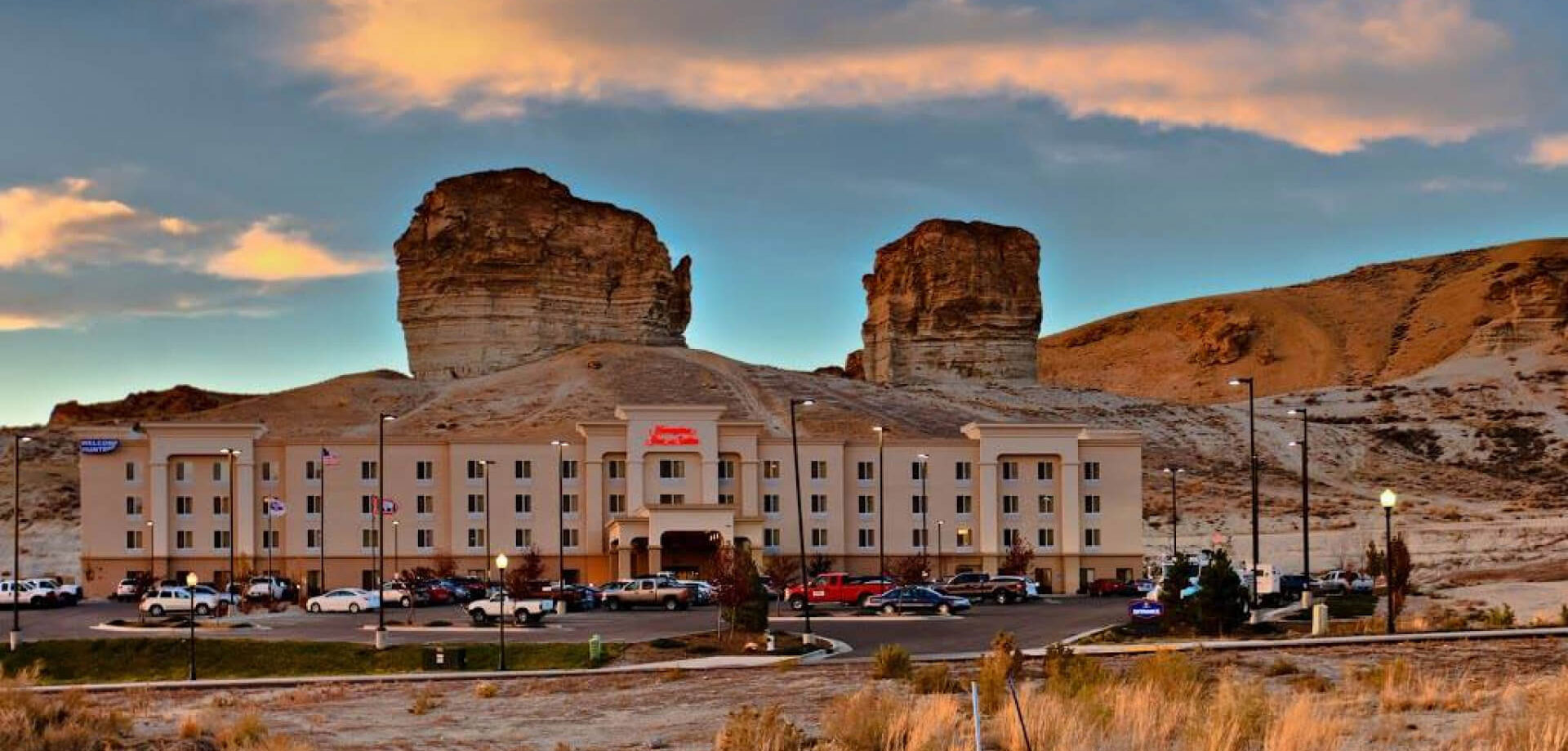
The "parties" to the Industrial Siting application for the Dry Creek Trona project are (fairly) well-defined, under Title 35, "Public Health and Safety," of Wyoming state law. They include These are the local governments which "will be primarily affected by the proposed facility," anyone resident in the local governments, "including any person holding record title to lands directly affected by construction of the facility," 35-12-110 and 35-12-111, available at https://wyoleg.gov/statutes/compress/title35.pdf 753/906, 756-757/906. local governments and nonprofit organizations in Wyoming concerned These are "any nonprofit organization with a Wyoming chapter", concerned with the environment and economic development. The interests of the nonprofit organisations are defined capaciously, to include those "concerned in whole or in part to promote conservation or natural beauty, to protect the environment, personal health or other biological values, to preserve historical sites, to promote consumer interests, to represent commercial, agricultural and industrial groups, or to promote the orderly development of the areas in which the facility is to be located." 757/906. with the environment and economic development. Far-away historians, and even "global" On the 1800 Histories project as "global history," see https://toynbeeprize.org/posts/historicizing-a-planetary-future-a-discussion-with-emma-rothschild-on-the-convergence-of-climate-science-and-historical/ historians, are there, if at all, to the extent that their histories are noted W.S. 35-12-110 (f) (iii), 754/906, https://wyoleg.gov/statutes/compress/title35.pdf in "one (1) or more newspapers of general circulation within the area to be primarily affected by the proposed facility," or by one of the organizations with Wyoming chapters.
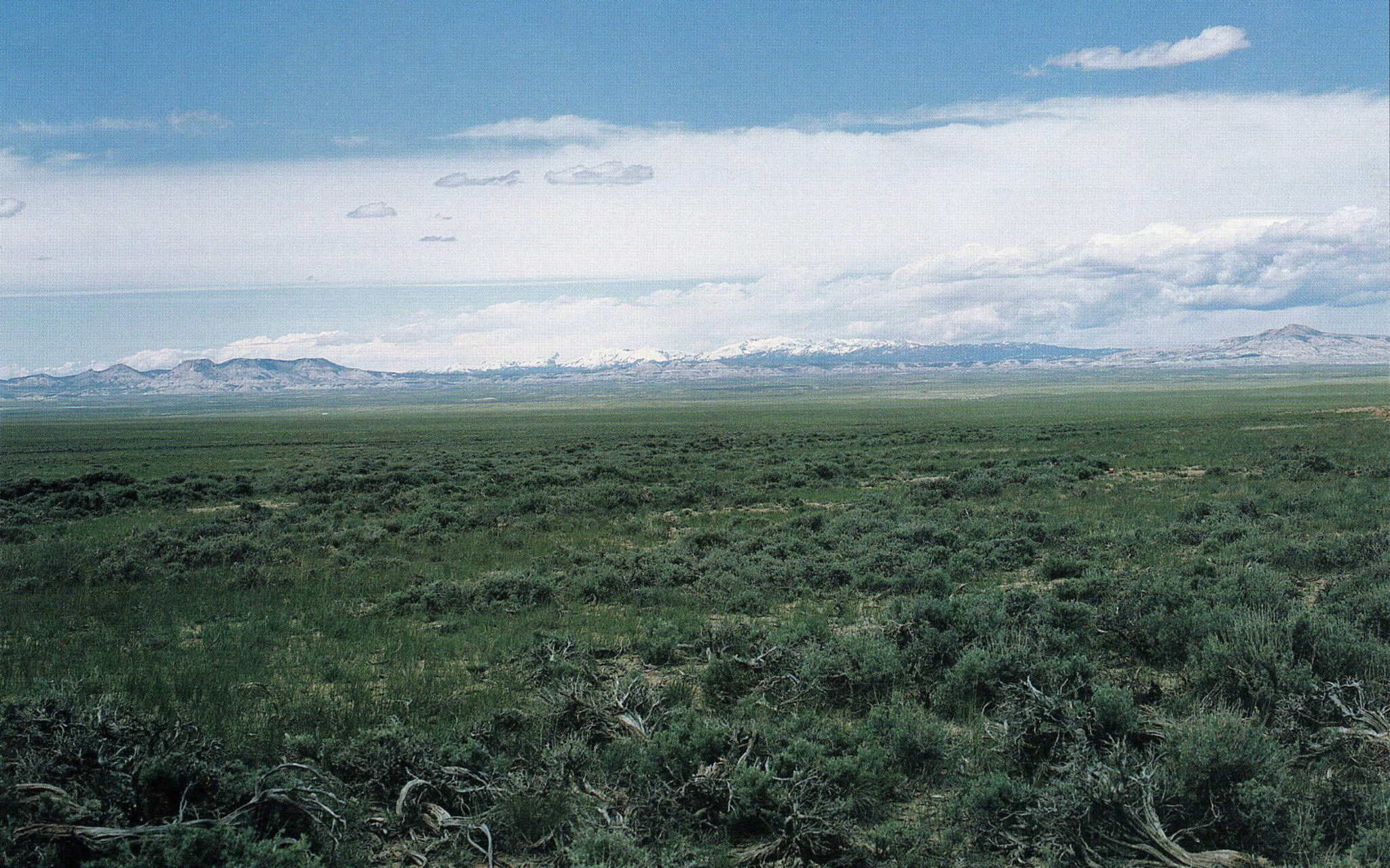
The micro-history of Sweetwater County has been a Humean Hume, A Treatise of Human Nature, vol. 2, pp. 99-100, and see above, The perspective of production. story, in the sense that it has been about a place, and a series of events, that "neither belongs, nor is related to" the historian, sitting far away in Lazio, but of which the "idea" hangs, "in a manner," upon the historian's idea of herself. There is an individual relationshipOne relationship, or connection of ideas, has to do with a long-standing individual and institutional interest in the economic history of intermediate goods. Another is more idiosyncratic. "To think about the localities in which climate change is happening -- its consequences and its causes -- is to have a sense of melancholy and hope," I said in the interview about the 1800 Histories project as global history; "one of the obligations, in the new trona projects now under discussion in Wyoming, is to try to protect the… grey-green expanse of the sagebrush steppe, which is heartbreakingly beautiful, and which has its own long history." My idea of the sagebrush steppe was based, in a late-modern sort of way, on looking online in 2024 at multiple photographs of the site where the new trona mines will be, and also on a distant memory of being in Sweetwater County, or nearby, in the summer of 1973, at the time of an earlier boom in shale oil. See https://www.nybooks.com/articles/1973/08/09/illusions-about-energy/ of ideas, and a collective, even a universal relationship, in that the historian, like everyone else, is part of a universal society, of human beings and other living things, which constitutes the population who has been and will be affected by the large-scale, atmospheric, blanket-like process of climate change; and who have an interest, thereby, however tenuous and however intrusive, in the small-scale and local causes of the immense global process.
But there is a different sort of conclusion, which is based on historical understanding. It is that the promise of public information -- of an indistinct and eventually global public discussion of environmental pollution -- is dependent on the unpoetic and usually local process of government regulation, which is public in the juridical sense of being founded on laws and on the regulations that "explain the critical details necessary to implement" https://www.epa.gov/laws-regulations/laws-and-executive-orders them.
The copious documents now available in relation to the new trona projects in Sweetwater County provide a compelling illustration. There are large, vague numbers (or numbers that are implausibly unvague), as in the single line in the Industrial Siting Council application ISC Project West, July 2024, 195/1296; Industrial Siting Permit Application, Dry Creek Trona Project, September 2024 [ISC Dry Creek Trona] available at https://content.govdelivery.com/accounts/WYDEQ/bulletins/3b49814 , 171/1884. There is an additional estimate of 17,125 tons of CO2e per year for the Dry "Creek Trona mine site." for Project West about estimated emissions of greenhouse gases in CO2 equivalent, of 1,283,545 tons per year, or the corresponding lines in the Dry Creek Trona Industrial Siting application, from September 2024, of 3,844,800 tons per year. There are the even vaguer numbers about global emissions, social costs and passenger mile equivalents.
This is the daily life of public information, or public discussion, and it is also, from time to time, empty noise; a sequence of numbers without meaning. But the "CO2e" numbers are surrounded, in the trona project documents, by estimates of future emissions that have a different legal aura, and a different meaning. These are the estimates ISC Project West, 195-196/1296, ISC Dry Creek Trona, 170-171/1884. of the "criteria pollutants" (nitrogen dioxide (NO2), sulfur dioxide (SO2), carbon monoxide (CO) and particulate matter) that are regulated https://www.epa.gov/criteria-air-pollutants under the National Ambient Air Quality Standards of the Clean Air Act of 1970, and of VOCs and HAPs (volatile organic compounds and hazardous https://www.epa.gov/haps/what-are-hazardous-air-pollutants or toxic air pollutants.)
The Dry Creek processing facility will be regulated as a "major stationary source" ISC Dry Creek Trona, 170/1884; ISC Project West, 195,204,231,652,1108/1296. of air pollution under US and Wyoming law; the Project West facility will be subject to "Prevention of Significant Deterioration permitting requirements" in respect of criteria and other air pollutants, as well as to regulations under the Clean Water Act, to the management of solid waste, and in relation to occupational health and safety. These are procedures that include ISC Project West, 60/1296; ISC Dry Creek Trona, 618/1884. "inspections and "regular monitoring," and an "Environmental Compliance Inspection Plan." Methane, or CH4, is not mentioned in either of the siting applications for the proposed new facilities, and the trona projects are unlikely to be regulated under the methane regulations https://www.federalregister.gov/documents/2024/03/08/2024-00366/standards-of-performance-for-new-reconstructed-and-modified-sources-and-emissions-guidelines-for that were introduced in 2024, which were concerned with emissions from the oil and gas industry. But the language of the new rule reflected an aura -- of seriousness -- that is much closer to that of the pollutants regulated under the Clean Air Act and other legislation. https://www.federalregister.gov/documents/2024/03/08/2024-00366/standards-of-performance-for-new-reconstructed-and-modified-sources-and-emissions-guidelines-for "in the event that the owner or operator submits an inadequate or fraudulent determination, or no determination at all when they should have, they could be subject to penalties. In addition, the professional engineer or other individual who certified the demonstration could be subject to penalties, including criminal charges." (print page 16592.)
This is the local, unpoetic language of environmental regulation, and it is very different from the idiom of public discussion, or of "sustainability information." Even the EU reporting rules are embedded in a framework of legal obligation, as well as in an eventual public of "investors and other stakeholders." The CO2e emissions from the new trona projects could thus be reported, eventually, as part of the EU "corporate sustainability due diligence" requirements, to be implemented https://commission.europa.eu/business-economy-euro/doing-business-eu/sustainability-due-diligence-responsible-business/corporate-sustainability-due-diligence_en This would at least be the case if Ciner -- or Şişecam -- were to be subject to EU regulations, as anticipated in Turkey's "pre-accession" agreements with the European Union. See https://www.ab.gov.tr/92_en.html updated on August 23, 2024, and accessed on September 7, 2024. by July 2029. An eventual Solvay solution mine in Sweetwater County -- as in the "cumulative" prospect in the Dry Creek Trona environmental assessment -- would be subject to the reporting requirements, and even to new carbon charges, On the 2026 Carbon Border Adjustment Mechanism, see https://taxation-customs.ec.europa.eu/carbon-border-adjustment-mechanism_en . I am grateful to Professor Thomas Lauvaux and Professor Francesca Romanin Jacur for discussion of EU environmental regulations. if the mine were to export soda ash to France rather than to Brazil or Vietnam.
So the idyll of environmental information is complementary, here as elsewhere, to local, national or international regulation. It is the details of environmental (and safety) regulation, in the end, that have made the history of soda ash an optimistic story. It was the inspections, reports and testing required by mine safety regulations that have ensured that mining has become less deadly over time. It is because of the regulation of air, water and soil pollution that the production of soda ash has become less contaminating, in North America, Europe and China. It is because of existing -- and future -- regulations that the new trona projects, if they do go ahead, will be no more, eventually, than a transient, forgotten episode in the long environmental history of south west Wyoming.
The next thirty years or so
Project West and Dry Creek Trona are close to being approved, in the winter of 2024-2025, at least according to the local opinion https://www.buffalobulletin.com/news/article_9284ef3c-58c3-11ef-a987-732910c9b9a7.html and https://trib.com/news/state-regional/article_36f624c6-55fb-11ef-a0f1-bb23b3069490.html accessed on October 14, 2024. of the Buffalo Bulletin and the Casper Star-Tribune. There was the contested case hearing for Dry Creek Trona on December 3, 2024, and the industrial siting applications give a start date of construction, for both projects, of January 2025. ISC Project West, 72/1296; ISC Dry Creek Trona, 59/1884. It is possible that the projects would be the object of more detailed scrutiny if they were to become the object of larger or regional public discussion. Such scrutiny might well be concerned with the consequences of the projects for land or water, more than for air pollution: with "increased seismicity Dry Creek Trona Draft EIS, 130/328. or additional subsidence," or with the consequences of the diversion of water from the Green River, and thereby from the Colorado River system. The draft Environmental Impact Statement for Dry Creek Trona is concerned with water resources largely in respect of the effects of the project on fish: "water depletion from the Project would contribute to a cumulative depletion of the Colorado River system and would represent a direct risk to long-term productivity. This impact would be irretrievable. However, it would not be an irreversible impact to long-term sustainability of the federally listed fish species because of implementation of ….mitigation requirements outlined by the US Fish and Wildlife Service." Dry Creek Trona Draft EIS, 178/328. The industrial siting application goes into greater detail about the possibility of drought, the (inter-state) Colorado River Compact of 1922 and the Upper Colorado River Basin Compact of 1948, and the possibility of "acquiring or putting under an option agreement water rights appropriated prior to 1922, and not subject to the Colorado River Compact curtailment impacts." ISC Dry Creek Trona, 360-361/1884. The preliminary opinion of the Surface Water Division of the Wyoming State Engineer's Office, as of September 2024, was that "a sufficient quantity of water for the Project has been adequately demonstrated." "Preliminary Opinion," September 16, 2024, available at https://seo.wyo.gov/home/news-press-releases and https://docs.google.com/document/d/12eVo5vU5jT3E2YY7hx_-QQvsigylds2pYfRqY8KtmFU/edit But the "Final Opinion "Letter of November 1, 2024, https://drive.google.com/file/d/16FtfPV-NeJ8lu_4_TvDDp2Gs2uTXoEnt/view, available at https://seo.wyo.gov/home/news-press-releases accessed on December 16, 2024. of the Wyoming State Engineer on the water supply for Dry Creek Trona, dated November 1, 2024, noted that "the only comment received was a letter from the Wyoming Game and Fish Department."
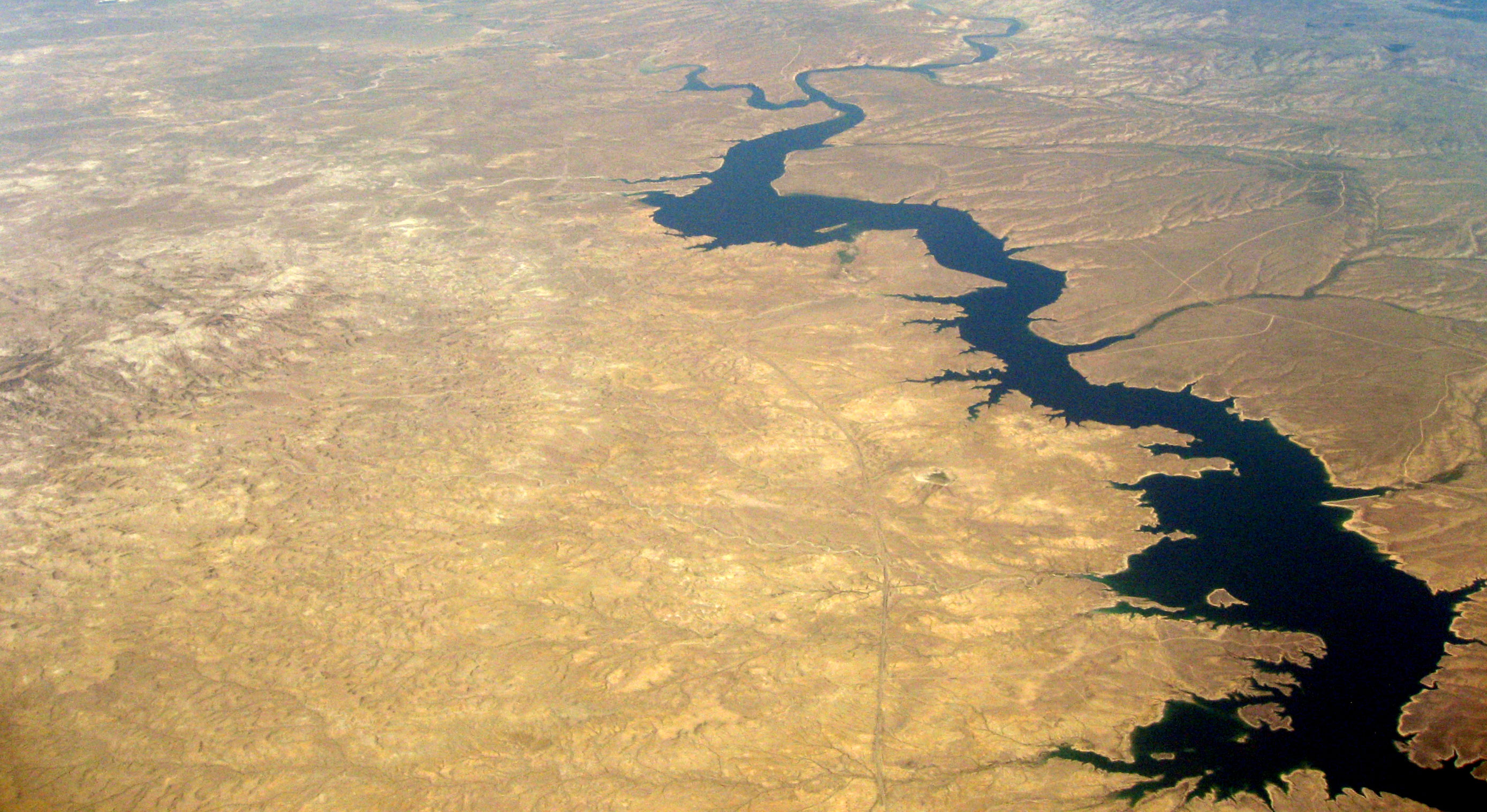
An eventual larger discussion of the projects could provide a basis, in turn, or the absence of a basis, for the afterthought, Dry Creek Trona Draft EIS, 265/328. in the Dry Creek Trona Environmental Impact Statement, that one "benefit" of the project would be that "when considered at a global level," "GHGs would likely decrease." But a convincing evaluation of benefits and costs to distant and future individuals, given the uncertainties of future technologies, is difficult to imagine. The new trona projects, which are private investments, subject to public regulation, are not themselves the sorts of proposals that would be the object of cost-benefit analysis, Cost-benefit analysis is now an established (and contested) feature of environmental regulation in the US. In the summary of the US EPA, in May 2021, "There has been an unbroken, bipartisan, decades-long commitment from Presidential Administrations to conducting benefit-cost analyses for economically significant regulations issued in the United States. These analyses are rigorous, publicly available, subject to interagency review, and are conducted according to extensive peer-reviewed guidelines from OMB and the EPA." https://www.federalregister.gov/documents/2021/05/14/2021-10216/rescinding-the-rule-on-increasing-consistency-and-transparency-in-considering-benefits-and-costs-in print page 26408. The May 2021 rule rescinded an earlier rule, announced by the EPA on December 23, 2020, which required, among other provisions, that "if any benefits and costs accrue to non-U.S. populations they must be reported separately to the extent possible," and that the definition of benefit-cost analysis, which should ignore "distributional effects," and should "represent the willingness-to-pay for a policy outcome valued by United States individuals." https://www.federalregister.gov/documents/2020/12/23/2020-27368/increasing-consistency-and-transparency-in-considering-benefits-and-costs-in-the-clean-air-act print pages 84136, 84139. On cost-benefit analysis and US policy, see Cass R. Sunstein, "The Economic Constitution of the United States," The Journal of economic perspectives, 2024-04, Vol.38 (2), p.25-42. by future, super-informed regulators, in Turkey or the United States or the European Union or in an as yet unimagined "global" bureau On a future "Bureau of Environmental Value," see Emma Rothschild, "Maintaining (Environmental) Capital Intact," Modern intellectual history, 2011-04, Vol.8 (1), 193-212. of cost-benefit evaluation.
So the decisions to be made about Project West and Dry Creek Trona will be local choices, as constrained by national (and state) regulations. If there were, eventually, a quasi-global discussion of the projects, in the remaining weeks or months before construction begins -- and neither project had as yet been mentioned, as of December 2024, The Wall Street Journal and the New York Times, accessed on December 16, 2024. I am grateful to Dr Levent Alpöge for looking at Turkish media online, in September 2024, and finding no greater level of interest in the Wyoming projects. in the US-global media of the Wall Street Journal and the New York Times -- then the large, vague numbers of estimated greenhouse gas emissions, which are public, would become public in a different way. The 1,283,545 or 3,844,800 tons of CO2e per year, ISC Project West, 195/1296; ISC Dry Creek Trona, 171/1884, and see above, Infinite Information. or the overall social cost, Dry Creek Trona Mine Project Draft EIS, 49/328. "from $924,506,133 to $11,180,530,348" would become, fleetingly, of global as well Wyoming interest.
There might even be a distant public interest, then, in the yellow-billed cuckoo and the pallid sturgeon (listed, in the Dry Creek Trona application, ISC Dry Creek Trona, 677/1884. as possibly "present within the project area," and threatened or endangered under the Endangered Species Act.) Or in the grey-green sagebrush steppe itself, of which the idea fluctuates with distance and history. There are multiple images in the project application; bleak little photographs ISC Dry Creek Trona, Addendum D7-1, Soil Survey photographs, 975-1024/1884. The soil survey was required in compliance with the regulations of the Bureau of Land Management and the Wyoming Department of Environmental Quality. of the land and of the trenches where samples were taken for the "soil survey." There is also the landscape of memory and of the great desert, On the great American desert, see https://windriver.org/sagebrush-country/ which is heartbreakingly beautiful.
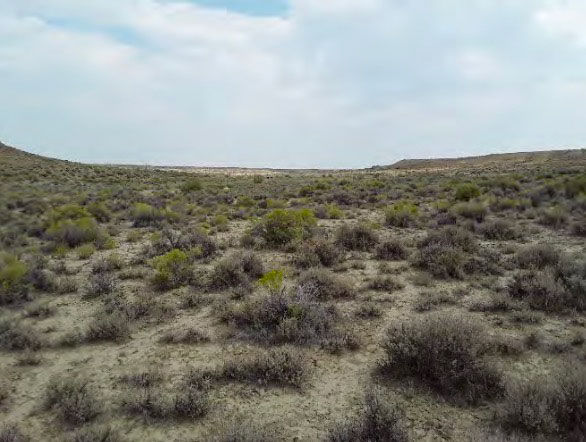
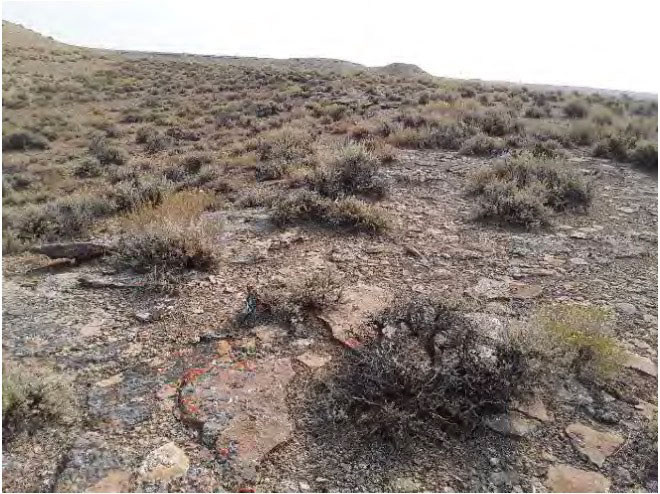
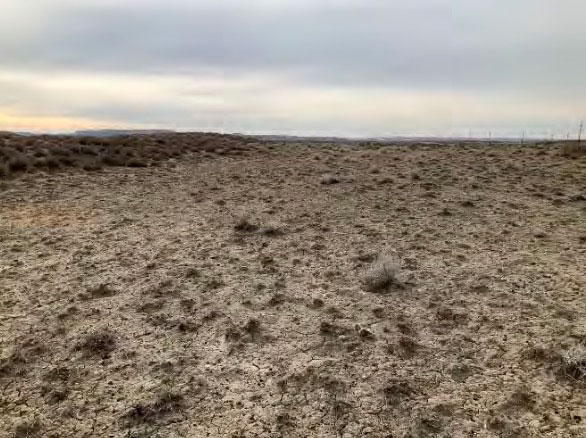
But the choices will still, in the end, be local. In Sweetwater County, as in hundreds, perhaps thousands of sites around the world, there are new investments being decided on, with lasting consequences for emissions of CO2, methane and other greenhouse gases. These investments, or investments like them, are needed, if millions of (distant) people are to have better lives. It is the daily life of regulation, over the coming thirty years, the inspections and reports and certifications, the bleak little photographs and the citations for respirable silica, that will make the new projects, if they happen, a little better.
31 December 2024
| « Trona and Climate Change | Introduction » |