
Methane Emissions, Mine Safety and Pollution
The methane emissions in Sweetwater County have been the outcome, over more than a generation, of a long history of mining regulation that has been almost invisible in environmental and climate policies. The drama of trona mining, since the 1950s, has itself been one of inventiveness in ventilating mines and of the deliberate "liberation" C. Pritchard et al, "Ventilation systems for underground trona mines," in Mine Ventilation, eds. R. Ganguli & S. Bandopadhyay (London, 2004), pp. 49-58; "methane is liberated during extraction from the surrounding oil shales." of methane. The trona in the Green River Basin is interbedded or inter-fingered with deposits of oil shale, and the methane comes from the shale above or below the trona. The giant lake of the Eocene period - Lake Gosiute - https://www.geowyo.com/lake-gosiute--the-blue-forest.html was surrounded by sycamores and palm trees, filled with algae and inhabited by crocodiles. There were plants that decomposed (the source of oil shale) and brine that evaporated (the source of trona.) Methane is "marsh gas," US Bureau of Mines, Miners' Circular 14, Gases found in Coal Mines (Washington DC, 1914). p. 9. and Lake Gosiute was a "paludal" or marshy lake.

The new concern with methane in the 2020s has been oddly disconnected from the history of occupational health and safety. But it is the presence of methane that has made so many mines -- coal and salt and potash -- so deadly. Methane is explosive in certain concentrations, See "Mine Category or subcategory," Code of Federal Regulations, https://www.ecfr.gov/current/title-30/chapter-I/subchapter-K/part-57/subpart-T/subject-group-ECFR28f8fc57a3bdd68/section-57.22003 and it can displace oxygen, leading to suffocation. The trona mines, classified as Category III "gassy mines," are subject to extensive regulation under the US Federal Mine Safety and Health Act of 1977 (Mine Act), and are inspected every week. Sections 57.22229 [applicable to Category III mines] and 57.22230 require that the mine atmosphere be tested for methane and/or carbon dioxide at least once every 7 days by a competent person or atmospheric monitoring system, or a combination of both. https://www.federalregister.gov/documents/2021/06/10/2021-12159/proposed-extension-of-information-collection-notification-of-methane-detected-in-underground-metal The only detailed descriptions of the daily economic life of the mines are in the dockets, petitions and reports of the MSHA, the Mine Safety Administration.
The trona mines of Wyoming are well-regulated by the standards of mining history. The terrible accident at the Cane Creek https://moabmuseum.org/moab-history-explosion-at-texas-gulf-sulphurs-cane-creek-potash-mine/ Texas Gulf Sulphur, the owner of the Cane Creek mine at the time of the accident, is among the past owners of the Genesis trona mine in Sweetwater County. potash mine in Moab, Utah in 1963, in which 18 miners died, was caused by a methane explosion; so was the deadly accident at the Belle Isle https://64parishes.org/entry/belle-isle-salt-mine-collapse US Mine Safety and Health Administration, Final Report of Mine Explosion Disaster, Belle Isle Mine, Cargill, Inc., Franklin, St. Mary Parish, Louisiana, June 8, 1979 (Washington, DC, 1980). salt mine in Louisiana in 1979. At the methane ultra-emission site near Yenakiieve https://histecon.fas.harvard.edu/1800_histories/sites/yenakiieve.html in Ukraine, in 1979, Soviet engineers exploded a small nuclear device 900 meters below the surface of the Yunkom coal mine, in an effort to release methane trapped in the mine. In 2023, workers were killed in methane explosions in a coal mine in Kazakhstan and in a disused gold mine in South Africa; in June 2024, there was a deadly accident https://www.healthandsafetyinternational.com/article/1875497/11-dead-suspected-methane-suffocation-pakistani-coal-mine of "suspected methane suffocation" in a coal mine in Balochistan.
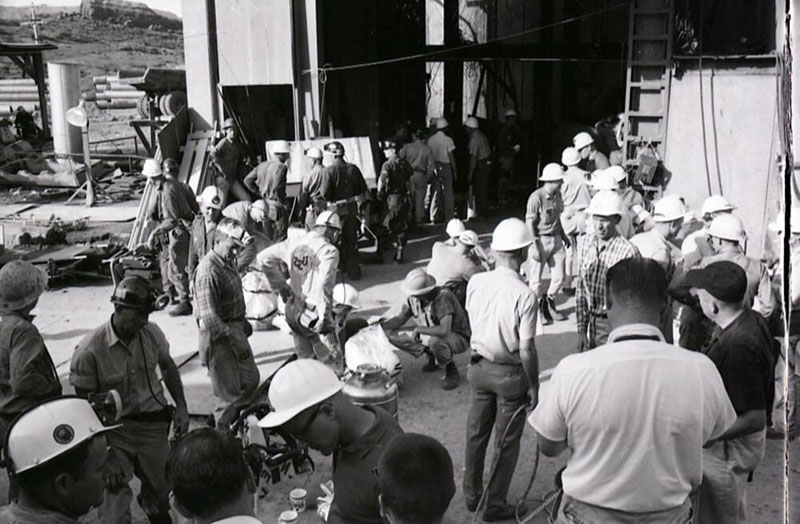
Mining is dangerous, as it always has been. A miner was killed https://arlweb.msha.gov/fatals/1995/ftl95m06.htm The rescue teams from the other mines encountered very high levels of methane: at 3:00 a.m. on February 4, 1995, "Rhone-Poulenc teams detected 13 percent (13%) methane at the two entries connecting 1E panel to the main return at crosscut Nos. 6W and 7W." at the Solvay trona mine in Wyoming in 1995, when underground pillars suddenly collapsed and "dense clouds of dust and high concentrations of gases were liberated." In 2000, another miner was seriously injured Federal Mine Safety and Health Review Commission, Docket No. WEST 2020-0278 https://www.fmshrc.gov/sites/default/files/decisions/alj/ALJd_11092021-WEST%202020-0278-M.htm when "800 to 900 pounds of rock" fell from the roof of the mine; it "was mainly trona, which is 'very dense . . . way harder than coal.'"
But the release of methane is now part of daily life in the Wyoming trona mines. A study of ventilation systems Pritchard et al., "Ventilation systems," pp. 50, 53, 58. at the four mines, published in 2004, provided a summary of "methane emissions," from 63.6 metric tons per day in the Genesis mine (then FMC), to 38.1 tons per day at Solvay, to 23.8 tons per day at the Tata mine (then GCSAP) to 6.7 tons per day at the shallowest of the mines, the Şişecam mine (then OCI.) The regulation of methane -- for safety purposes -- is required in the ordinary operation of the mines, and there are new technologies for detecting and using methane. There are "bed-to-bed methane monitoring holes" https://dasmithdrilling.com/projects/big-island-trona-mine-green-river-wyoming at the Şişecam mine; Solvay, in 2010, developed US EPA, "Case Study: Methane Recovery at Non-coal Mines" (2016), available at https://www.epa.gov/sites/default/files/2016-03/documents/cmop-noncoal_flyer.pdf "a system that collects and combusts methane drained from gob vent boreholes," and uses the recovered mine methane in its adjacent trona and soda ash processing facility.
The dialectic of environmental pollution
It was the very large emissions of methane near the Wyoming trona mines that the TROPOMI instrument was able to observe from space in 2019-2020. But the mines and the processing plants produce other kinds of pollution as well. The trona -- and soda ash -- of Wyoming enter a long and elaborate sequence of intermediate exchanges. Each of the exchanges has environmental consequences. The methane that is liberated or vented from a mine is an (unsold) output which might or might not have had a (negative) price, if there were to have been a charge for methane emissions. If it is recovered, or collected, it is itself an intermediate (or an intra-enterprise) input, as in the case of the methane that Solvay delivers US EPA, "Case Study: Methane Recovery at Non-coal Mines." The calciner and dryer were "operated with a mixture of mine methane and natural gas." to the "mine's on-site trona ore calciner and soda ash dryer." From the calcining and drying plant, the soda ash then enters the sequence or chain of intra- and inter-industry exchanges that ends in the eventual destiny of economic life, or final demand.
All of this sounds energy-intensive and environmentally demanding, and so it is. "Calcining involves placing crushed trona ore into a kiln," in the description of the US Environmental Protection Agency, where https://www.epa.gov/system/files/documents/2024-04/us-ghg-inventory-2024-main-text_04-18-2024.pdf , pp. 4-61, 4-62. it is "chemically transformed into a crude soda ash that requires further processing." The soda ash facilities require energy -- as at the site on General Chemical Road, with its coal-fired plant and its plans for a small nuclear reactor -- and they produce pollutants other than methane. Trona dust is alkaline and irritating, WN Rom et al. "A study of dermatitis in trona miners and millers," J Occup Med. 25(4)(1983):295-9. https://pubmed.ncbi.nlm.nih.gov/6854418/ The study draws in part on a Soviet study of port workers exposed to soda ash dust. On soda ash and trona dust as an irritant, see also the Dry Creek Trona Mine Project Draft Environmental Impact Statement, August 2024, available at https://eplanning.blm.gov/public_projects/2016395/200519818/20116856/251016836/Dry%20Creek%20Draft%20EIS_August%202024.pdf ; https://eplanning.blm.gov/eplanning-ui/project/2016395/570 , 216-219/328. and miners are exposed to crystalline silica. On the health effects of silica, see https://m.usw.org/blog/2023/fighting-killer-dust and https://www.msha.gov/regulations/rulemaking/silica The Solvay mine received 4 citations and 2 orders from the Mine Safety Administration in July 2024, following compliance inspections; the Tata mine received 9 citations https://www.msha.gov/sites/default/files/News_Media/Impact_Inspections/April%202023%20Impact%20Inspections.pdf ; https://www.msha.gov/sites/default/files/News_Media/Impact_Inspections/July-2024-Impact-Inspection.pdf in April 2023, of which 4 were for "respirable silica." https://www.wyomingpublicmedia.org/natural-resources-energy/2023-06-26/mountain-west-mines-hit-with-83-safety-violations-in-april-as-citations-rise-nationwide The "co-products" https://www.ansac.com/products/about-soda-ash/ of the trona industry include "sodium sulfite, sodium tripolyphosphate, and chemical caustic soda;" in 1990, FMC US SEC, Form 10-K https://www.sec.gov/Archives/edgar/data/37785/0000950131-95-000767.txt "constructed a new facility to produce liquid sodium cyanide at our Alkali Chemicals site in Green River."
The word "alkali" comes from the Arabic al-qaliy, meaning "burnt ashes," and the natural or vegetable production of soda ash, from barilla in Spain or qilw in Palestine https://palestiniansoap.coop/blogs/news/barilla-a-mini-history and see Beshara Doumani, Rediscovering Palestine. or kelp in Scotland, was itself a process Joaquín Fernández Pérez, "From the Barilla to the Solvay factory in Torrelavega: the manufacture of saltwort in Spain," Spanish Journal of History of Natural Sciences and Technology (1998). https://web.archive.org/web/20071218070149/http://www.ucm.es/info/antilia/revista/vol4-en/ant4-1-en.htm of incineration, lixiviation (or leaching) and boiling. In the artificial or chemical process of production, starting on a large scale in the early nineteenth century with the "Leblanc" process, sodium carbonate was made out of easily accessible sea salt, which was treated with sulphuric acid, heated in coal furnaces, and lixiviated.
It was the Leblanc On the Leblanc process, first developed in 1791, see Auguste Anastasi, Nicolas Leblanc, sa vie, ses travaux, et l'histoire de la soude artificielle (Paris. 1884). process that the chemist Jean-Baptiste Dumas Dumas, quoted in Anastasi, Nicolas Leblanc , pp. 159-162 described as one of the "two great economic innovations" of the century, and it was spectacularly destructive. The production of "artificial soda" was "without any doubt the most polluting sector of the nineteenth century," François Jarrige and Thomas Le Roux wrote in their important history of pollution, La contamination du monde. François Jarrige and Thomas Le Roux, La contamination du monde : une histoire des pollutions à l'âge industriel (Paris, 2017), pp. 128, 163-164. The process emitted hydrogen chloride gas that was converted into highly toxic hydrochloric acid, and generated more than ten tons of "liquid, solid, and gaseous wastes" for every ton of soda ash. There were continuing protests around alkali factories starting in the 1850s, involving neighbours, workers and farmers in Belgium, France, and Germany. In England, the protests of landowners in Lancashire -- the trees "appear to be burnt and dry up" -- led to the passage of the Alkali Act Dingle, A.E, "'The monster nuisance of all': landowners, alkali manufacturers, and air pollution, 1828-64," The Economic history review (1982), 35 (4), 529-548, p. 531. of 1863, the first substantial regulation of industrial air pollution in Britain.
The new process patented by Ernest Solvay in 1872, which used salt and limestone, processed with ammonia instead of sulphuric acid, was cheaper, relatively less energy-intensive and less polluting. By 1889, Soude et produits chimiques : exposition universelle tenue à Paris en 1889 , pp. 10,12,13. as the Solvay company wrote, there were factories using the process in "the majority of large industrial countries." This was, at last, what the company described as a "normal regime," in which the old, Leblanc process was used mostly to produce what had been once the "secondary products" of soda ash factories, or chloride and hydrochloric acid.
The Solvay or related processes of producing synthetic soda ash -- notably the Hou process, developed in the 1930s by the Fujianese chemist Hou Te-Pang -- is used, still, in most soda ash production around the world. But it produces On new technologies for reducing energy use, see Yifan Wu et al., "Soda Ash Production with Low Energy Consumption Using Proton Cycled Membrane Electrolysis," Ind. Eng. Chem. Res. 2019, https://pubs.acs.org/doi/10.1021/acs.iecr.8b05371 high carbon emissions and large amounts of solid, limestone waste, as well as liquid waste. Soda ash production has been the scene of some of the most picturesque pollution of the 20th century: from the "white lava" https://www.syracuse.com/living/2023/11/white-lava-in-solvay-memories-of-the-1943-solvay-wastebed-disaster.html of Solvay, NY in 1943 -- on the shores of Lake Onondaga, now a New York State superfund site -- to the spiagge bianche, the white beaches of Solvay Rosignano in Tuscany, the sand https://www.bloomberg.com/graphics/2022-italian-beach-tuscany-coast-solvay-dumping/ bleached white by calcium sulphate, and the water, with its white foam and its residues of mercury, arsenic and cadmium, tinted blue by calcium chloride. The vast soda ash factory by the shores of the Arabian Sea in Sutrapada, Gujarat is celebrated in a whitish video, https://www.youtube.com/watch?app=desktop&v=HGmR3FrqLwI accessed on Jul 30, 2024. a landscape of limestone, salt and lignite.
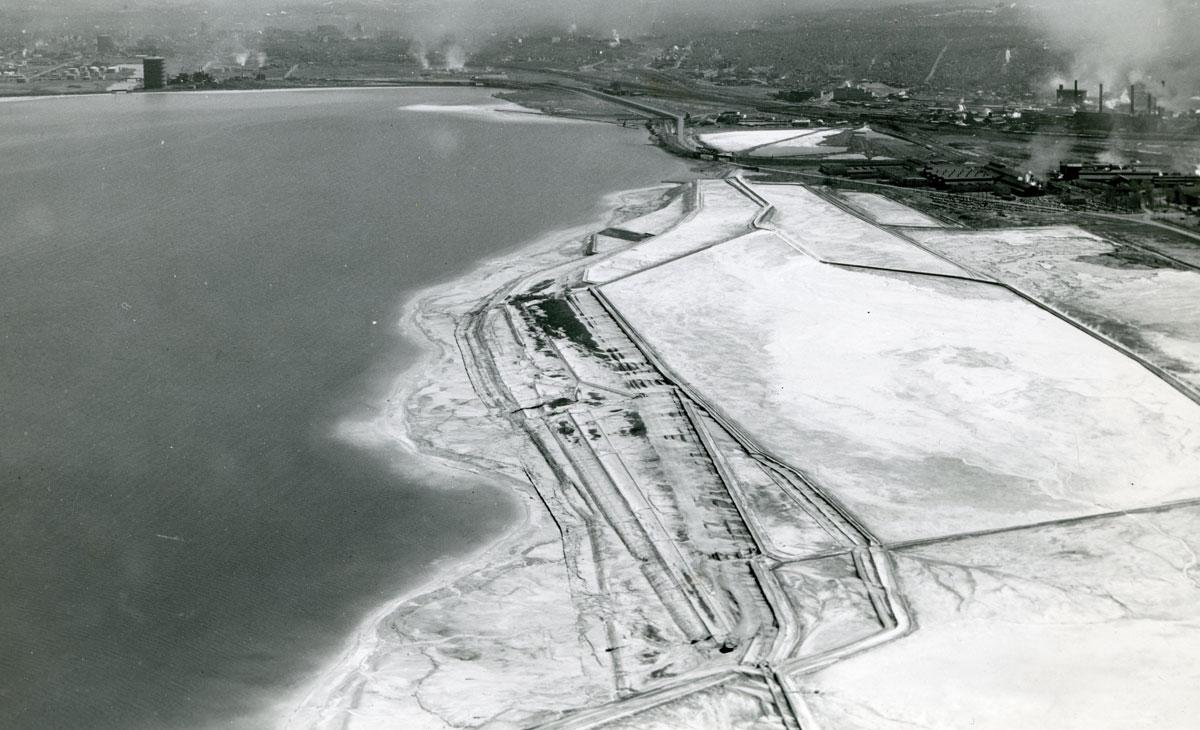
This is a dialectic of pollution, regulation and invention that has continued over ever larger distances. In Rosignano, Solvay operates under an "Integrated Pollution Prevention and Control" permit, in what the company describes as an "ongoing sustainability journey." https://www.solvay.com/en/rosignano In Trona, CA, near the desolate https://www.latimes.com/archives/la-xpm-2006-oct-04-me-trona4-story.html dry lake, Lake Searles, There are amazing aerial photographs of Lake Searles at https://www.photopilot.com/blog/searles-lake-a-mineral-marvel-in-california-mojave-desert/ where the US trona and borax industry began in the 1870s https://ohp.parks.ca.gov/ListedResources/Detail/774 -- and where the frenzy over the German potash cartel unfolded in 1917 -- there has been a carbon capture facility since 1978, https://archive.epa.gov/epa/sites/production/files/2015-11/documents/tsd-cps-literature-survey-carbon-capture-technology.pdf in a facility now owned https://www.svminerals.com/ by a different Indian company. There is a "microbial-assisted" carbon capture project near a different white, endorheic, interior lake, Lake Urmia Hamed Rahimpour et al., "Toward sustainable soda ash production: A critical review on eco-impacts, modifications, and innovative approaches," Results in Engineering 23 (2024), https://doi.org/10.1016/j.rineng.2024.102399 in Iran. The Solvay company, which produces only "natural" or trona-based soda ash in North America, has announced a new process, e.Solvay, https://www.solvay.com/en/press-release/solvay-reinventing-its-soda-ash-process-and-targets-zero-limestone-discharge-2050 with lower CO2 emissions and no limestone residues.
| « The History of Ash | Two (or Three) New Mines » |